# Federated Learning: How Privacy-Preserving AI is Transforming Enterprise Data Security in 2026
The tension between AI innovation and data privacy is finally being resolved. Federated learning—a decentralized machine learning approach that trains AI models without centralizing sensitive data—is emerging as the breakthrough technology enterprises have been waiting for.
What Is Federated Learning and Why It Matters Now
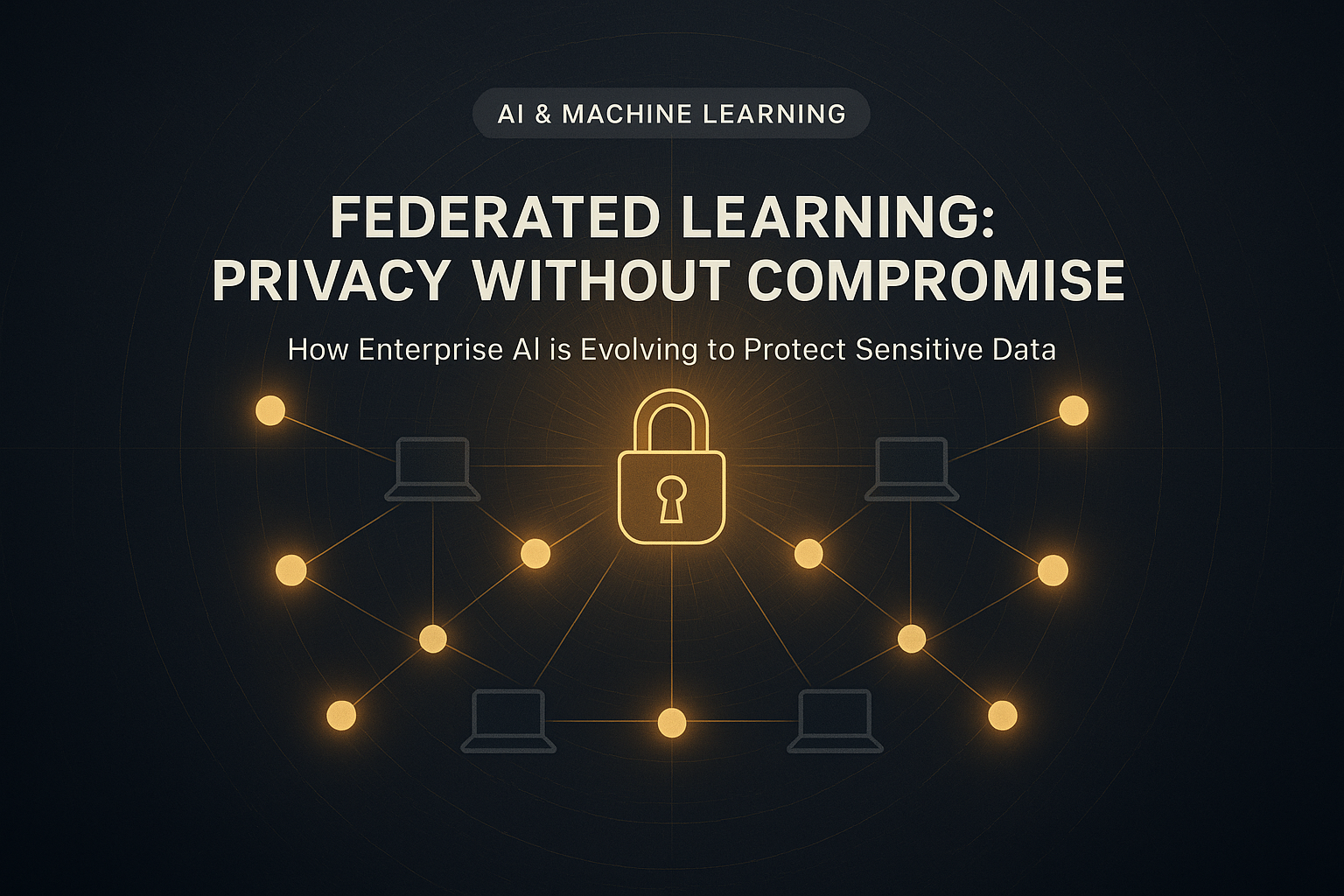
Federated learning fundamentally changes how organizations approach AI development. Instead of collecting raw data in a central repository and training models on that consolidated dataset, federated learning keeps data distributed across local devices, servers, or edge networks. The model training happens locally, and only the learned parameters—not the raw data—are shared back to a central server for aggregation.
This architectural shift addresses one of the most pressing challenges in modern AI: how to build powerful machine learning systems while respecting privacy regulations and protecting sensitive information. According to industry research, the global federated learning solutions market is experiencing significant growth as organizations increasingly prioritize data privacy alongside AI innovation.
The timing is critical. Regulatory frameworks like GDPR, CCPA, and emerging privacy laws are making traditional centralized data collection increasingly risky and expensive. Federated learning offers a technical solution that aligns business objectives with compliance requirements.
The Privacy Advantage: Keeping Data Where It Belongs
The core strength of federated learning lies in its privacy-by-design architecture. Raw data never leaves the device or organization where it originates. Instead, only model updates—mathematical parameters that have been learned from the data—are transmitted to the central aggregation server.
This creates several critical advantages:
- Reduced breach exposure: If a central server is compromised, attackers gain access only to model parameters, not the underlying sensitive data
- Regulatory compliance: Organizations can demonstrate strong data governance practices by keeping personal information localized
- User trust: Consumers increasingly expect companies to protect their data; federated learning provides a transparent, privacy-first approach
- Cross-organizational collaboration: Competitors or partners can collaboratively train shared models without exposing proprietary datasets
In 2026, brands are using “on-device personalization” to tailor user experiences while keeping personal data completely local. This approach is proving particularly valuable in digital marketing, healthcare, and financial services—industries where data sensitivity is highest.
Differential Privacy: Adding Layers of Protection
Federated learning becomes even more powerful when combined with differential privacy, a mathematical framework that adds statistical noise to model updates before they’re aggregated. This ensures that even if someone attempts to reverse-engineer the model updates, they cannot reliably extract information about any individual’s data.
The combination of federated learning and differential privacy represents a significant leap forward in privacy-preserving AI. Organizations can now train sophisticated machine learning models—including large language models and deep neural networks—without creating centralized honeypots of sensitive information.
This dual-layer approach is particularly important for industries handling regulated data: healthcare providers training diagnostic AI systems, financial institutions building fraud detection models, and government agencies developing policy analysis tools can all benefit from the privacy guarantees these technologies provide.
Real-World Enterprise Adoption: From Theory to Practice
The transition from research concept to production deployment is accelerating. Enterprises across multiple sectors are implementing federated learning for tangible business outcomes.
Healthcare and Life Sciences: Medical institutions are collaborating on disease prediction models without sharing patient records. Federated learning enables hospitals to contribute to multi-institutional research while maintaining HIPAA compliance and patient confidentiality.
Financial Services: Banks are using federated learning to train fraud detection and anti-money-laundering models across distributed branches and partner institutions. The approach preserves competitive advantages while improving collective security posture.
Telecommunications and Digital Marketing: Service providers are personalizing customer experiences with on-device models that learn from user behavior without transmitting personal data to centralized servers. This approach satisfies both consumer privacy expectations and regulatory requirements.
Decentralized GPU Networks: A emerging frontier involves federated learning on decentralized computing networks, where participants contribute compute resources and data to collaborative AI training. This model unlocks new AI opportunities without requiring any single organization to control the data or infrastructure.
The Technical and Organizational Challenges Ahead
While the promise is substantial, federated learning adoption faces real obstacles. Model convergence across heterogeneous data distributions requires sophisticated algorithms. Communication efficiency remains a bottleneck—sending model updates across distributed networks can be bandwidth-intensive compared to centralized training.
Organizations also face organizational challenges: integrating federated learning into existing ML pipelines, training data science teams on new frameworks, and establishing governance models for collaborative AI projects. However, these are solvable engineering and organizational problems, not fundamental technical limitations.
Major technology vendors and open-source communities are actively addressing these challenges. Frameworks and platforms are maturing, making federated learning increasingly accessible to enterprise teams without deep expertise in distributed systems or privacy-preserving cryptography.
The Future: Privacy-First AI as Competitive Advantage
Looking ahead, federated learning and privacy-preserving AI are transitioning from niche research topics to mainstream enterprise practice. Organizations that master these technologies will gain significant competitive advantages: faster time to compliance, stronger customer trust, and the ability to unlock insights from sensitive data that competitors cannot access due to privacy constraints.
The convergence of regulatory pressure, consumer expectations, and technical maturity is creating a perfect storm that will accelerate federated learning adoption throughout 2026 and beyond. The question is no longer whether organizations should invest in privacy-preserving AI—it’s how quickly they can implement these capabilities to stay competitive.
As AI becomes increasingly central to business strategy, the organizations that can innovate rapidly while protecting privacy will lead their industries. Federated learning isn’t just a privacy solution; it’s becoming a fundamental business enabler for the AI-driven enterprise.
What privacy challenges is your organization facing with centralized AI systems, and how might federated learning change your approach to data governance?
—
📖 Recommended Sources:
• **Federated Learning Research & Conferences** – Academic institutions and IEEE are publishing extensive research on federated learning architectures and privacy guarantees (Manuscript submission deadlines for special issues in 2026 indicate active research momentum)
• **Enterprise AI Adoption Reports** – Industry analyses showing federated learning integration in healthcare, financial services, and telecommunications sectors
• **Privacy-Preserving AI Frameworks** – Open-source communities developing practical federated learning tools and platforms making the technology accessible to enterprise teams
• **Regulatory Compliance Documentation** – GDPR, CCPA, and emerging privacy regulations driving organizational adoption of privacy-by-design AI approaches
ⓘ This content is AI-generated based on research through February 28, 2026. Specific statistics and company announcements should be verified independently through official sources.