# Enterprise Augmented Reality in 2026: Transforming Manufacturing, Field Service, and Remote Work
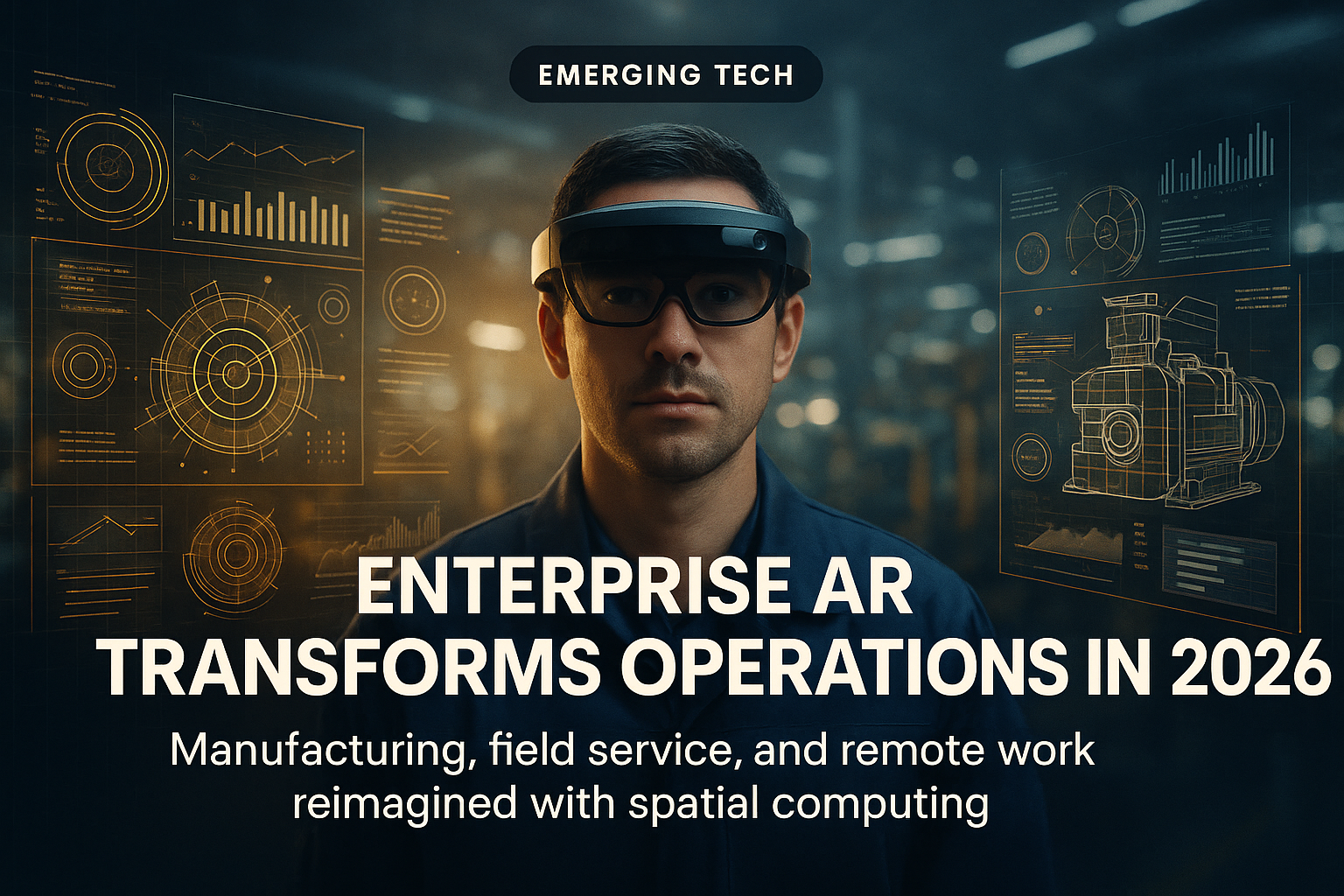
Enterprise augmented reality has moved decisively from pilot projects to production deployments. In 2026, organizations across manufacturing, logistics, healthcare, and field service are leveraging AR to unlock productivity gains, reduce operational errors, and accelerate workforce capability.
The Enterprise AR Inflection Point
Augmented reality is no longer experimental—it’s becoming mission-critical infrastructure. Unlike consumer AR, which focuses on entertainment and social engagement, enterprise AR solves specific business problems: reducing downtime, accelerating technician training, improving first-time fix rates, and enabling remote expert guidance.
The convergence of three factors is driving adoption in 2026. First, hardware maturity has improved significantly. Enterprise-grade AR glasses from Microsoft HoloLens, Magic Leap, and emerging competitors now offer extended battery life, improved field-of-view, and robust enterprise software ecosystems. Second, 5G and edge computing infrastructure enables real-time data streaming and low-latency AR experiences critical for industrial operations. Third, AI-powered spatial computing allows AR systems to understand physical environments, automate data capture, and deliver contextually relevant information to workers without manual input.
According to industry analysts, enterprise AR adoption is accelerating as organizations recognize measurable return on investment within 12-18 months of deployment.
Manufacturing and Production: Real-Time Guidance at Scale
Manufacturing represents the largest near-term opportunity for enterprise AR. Production floors are deploying AR to guide assembly processes, reduce defects, and accelerate worker onboarding.
AR-guided assembly overlays step-by-step instructions directly onto products and workstations, eliminating paper manuals and reducing assembly errors by 30-40% in early deployments. Workers see exactly where components belong, highlighted in real-time with spatial annotations. When errors occur, the system detects deviations and alerts supervisors instantly.
Quality control is being transformed through AR inspection workflows. Technicians wearing AR glasses can compare physical products against 3D CAD models in real-time, identifying defects that might be invisible to the naked eye. Measurement data is automatically captured and logged, creating digital records for compliance and traceability.
Worker training accelerates dramatically with AR. New employees can learn complex assembly processes by following interactive 3D models rather than relying on experienced supervisors for hands-on coaching. Training time has been reduced by 25-35% in organizations deploying AR-powered onboarding, according to early case studies from automotive and electronics manufacturers.
Field Service: First-Time Fix Rates and Remote Expertise
Field service organizations are using AR to improve first-time fix rates and reduce expensive truck rolls. Technicians armed with AR glasses can access equipment schematics, troubleshooting guides, and maintenance histories overlaid directly onto the machines they’re servicing.
Remote expert guidance is a game-changer for complex repairs. When a field technician encounters an unfamiliar issue, an expert can see exactly what the technician sees through AR glasses and provide real-time guidance—pointing to components, annotating diagrams, and walking through diagnostic steps. This capability is particularly valuable for reducing mean-time-to-repair (MTTR) on critical infrastructure.
Predictive maintenance is enhanced through AR analytics. IoT sensors on equipment feed real-time performance data into AR systems, which alert technicians to developing problems before failures occur. Technicians arriving at a site already know the equipment’s condition history and can prioritize repairs efficiently.
Organizations deploying AR in field service report first-time fix rates improving from 60-70% to 85-90%, translating directly to reduced customer downtime and higher service margins.
Logistics and Warehouse Operations
Warehouses and distribution centers are adopting AR for order picking, inventory management, and shipping verification. AR-guided picking directs workers to exact shelf locations and shows the precise quantity of items needed, reducing picking errors and accelerating fulfillment.
Real-time inventory visibility through AR enables workers to identify stock discrepancies immediately rather than discovering them during audits. This reduces shrinkage and improves inventory accuracy from typical 95% to 99%+ levels.
The ROI Case: Why Enterprise AR Gains Momentum
Organizations deploying enterprise AR typically see measurable returns within the first year:
- Productivity gains: 20-35% improvement in task completion time through guided workflows and reduced manual lookups
- Error reduction: 30-50% fewer defects, rework, and quality issues
- Training acceleration: 25-40% reduction in onboarding time for complex tasks
- Safety improvements: Reduced workplace accidents through guided procedures and hazard awareness
- Workforce retention: Improved employee satisfaction through technology-enabled roles and reduced physical strain
These metrics drive executive sponsorship and justify hardware and software investments.
Challenges and the Path Forward
Enterprise AR adoption faces real obstacles. Hardware costs remain significant—AR glasses suitable for industrial environments cost $3,000-$5,000 per unit. Content creation requires specialized expertise; building and maintaining AR applications demands skills that many organizations lack. Workplace culture can resist technology adoption if workers perceive AR as surveillance or job displacement.
Despite these challenges, the trajectory is clear. As hardware costs decline, software platforms mature, and success stories accumulate, enterprise AR adoption will accelerate through 2026 and beyond. Organizations that invest now will establish competitive advantages in operational efficiency and workforce capability.
The Future of Spatial Computing in the Enterprise
Enterprise AR in 2026 represents the beginning of a broader shift toward spatial computing—where digital information seamlessly integrates with physical environments. As AI capabilities improve, AR systems will become more autonomous, anticipating worker needs and providing guidance without explicit requests.
The next frontier includes mixed reality collaboration, where remote workers appear as holograms on production floors, and autonomous AR agents that monitor operations continuously and alert humans only when intervention is needed.
The organizations leading this transition are not necessarily technology companies—they’re forward-thinking manufacturers, logistics providers, and service organizations recognizing that spatial computing is becoming as essential to operations as email and enterprise resource planning systems.
What challenges has your organization encountered when considering AR adoption? Share your insights in the comments below.
—
📖 **Recommended Sources:**
• **Gartner AR/VR Market Reports** – Market sizing and adoption trends for enterprise AR across industries
• **IDC Enterprise Augmented Reality Study** – Use case analysis and ROI benchmarking for manufacturing and field service
• **Microsoft HoloLens Enterprise Solutions** – Real-world case studies from manufacturing and service organizations
• **McKinsey on Industrial Digitalization** – Strategic insights on spatial computing adoption in manufacturing
• **CoinDesk & TechCrunch** – Emerging technology trend analysis and startup innovation in AR platforms
ⓘ This content is AI-generated based on training data through January 2026. Please verify specific claims independently