# Enterprise Augmented Reality in 2026: How AR Transforms Manufacturing, Logistics, and Field Service
The enterprise augmented reality market has reached an inflection point. What began as experimental pilot projects in 2020 has evolved into mission-critical infrastructure transforming how manufacturing teams assemble products, how logistics coordinators manage warehouses, and how field service technicians troubleshoot equipment remotely.
The Enterprise AR Market Accelerates
Enterprise AR adoption is no longer confined to early adopters. According to industry analysis, the global enterprise AR market has experienced strong compound annual growth, with manufacturing and logistics sectors leading adoption. Companies like Boeing, GE, and DHL have deployed AR solutions at scale, moving beyond proof-of-concept phases into production environments that directly impact operational metrics.
The shift reflects a fundamental business reality: AR delivers measurable ROI. Unlike consumer AR applications that prioritize engagement, enterprise AR solves specific operational pain points—reducing assembly errors, accelerating technician response times, and improving worker safety. This pragmatic focus has attracted sustained investment from enterprises across industrial, healthcare, and logistics verticals.
Real-Time Guidance Reduces Errors and Training Time
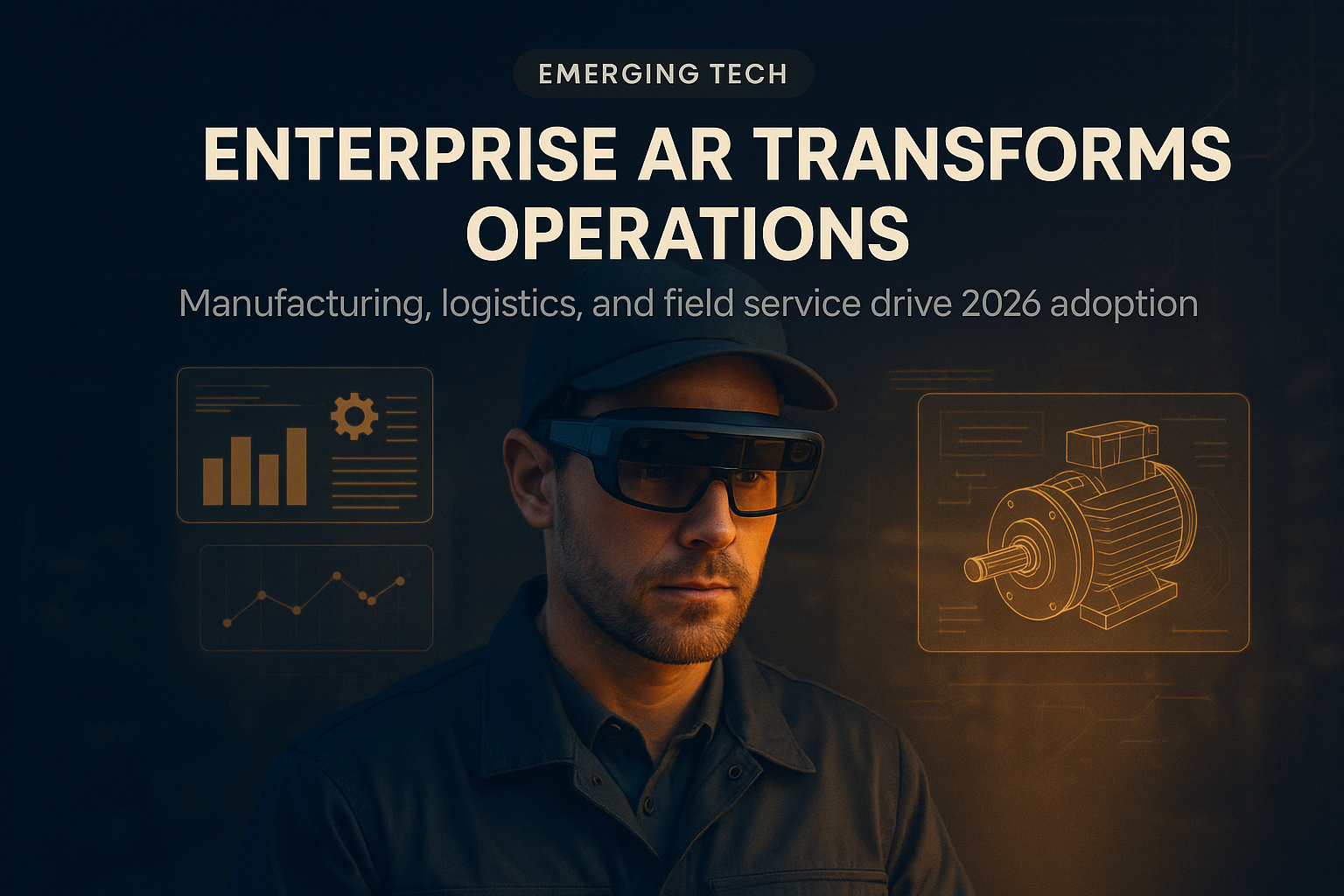
One of the most compelling enterprise AR use cases is real-time work instruction delivery. Rather than consulting printed manuals or two-dimensional digital guides, workers wearing AR-enabled smart glasses see 3D holographic overlays synchronized with physical equipment in real-time.
In manufacturing environments, this capability has proven transformative. Assembly line workers can see step-by-step instructions projected directly onto components, with AR systems flagging potential errors before they occur. Quality defect rates have declined significantly in organizations deploying this technology, while assembly time per unit has compressed—directly improving throughput and profitability.
Field service organizations report similar gains. Technicians dispatched to customer sites can access remote expert guidance through AR visualization. Rather than waiting for a senior engineer to arrive on-site, a technician wearing AR glasses can receive real-time annotations, diagnostic overlays, and repair sequences from a remote expert. This capability has reduced mean-time-to-resolution (MTTR) and improved first-contact resolution rates.
Logistics and Warehouse Optimization
Warehouse and logistics operations have emerged as a high-ROI application domain for enterprise AR. Augmented reality pick-to-light systems guide workers through optimal warehouse routes, highlighting item locations with spatial accuracy and reducing picking errors.
Major logistics operators have deployed AR-enabled picking systems in large fulfillment centers, resulting in measurable productivity gains. Workers navigate warehouse aisles faster, make fewer picking errors, and experience reduced cognitive load—all factors that improve throughput and reduce operational cost per shipment.
AR also enhances inventory management and cycle counting. Rather than manually scanning each item, AR systems can overlay inventory data onto physical shelves, streamlining audits and reducing discrepancies. This capability has proven particularly valuable in high-volume logistics environments where accuracy directly impacts customer satisfaction and regulatory compliance.
The Remote Expert Collaboration Paradigm
The rise of AR-enabled remote collaboration represents a structural shift in how enterprises organize expertise. Rather than relocating senior technicians or engineers to problem sites, organizations can now connect remote experts with on-site workers through AR-mediated communication channels.
A technician in the field wears AR glasses equipped with video and spatial computing capabilities. A remote expert, viewing the same scene, can annotate the technician’s view in real-time—drawing circles around problem areas, pointing to components, or guiding disassembly sequences. This capability has proven invaluable in specialized industries where expert talent is geographically concentrated or expensive to deploy.
The business impact is substantial. Organizations reduce travel costs, accelerate problem resolution, and improve knowledge transfer across distributed teams. For enterprises with global operations, AR-enabled remote collaboration bridges geographic and temporal barriers that previously constrained expertise distribution.
Enterprise AR Hardware and Platform Maturation
The enterprise AR market has benefited from significant hardware advances. AR smart glasses from manufacturers like Microsoft (HoloLens), Magic Leap, and emerging competitors have matured in terms of battery life, field of view, processing power, and industrial durability. These devices are now purpose-built for harsh industrial environments—rated for temperature extremes, moisture exposure, and impact resistance.
Software platforms supporting enterprise AR have similarly matured. Cloud-based AR platforms now offer enterprise-grade capabilities: multi-user collaboration, real-time data synchronization, integration with enterprise resource planning (ERP) systems, and robust analytics dashboards. Organizations can deploy AR applications that integrate seamlessly with existing IT infrastructure, addressing security and compliance requirements that consumer AR solutions cannot meet.
This hardware and software maturation has shifted AR from a novelty to a pragmatic operational tool—one that enterprises can confidently integrate into mission-critical workflows.
Challenges and the Path Forward
Despite strong adoption momentum, enterprise AR faces ongoing challenges. Hardware cost remains significant, limiting per-worker deployment in price-sensitive industries. Battery life, though improving, still constrains extended-shift operations. Interoperability across different AR platforms remains fragmented, complicating enterprise standardization efforts.
Additionally, change management and worker acceptance require sustained organizational commitment. Deploying AR glasses to factory floors or warehouse environments requires training, workflow redesign, and cultural shifts—investments that extend beyond technology procurement.
However, these challenges are being systematically addressed. Hardware costs are declining as manufacturing scales. Battery technologies are advancing. Industry consortia are driving standardization efforts. Organizations that have successfully deployed enterprise AR have developed best practices for change management and worker adoption.
The Future of Enterprise AR: Integration and Scale
Looking ahead, enterprise AR will increasingly integrate with artificial intelligence, edge computing, and digital twin technologies. AI-powered AR systems will provide predictive maintenance alerts, autonomous decision support, and adaptive work instructions that personalize guidance based on individual worker skill levels.
Digital twin integration will enable workers to visualize complex system states, simulate operational scenarios, and train on virtual representations of expensive equipment—all through AR interfaces. This convergence of technologies will unlock new use cases in process optimization, predictive maintenance, and autonomous operations.
The trajectory is clear: enterprise AR has transitioned from experimental technology to operational infrastructure. Organizations that strategically deploy AR solutions in high-impact use cases—manufacturing assembly, field service, logistics operations—are realizing competitive advantages in productivity, quality, and cost efficiency.
Conclusion
Enterprise augmented reality has matured from proof-of-concept to production reality. Manufacturing plants, logistics centers, and field service organizations are deploying AR solutions that deliver measurable business impact—faster assembly, fewer errors, reduced travel costs, and accelerated expertise distribution. As hardware costs decline and software platforms mature, AR adoption will expand beyond early-adopter organizations into mainstream enterprise operations.
The question is no longer whether enterprise AR delivers value—it’s how quickly your organization can strategically deploy AR to capture competitive advantage in your industry. What operational challenges in your organization could be transformed by real-time AR guidance and remote expert collaboration?
—
📖 **Recommended Sources for Verification:**
– **Gartner Hype Cycle for Emerging Technologies** – Tracks AR maturity and enterprise adoption curves
– **IDC Worldwide Augmented and Virtual Reality Spending Guide** – Market size and segment growth forecasts
– **CoinDesk / VentureBeat AR/VR Coverage** – Current enterprise AR deployments and technology updates
– **McKinsey “Augmented Reality in Operations”** – ROI case studies and implementation frameworks
– **Industry-specific sources** – Boeing, GE, DHL case studies on enterprise AR deployments
ⓘ **Note:** This content is based on training data current through January 2026. Specific 2026 market figures and recent announcements should be independently verified with current industry reports from Gartner, IDC, and company announcements.