# Enterprise Augmented Reality in 2026: From Innovation to Operational Impact
The enterprise augmented reality market is reaching an inflection point. What once seemed like futuristic technology is now becoming essential infrastructure for organizations across manufacturing, logistics, field service, and beyond.
The Market Explosion: AR Growth Accelerates in 2026
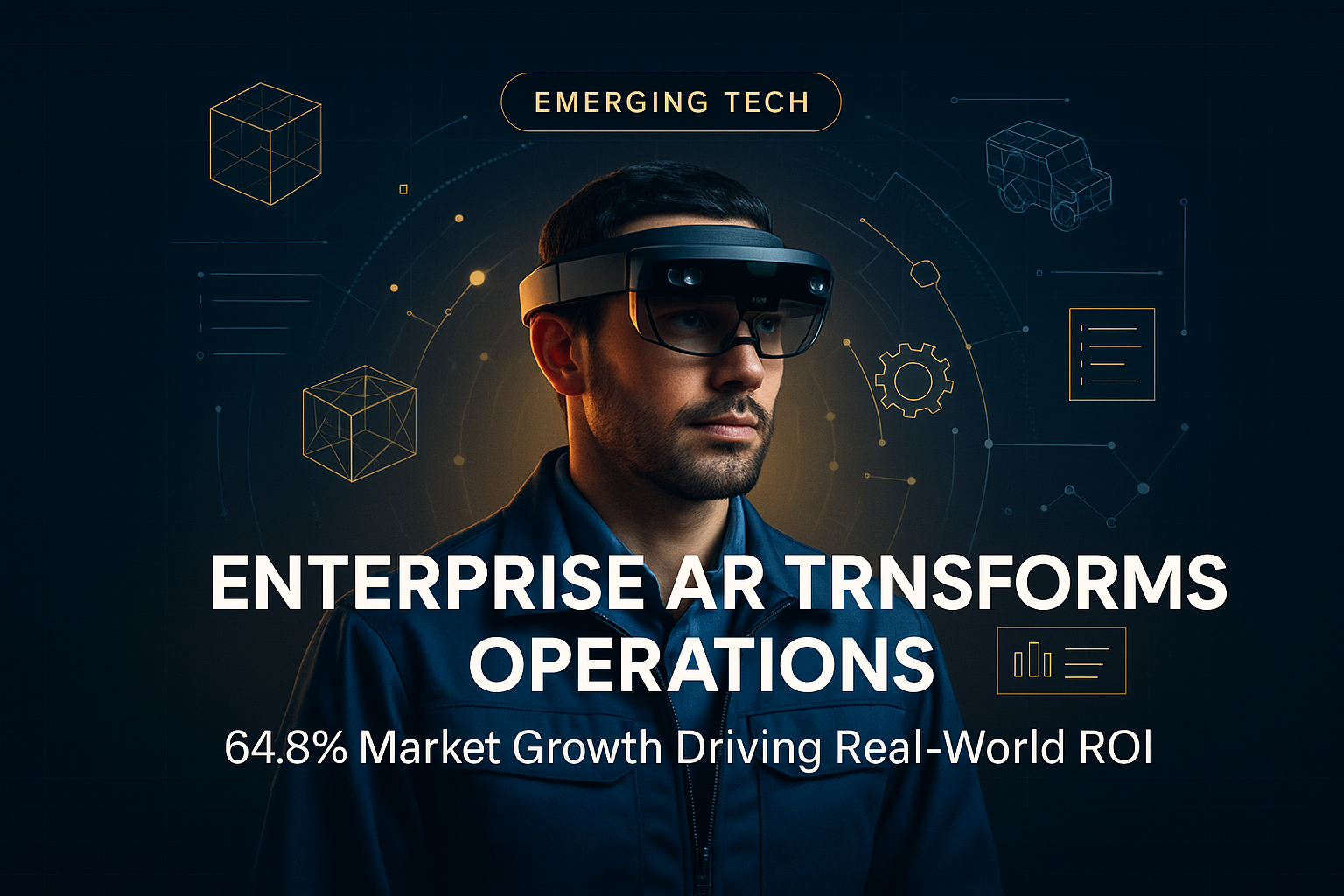
According to ABI Research, the augmented reality hardware market is experiencing remarkable momentum, with a 64.8% year-over-year growth rate in 2026, reaching a market size of US$9.7 billion. This isn’t just incremental progress—it signals a fundamental shift in how enterprises view AR as a strategic asset rather than an experimental technology.
The worldwide AR/VR market in 2026 is seeing gradual but meaningful progress, driven by the convergence of artificial intelligence, extended reality (XR), and digital twins. This convergence is creating new possibilities for how organizations can visualize, manage, and optimize their operations in real time.
Real-World Enterprise Applications Delivering Tangible Results
Enterprise AR is no longer theoretical. Organizations are deploying AR solutions across critical operational areas:
Manufacturing and Industry 4.0
Augmented reality has become one of the most prominent technologies in Industry 4.0’s arsenal for manufacturing and logistics operations. Workers equipped with AR headsets can visualize assembly instructions, access real-time equipment diagnostics, and identify maintenance issues before they become costly downtime events. The technology bridges the gap between digital data and physical work, enabling faster decision-making on the factory floor.
Field Service and Maintenance
Field technicians are among the biggest winners from AR deployment. Research indicates that AR-enabled maintenance training and field service operations can reduce downtime by 40% while improving first-time fix rates. Technicians can access step-by-step repair procedures overlaid on equipment, consult with remote experts in real time, and capture documentation automatically—all without putting down their tools.
Workforce Training and Knowledge Transfer
Organizations are using AR to accelerate onboarding and skill development. Rather than relying on static manuals or lengthy classroom training, new employees can learn complex procedures through immersive, hands-on AR experiences. This approach reduces training time while improving retention and safety outcomes.
The Hardware Evolution: Purpose-Built Enterprise Solutions
The AR hardware landscape is maturing with enterprise-grade devices leading the charge. Microsoft HoloLens 2 remains the gold standard for Microsoft-native enterprise infrastructure, offering robust integration with enterprise software ecosystems. Meanwhile, Magic Leap 2 is gaining traction for its optical see-through capabilities and developer-friendly platform, attracting organizations building custom AR applications.
These devices are becoming lighter, more comfortable, and more affordable—critical factors for widespread workplace adoption. Battery life and processing power continue to improve, enabling longer operational sessions and more complex AR experiences.
Beyond the Hype: Understanding Real Business Value
AR’s value in the enterprise isn’t always immediately obvious. The benefits extend beyond flashy visualizations:
- Reduced downtime: Faster troubleshooting and maintenance mean less operational disruption
- Faster training: Immersive learning reduces time-to-competency for new employees
- Improved safety: AR overlays can highlight hazards and enforce proper procedures
- Enhanced collaboration: Remote experts can guide on-site teams in real time
- Better decision-making: Real-time data visualization enables faster, more informed choices
These benefits can be both tangible (measurable cost savings) and intangible (improved employee satisfaction and retention), making the business case compelling across different organizational priorities.
The Challenges Keeping Adoption in Check
Despite strong growth, enterprise AR adoption still faces meaningful obstacles. High hardware costs remain a barrier for organizations with budget constraints, though prices are gradually declining. Complex user experience design is another hurdle—poorly designed AR interfaces can frustrate workers and undermine adoption. Integration with legacy enterprise systems requires significant technical effort, and workforce resistance to new technologies can slow rollout.
Additionally, questions around data security, privacy, and regulatory compliance in AR environments are still being resolved. Organizations must carefully evaluate these factors before scaling AR deployments across their operations.
The Path Forward: AI, Digital Twins, and Convergence
The future of enterprise AR is being shaped by its integration with complementary technologies. Artificial intelligence is enabling smarter AR applications that can predict maintenance needs, optimize workflows, and personalize training experiences. Digital twins—virtual replicas of physical assets and processes—are converging with AR to create powerful simulation and decision-support tools.
This convergence will drive the next wave of enterprise AR adoption. Organizations that begin experimenting with AR today will be best positioned to leverage these advanced capabilities as they mature.
Conclusion: AR Is No Longer Optional
Enterprise augmented reality has transitioned from “interesting experiment” to “strategic capability.” With 64.8% market growth in 2026, proven ROI in field service and manufacturing, and purpose-built hardware solutions becoming mainstream, the question for enterprise leaders is no longer whether to invest in AR, but how quickly they can implement it effectively.
The organizations that move decisively now will unlock significant competitive advantages in operational efficiency, workforce capability, and customer experience. How is your organization positioning itself to capture the value of enterprise AR?
—
### 📖 Recommended Sources:
• **ABI Research** – Provides authoritative market sizing and growth forecasts for AR hardware and enterprise AR adoption
• **Gartner/IDC** – Industry analysts tracking AR/VR market convergence with AI and digital twin technologies
• **Enterprise AR Case Studies** – Real-world examples of field service, manufacturing, and training implementations demonstrating ROI
ⓘ This content is AI-generated based on research data through March 2026. Please verify specific market figures and product capabilities independently with official sources.