# Edge AI Inference on Device: The Shift Toward Local Intelligence in 2026
The future of artificial intelligence isn’t in the cloud—it’s in your pocket. As we move deeper into 2026, edge AI inference is fundamentally reshaping how devices process data, making local intelligence the new standard for real-time applications across smartphones, automotive systems, and IoT devices.
What Is Edge AI Inference?
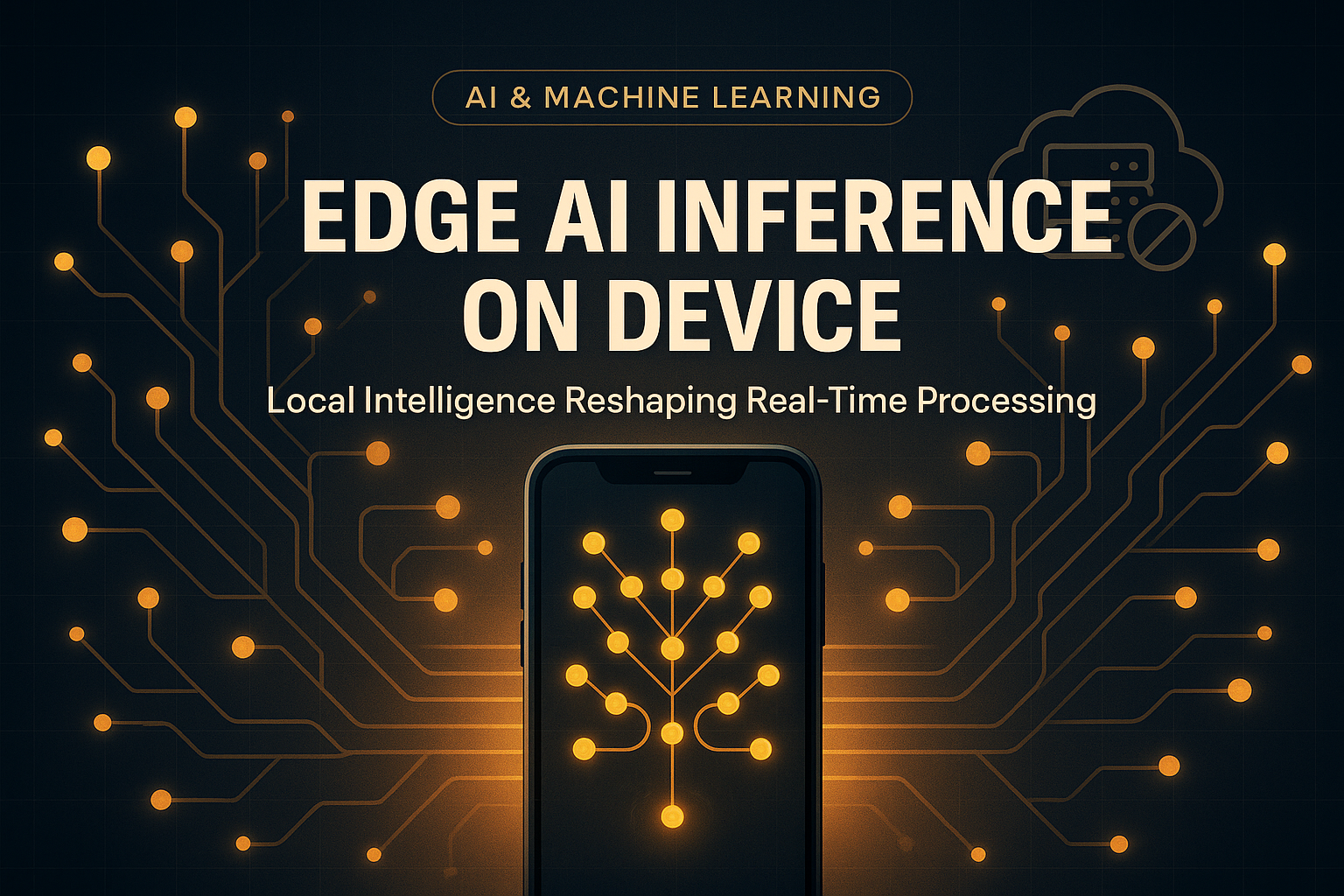
Edge AI inference refers to the process of running trained AI models directly on devices—smartphones, tablets, IoT sensors, or vehicles—rather than sending data to cloud servers for processing. Unlike cloud-based AI, which relies on network connectivity and centralized data centers, edge inference executes machine learning predictions locally, delivering immediate results without the latency penalty of round-trip network communication.
This architectural shift represents a fundamental departure from the cloud-first paradigm that dominated the last decade. Instead of treating edge devices as mere data collection points, modern edge AI transforms them into intelligent processing units capable of real-time decision-making.
The Three Core Advantages Driving Adoption
Latency Elimination and Real-Time Performance
Cloud-based AI inherently suffers from network latency—the time required to transmit data to servers and receive predictions back. For applications requiring split-second decisions, this delay is unacceptable. Autonomous vehicles deciding whether to brake, medical devices monitoring patient vitals, or augmented reality applications tracking hand gestures all demand sub-100 millisecond response times. By processing inference locally, edge AI eliminates this bottleneck entirely, enabling genuinely real-time AI experiences.
Privacy and Data Sovereignty
Sending sensitive data to cloud servers creates privacy risks and regulatory compliance challenges. Edge inference keeps personal information—facial recognition data, health metrics, financial transactions—on the device itself. According to industry analysis, this localized processing approach aligns with increasingly stringent data protection regulations like GDPR and emerging privacy frameworks worldwide. Users maintain control over their data, and organizations reduce exposure to data breach risks.
Cost Efficiency and Offline Capability
Cloud-based inference incurs ongoing API costs and requires persistent internet connectivity. Edge AI reduces operational expenses by eliminating per-inference charges and enables devices to function intelligently even without network access. This is particularly valuable in remote areas, developing markets with inconsistent connectivity, and mission-critical applications where network unavailability cannot interrupt service.
Market Momentum and Industry Forecasts
The edge AI chip market is experiencing explosive growth. Industry forecasts indicate the edge AI chip market will exceed US$80 billion by 2036, driven by five primary application segments: automotive systems, AI-enabled smartphones, AI PCs, industrial IoT, and smart home devices. This growth trajectory reflects a fundamental industry consensus: edge inference is no longer experimental—it’s becoming essential infrastructure.
Major technology companies are racing to integrate edge AI capabilities. Smartphone manufacturers are embedding specialized neural processing units (NPUs) directly into chips. Automotive manufacturers are deploying edge AI for autonomous driving perception tasks. Industrial equipment producers are implementing edge inference for predictive maintenance and quality control. This convergence signals that edge AI has transitioned from niche innovation to mainstream technology.
Engineering Edge AI: The Technical Challenge
Building effective edge AI systems requires rethinking how models are designed and deployed. Unlike cloud-based systems where computational resources are virtually unlimited, edge devices operate under strict constraints: limited memory, battery power, and processing capability.
Model optimization has become critical. Techniques like quantization (reducing numerical precision), pruning (removing less important neural connections), and knowledge distillation (training smaller models to mimic larger ones) enable powerful AI models to run on modest hardware. These methods can reduce model size by 50-90% while maintaining acceptable accuracy—a crucial trade-off in edge environments.
Hardware acceleration through specialized chips—GPUs, TPUs, and custom NPUs—provides the computational power needed for real-time inference. Apple’s Neural Engine, Qualcomm’s Hexagon processors, and Google’s Tensor Processing Units exemplify this trend. These specialized processors dramatically improve energy efficiency compared to general-purpose CPUs, extending device battery life while enabling complex AI tasks.
Real-World Applications Reshaping Industries
Mobile AI and Smartphone Intelligence
Modern AI-enabled smartphones now perform on-device tasks: real-time language translation, advanced computational photography (portrait mode, night mode, object removal), voice recognition, and personalized recommendations—all without sending data to cloud servers. This capability creates genuinely private, responsive user experiences that define competitive advantage in the smartphone market.
Autonomous Vehicles and Edge Perception
Self-driving vehicles generate enormous data volumes from cameras, lidar, and radar sensors. Processing this data in the cloud introduces unacceptable latency for safety-critical decisions. Edge inference enables vehicles to perform real-time object detection, lane tracking, and collision avoidance locally, with cloud systems handling only higher-level planning and map updates.
Industrial and Predictive Maintenance
Manufacturing facilities deploy edge AI for real-time quality control and predictive maintenance. Sensors on equipment run inference models locally to detect anomalies, predict failures, and trigger maintenance alerts—reducing downtime and extending equipment lifespan without requiring constant cloud connectivity.
The Future: End-to-End Edge Intelligence
Industry experts predict that by 2030, edge AI will evolve beyond simply “deploying models onto devices” toward systems engineered end-to-end around local intelligence. This means entire application architectures will be designed with edge inference as the primary processing paradigm, with cloud systems playing supporting roles for training, analytics, and occasional high-complexity tasks.
This architectural evolution will drive continued innovation in semiconductor design, model optimization techniques, and edge-cloud hybrid frameworks. Organizations that master edge AI will gain decisive advantages in latency-sensitive markets, data privacy, and operational cost efficiency.
The Competitive Imperative
Edge AI inference isn’t a future possibility—it’s reshaping technology infrastructure right now. The convergence of specialized hardware, optimized models, and market demand creates a compelling case for edge-first architecture across industries. Organizations that delay adopting edge AI risk falling behind competitors who leverage local intelligence for superior performance and user experience.
As edge AI becomes the default rather than the exception, the question isn’t whether to implement on-device inference—it’s how quickly you can build it into your competitive strategy. What role will edge AI play in your organization’s next-generation products?
📖 **Recommended Sources:**
– **Industry forecasts on edge AI chip market growth** – Market research firms tracking semiconductor and AI infrastructure trends through 2036
– **On-device AI inference technical documentation** – Hardware manufacturer resources (Apple, Qualcomm, Google) detailing neural processing units and optimization frameworks
– **Edge computing architecture research** – Academic and industry studies