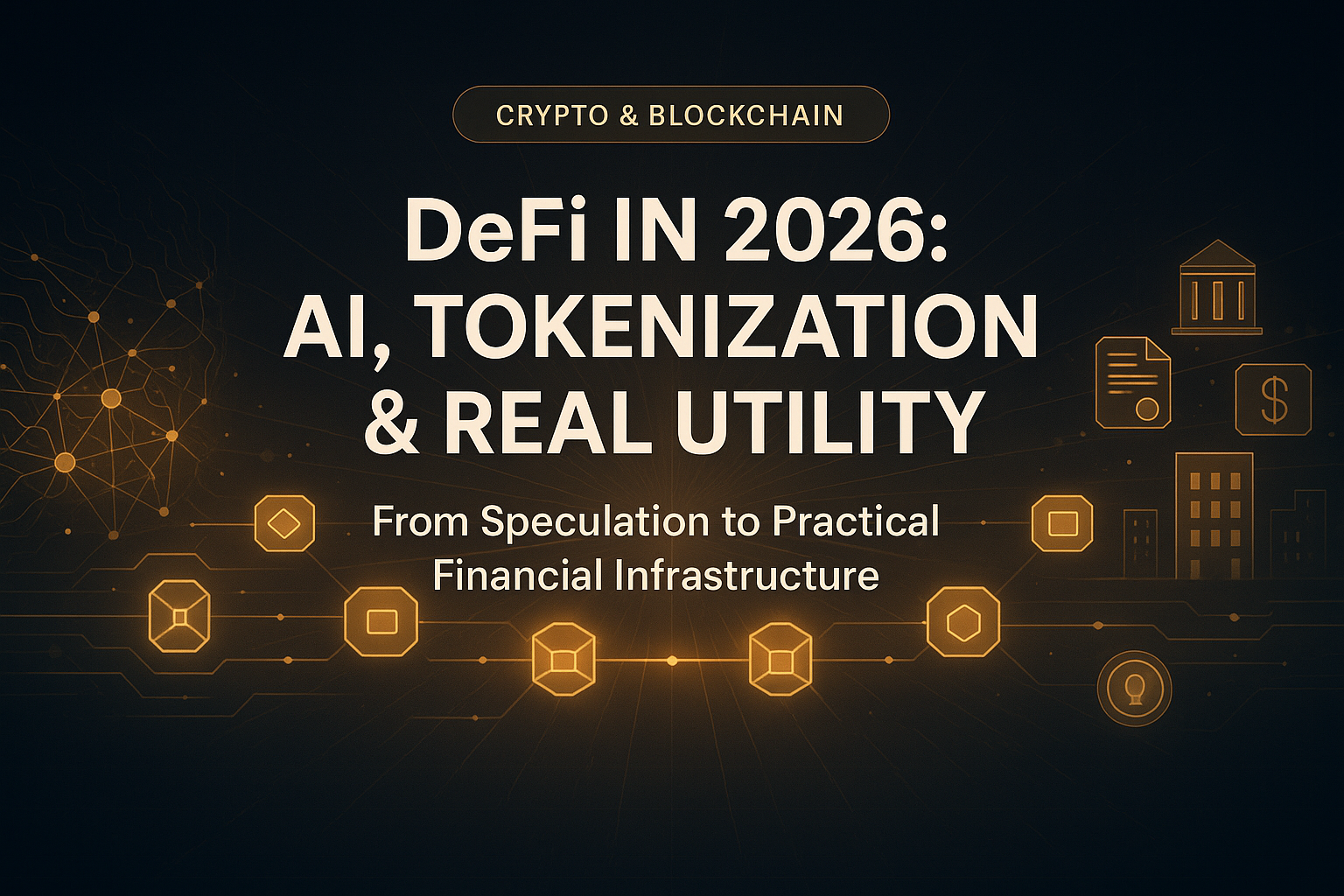
# DeFi in 2026: AI Agents, Tokenization, and the Rise of Real-World Utility
The decentralized finance landscape is undergoing a fundamental transformation. What once thrived on speculation and yield chasing is maturing into a practical financial infrastructure with tangible real-world applications. In 2026, three major forces are reshaping DeFi: artificial intelligence-driven automation, tokenization of real-world assets, and seamless cross-chain interoperability.
The Shift From Speculation to Utility
For years, DeFi was synonymous with high-risk trading and yield farming. Today, the narrative has fundamentally changed. DeFi markets are shifting from speculation to real economic utility, creating a parallel financial layer that operates independently of traditional institutions.
This maturation reflects broader market evolution. Regulatory clarity is facilitating increased adoption and scalability of digital assets, enabling institutions to participate with greater confidence. The shift isn’t just philosophical—it’s structural. DeFi protocols are now being designed with sustainability, interoperability, and real-world asset integration as core features rather than afterthoughts.
AI Agents and Smart Contract Automation
One of the most significant trends reshaping DeFi in 2026 is the expansion of AI-powered agents managing portfolio automation. These intelligent systems go beyond simple automation; they actively optimize strategies, manage risk, and execute complex transactions across multiple protocols.
Automation and AI agents are expanding the role of smart contracts, enabling them to respond dynamically to market conditions. Instead of static, pre-programmed logic, DeFi smart contracts now leverage machine learning to adapt to changing market environments. This creates more efficient capital allocation, reduces slippage, and improves user outcomes.
The implications are profound. Portfolio management, once the domain of professional traders and hedge funds, is becoming democratized. AI agents can monitor thousands of yield opportunities simultaneously, rebalancing positions and capturing arbitrage opportunities that human traders would miss. This technology is particularly valuable for institutional participants entering the DeFi space.
Tokenized Real-World Assets: Bridging Traditional and Decentralized Finance
Perhaps the most transformative trend is the acceleration of asset tokenization—converting real-world assets like real estate, commodities, securities, and corporate debt into blockchain-based tokens. This development is impacting the entire DeFi ecosystem.
Tokenized real-world assets and derivatives are driving ecosystem maturity by creating new use cases beyond cryptocurrency-native instruments. A real estate property can now be fractionalized and traded on DeFi protocols. Corporate bonds can be tokenized and accessed by global participants. Commodities can be represented on-chain with transparent, immutable transaction histories.
This convergence of traditional finance and decentralized systems is creating entirely new markets. Regulatory clarity around tokenization is accelerating adoption, with major jurisdictions establishing frameworks for security tokens and digital asset ownership. The result is a hybrid ecosystem where traditional assets gain the liquidity, accessibility, and transparency benefits of blockchain technology.
Cross-Chain Interoperability and Seamless Asset Movement
DeFi’s fragmentation across multiple blockchains—Ethereum, Solana, Polygon, Arbitrum, and others—created friction. Users had to manage multiple wallets, understand different ecosystems, and navigate liquidity silos. Cross-chain interoperability solutions are changing this dynamic.
Bridges and cross-chain protocols enable assets to move seamlessly between networks, allowing users to access the best yields and opportunities regardless of which blockchain hosts them. This interoperability is critical for DeFi’s evolution from isolated ecosystems to a truly interconnected financial network.
Advanced bridge technologies and standardized cross-chain messaging protocols are reducing transaction costs and execution risk. Users can now deploy capital where it generates the highest risk-adjusted returns, without being constrained by blockchain boundaries. This is particularly important as tokenized real-world assets are deployed across multiple chains to maximize liquidity and accessibility.
The Emergence of a User-Owned Financial Layer
Collectively, these trends are creating something unprecedented: DeFi is forming a parallel, open, and user-owned financial layer. Unlike traditional finance, where institutions control the infrastructure and extract value through intermediation, DeFi is transparent, composable, and owned by its participants.
Governance tokens, decentralized protocols, and community-driven development mean that users have agency over the systems they rely on. This represents a fundamental shift in financial power dynamics—from centralized custodians to distributed networks of participants.
What’s Next for DeFi?
As we progress through 2026, expect further convergence between traditional and decentralized finance. Institutional adoption will accelerate as regulatory frameworks mature and tokenization becomes mainstream. AI-driven portfolio management will become table stakes for competitive DeFi platforms. And cross-chain infrastructure will continue to improve, eventually making blockchain boundaries invisible to end users.
The question is no longer whether DeFi will replace traditional finance—it’s how the two systems will coexist and integrate. The answer lies in practical utility, regulatory compliance, and seamless user experience. DeFi’s maturation from a speculative playground to a legitimate financial infrastructure is well underway.
What aspect of DeFi’s evolution interests you most—AI automation, asset tokenization, or cross-chain interoperability? Share your thoughts in the comments below.
📖 **Recommended Sources:**
• **SerpAPI DeFi Research (2026)** – Current market trends showing AI automation, tokenization acceleration, and cross-chain protocol development
• **Blockchain Industry Reports** – Regulatory clarity and institutional adoption frameworks for digital assets and tokenized securities
• **DeFi Protocol Documentation** – Technical insights on smart contract automation, interoperability solutions, and real-world asset integration
ⓘ This content is AI-generated based on research data through April 2026. Please verify specific claims and market conditions independently with current sources like CoinDesk, CoinTelegraph, and official protocol documentation.