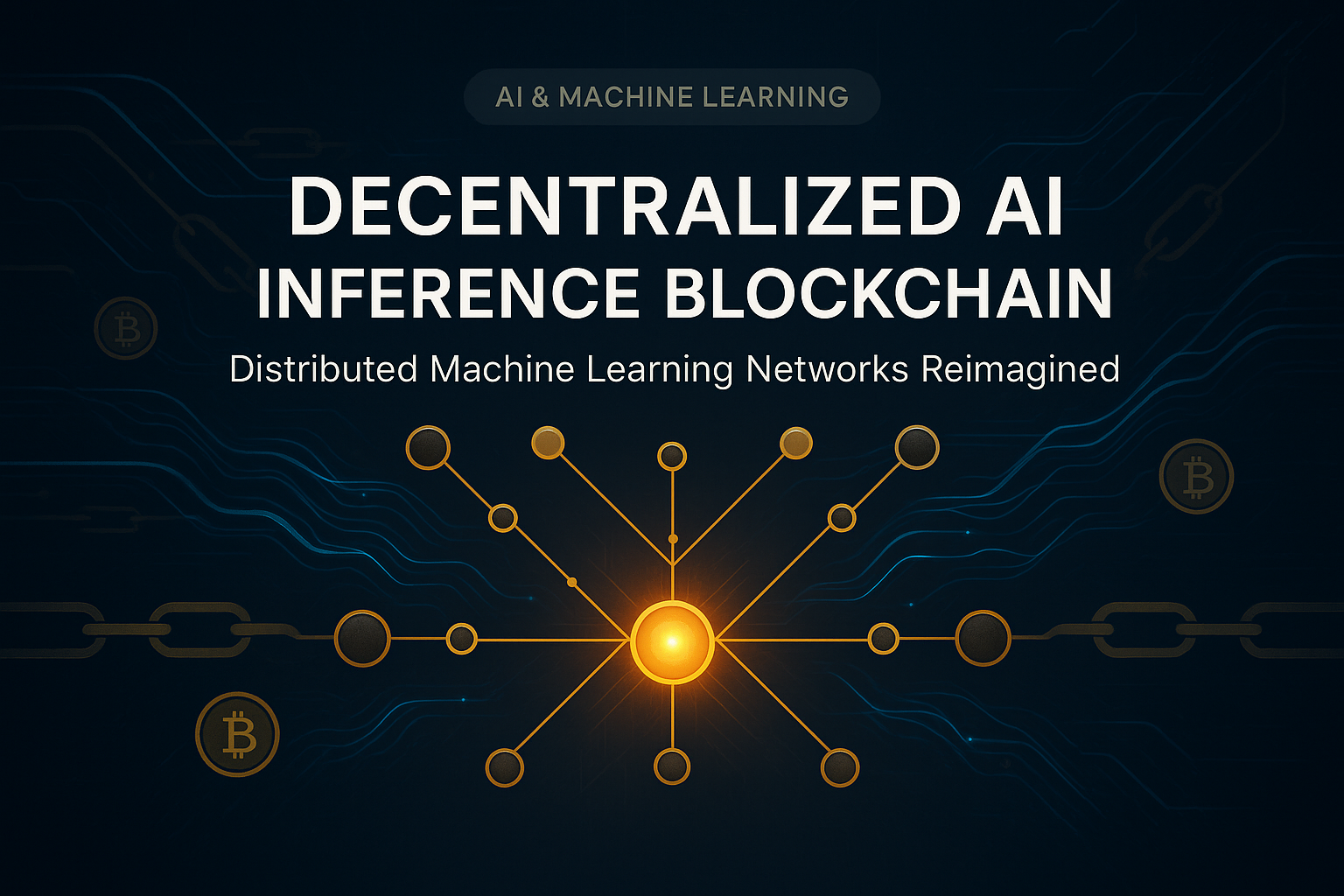
# Decentralized AI Inference on Blockchain: The Future of Distributed Machine Learning Networks
The convergence of artificial intelligence and blockchain technology is fundamentally reshaping how enterprises access computational power for machine learning. Decentralized AI inference represents a paradigm shift from centralized cloud providers to trustless, distributed networks where AI models run across a globally distributed infrastructure secured by blockchain consensus mechanisms.
What Is Decentralized AI Inference?
Decentralized AI inference is the process of running machine learning models across a distributed network of nodes rather than relying on a single centralized server or cloud provider. Unlike traditional cloud-based AI services, decentralized inference leverages blockchain technology to create transparent, verifiable, and censorship-resistant computation networks.
In this model, individuals and organizations contribute computational resources (GPUs, TPUs, and processing power) to a shared network. When users require AI inference—such as running a language model, image recognition, or predictive analytics—their requests are routed to available nodes on the network. The blockchain layer ensures transaction settlement, resource allocation, and payment distribution to node operators, all without requiring a trusted intermediary.
This architecture eliminates single points of failure, reduces latency through geographic distribution, and democratizes access to expensive AI infrastructure. Instead of paying premium rates to centralized providers, users can access competitive pricing from a global pool of independent compute providers.
Key Platforms Pioneering Decentralized AI Inference
Several blockchain-based projects are leading the charge in building decentralized AI inference networks. Akash Network, a leading decentralized cloud computing platform, has emerged as a primary infrastructure layer for distributed AI workloads. Akash enables developers to deploy and run AI models on a permissionless marketplace where compute providers bid for work, creating competitive pricing dynamics.
Gensyn represents another significant player, focusing specifically on distributed machine learning inference and training. By tokenizing computational resources and creating economic incentives for node participation, Gensyn has built a protocol where researchers and enterprises can access powerful AI capabilities without vendor lock-in.
These platforms demonstrate that blockchain-based incentive structures can effectively coordinate distributed resources at scale. By rewarding node operators with cryptocurrency tokens and ensuring transparent, auditable transactions, these networks create self-sustaining ecosystems where participation is economically rational.
Business and Technical Advantages
The shift toward decentralized AI inference offers compelling advantages for enterprises, developers, and individual contributors. Cost efficiency is perhaps the most immediate benefit—competitive marketplaces naturally drive down prices as multiple providers compete for work. Organizations can reduce AI infrastructure expenses by 30-50% compared to centralized cloud providers, according to emerging market analysis.
Transparency and auditability represent another critical advantage. Every inference request, computation, and payment is recorded on the blockchain, creating an immutable audit trail. For regulated industries like healthcare and finance, this capability addresses compliance requirements and enables verifiable AI governance.
Resilience and availability improve dramatically in distributed models. Decentralized networks eliminate single points of failure; if one node goes offline, requests automatically route to others. This geographic distribution also reduces latency for global users by bringing computation closer to end-users.
Data privacy is enhanced through cryptographic techniques and local processing. Users can run inference on their own nodes or through privacy-preserving protocols that prevent the network from accessing sensitive input data. This contrasts sharply with centralized AI providers that often retain data for model improvement.
The Smart Contract Revolution in AI Execution
Smart contracts are the technological backbone enabling trustless AI inference on blockchain networks. These self-executing protocols automatically validate computation results, verify resource allocation, and settle payments without human intermediaries.
Verification mechanisms ensure that nodes actually performed the work claimed. Through cryptographic proofs and redundant computation verification, the network can confirm that inference results are accurate before releasing payment. This creates a trustless environment where bad actors cannot earn rewards for fraudulent or incomplete work.
As blockchain technology matures—particularly with improvements in transaction throughput and reduced gas fees—smart contracts are becoming economically viable for high-frequency AI inference tasks. This technological maturation is critical for scaling decentralized AI beyond niche use cases into mainstream enterprise adoption.
Industry Adoption and Real-World Applications
Early adopters are already leveraging decentralized AI inference for production workloads. Cryptocurrency projects use distributed inference for on-chain prediction markets and oracle services. Research institutions tap decentralized networks for cost-effective model training and inference. Startups building AI applications benefit from avoiding long-term vendor contracts and infrastructure lock-in.
The intersection of DeFi (decentralized finance) and AI is particularly promising. Decentralized prediction markets, algorithmic trading systems, and risk assessment protocols all require reliable, verifiable inference at scale—precisely what decentralized networks provide.
Future Outlook: Convergence of AI and Web3
The trajectory is clear: decentralized AI inference will become a standard component of enterprise infrastructure by 2027-2028. As blockchain scalability improves and AI models become more sophisticated, we’ll see increased competition and specialization among node operators. Some networks will optimize for real-time inference, others for batch processing or specific model types.
Regulatory frameworks will also evolve to address liability, data residency, and computational verification. These frameworks will likely accelerate enterprise adoption by providing legal clarity around decentralized AI services.
Conclusion: Rethinking AI Infrastructure
The shift from centralized to decentralized AI inference represents more than a technological upgrade—it’s a fundamental reimagining of how computational resources are allocated, priced, and governed. By combining blockchain’s transparency with AI’s transformative power, these networks create economic models where efficiency, fairness, and innovation naturally align.
For technology leaders and investors, the question is no longer whether decentralized AI inference will matter, but how quickly your organization can integrate these capabilities into your competitive strategy. Are you prepared to transition away from centralized AI providers, or will your competitors capture the cost and efficiency advantages first?
—
**📖 Recommended Sources:**
– **Akash Network Documentation & Blog** – Official platform for decentralized cloud computing and AI inference infrastructure
– **Gensyn Protocol Research** – Distributed machine learning and inference network specifications
– **CoinDesk & CoinTelegraph** – Ongoing coverage of blockchain-based AI infrastructure developments and market trends
– **McKinsey AI Reports** – Enterprise AI adoption