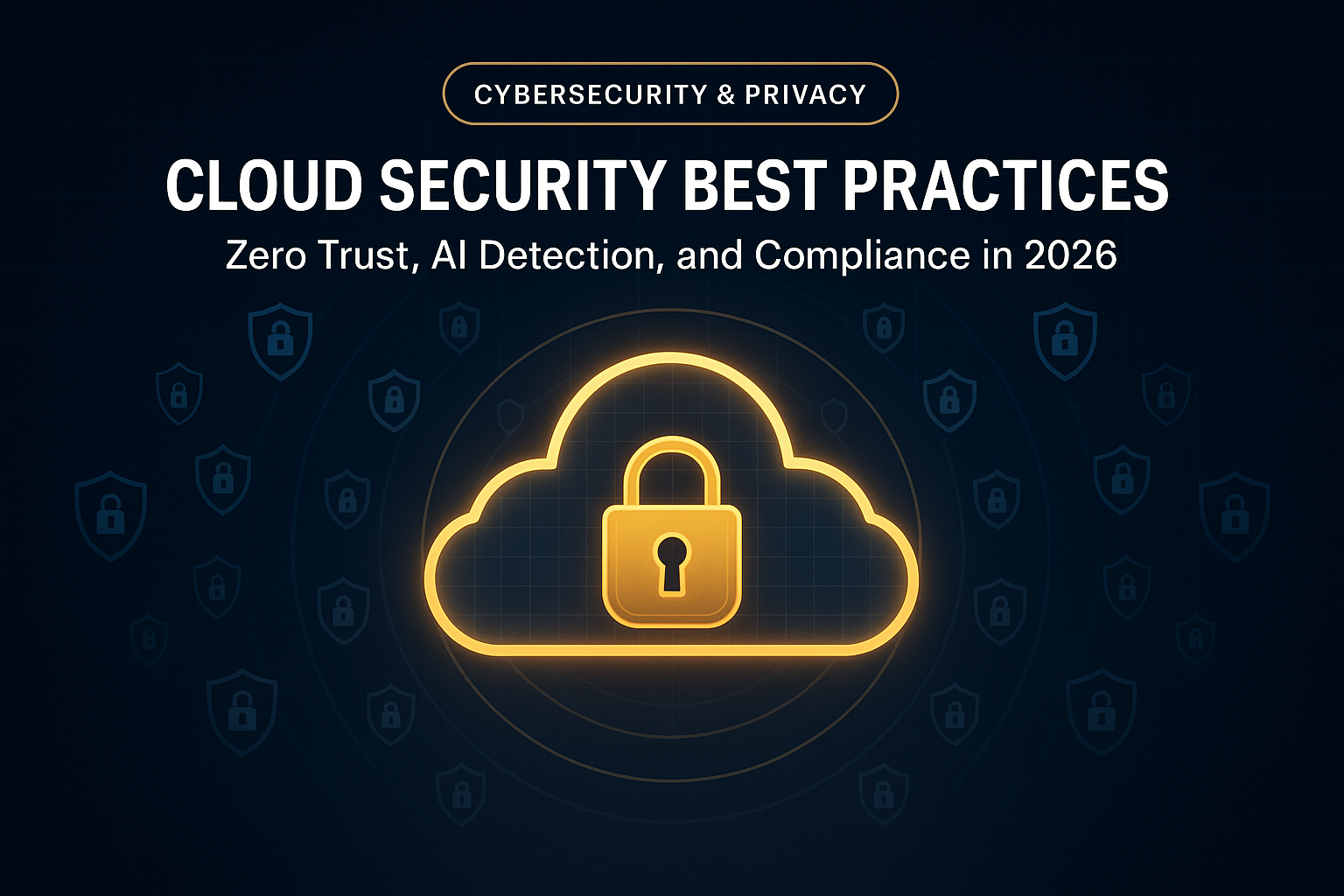
# Cloud Security Best Practices 2026: Zero Trust, AI-Driven Detection, and Compliance Automation
As organizations continue migrating critical workloads to the cloud, security has become the paramount concern. The threat landscape in 2026 is more sophisticated than ever, with attackers leveraging AI, supply chain vulnerabilities, and advanced persistent threats. Enterprises must adopt a comprehensive security posture that goes beyond traditional perimeter defense.
The Rise of Zero Trust Architecture
Zero trust has moved from emerging concept to industry standard in 2026. This security model operates on a simple but powerful principle: never trust, always verify. Every access request—whether from internal users, external partners, or applications—requires continuous authentication and authorization, regardless of network location.
According to industry leaders, zero trust architecture eliminates the traditional castle-and-moat approach where organizations trusted everything inside their network perimeter. Instead, it implements microsegmentation, continuous identity verification, and least-privilege access controls. Major cloud providers including AWS, Microsoft Azure, and Google Cloud Platform have integrated zero trust principles into their security frameworks and now recommend them as foundational to cloud security strategies.
Organizations implementing zero trust report significant reductions in breach impact and lateral movement by attackers. The approach requires robust identity and access management (IAM) solutions, multi-factor authentication (MFA), and continuous monitoring of user behavior and device health.
AI-Powered Threat Detection and Response
Artificial intelligence has fundamentally transformed cloud security operations in 2026. AI-driven threat detection systems now analyze massive volumes of log data, network traffic, and user behavior in real-time, identifying anomalies that would be impossible for human analysts to detect manually.
These intelligent systems use machine learning algorithms to establish baseline behavior patterns for users, applications, and infrastructure. When deviations occur—unusual login times, unexpected data access, or suspicious lateral movement—the system triggers automated alerts or response actions. This capability is critical because the average time to detect a breach has compressed significantly, and organizations that respond within minutes rather than days substantially reduce damage.
Cloud security platforms like Gartner-recommended solutions now incorporate behavioral analytics, threat intelligence integration, and automated incident response workflows. These tools not only detect threats faster but also reduce false positives through advanced correlation and context analysis, allowing security teams to focus on genuine threats.
Identity and Access Management as the Security Cornerstone
In a cloud-native environment, identity is the new perimeter. Proper identity and access management (IAM) is non-negotiable for cloud security in 2026. This includes:
- Passwordless authentication: Biometric and hardware-based authentication methods are replacing password-dependent systems
- Conditional access policies: Dynamic access rules based on risk assessment, device compliance, and contextual factors
- Just-in-time (JIT) access: Granting temporary elevated permissions only when needed, reducing standing access rights
- Privileged access management (PAM): Enhanced monitoring and control of high-risk administrative accounts
Organizations must ensure that cloud identity systems integrate with on-premises directories while maintaining strong governance over hybrid environments. Regular access reviews, automated deprovisioning, and comprehensive audit logging are essential practices.
Encryption Standards and Data Protection
Encryption remains fundamental to cloud security, but 2026 best practices go beyond basic encryption in transit and at rest. Advanced encryption strategies now include:
- End-to-end encryption for sensitive data, even when processed by cloud services
- Encryption key management with hardware security modules (HSMs) and separation of key management from cloud providers
- Tokenization of sensitive data to reduce exposure of personally identifiable information (PII)
- Homomorphic encryption for emerging use cases requiring computation on encrypted data
Cloud providers AWS, Azure, and Google Cloud all offer robust encryption services, but organizations must maintain control over encryption keys and implement proper key rotation policies. Compliance frameworks like HIPAA, PCI-DSS, and GDPR increasingly mandate specific encryption standards and key management practices.
Compliance Automation and Governance
Regulatory compliance has become increasingly complex, with frameworks like GDPR, CCPA, SOC 2, ISO 27001, and industry-specific standards requiring continuous monitoring. Compliance automation tools in 2026 now enable organizations to:
- Continuously assess infrastructure against compliance requirements
- Automatically remediate misconfigurations that violate compliance policies
- Generate audit reports with real-time compliance status
- Enforce policy as code to prevent non-compliant deployments
Many organizations are adopting infrastructure-as-code (IaC) security scanning to catch compliance violations before resources are deployed. This shift-left approach prevents security and compliance issues from reaching production environments, reducing remediation costs and risk.
Future Outlook: Quantum-Safe Cryptography and AI-Resistant Defense
Looking ahead, organizations should begin preparing for quantum computing’s impact on current encryption standards. The migration to quantum-resistant cryptography will be a multi-year initiative, and forward-thinking enterprises are already assessing their cryptographic inventory and planning transitions.
Additionally, as attackers increasingly employ AI to evade detection, defensive AI systems will need to evolve to counter AI-powered attacks. This arms race between offensive and defensive AI will define cloud security strategy in the coming years.
Conclusion: A Holistic Security Approach
Cloud security in 2026 requires a holistic approach combining zero trust principles, AI-powered detection, robust identity management, strong encryption, and continuous compliance monitoring. No single tool or practice provides complete protection—success requires integration across multiple security domains and continuous adaptation to emerging threats.
Organizations that prioritize these best practices will significantly reduce their breach risk and respond more effectively to incidents. What aspects of cloud security are most challenging in your organization—identity management, compliance, or threat detection? Share your experiences in the comments below.
—
**📖 Recommended Sources:**
– **AWS Security Best Practices** – Amazon Web Services official documentation and security whitepapers on zero trust and compliance frameworks
– **Microsoft Azure Security Center** – Microsoft’s comprehensive cloud security guidance and threat intelligence integration recommendations
– **Gartner Cloud Security Reports** – Industry analysis on emerging threats, zero trust adoption, and AI-driven detection technologies
– **NIST Cybersecurity Framework** – National Institute of Standards and Technology guidelines for cloud security and compliance
ⓘ This content is AI-generated based on training data through January 2026. Please verify specific claims independently with official cloud provider documentation and current compliance frameworks.