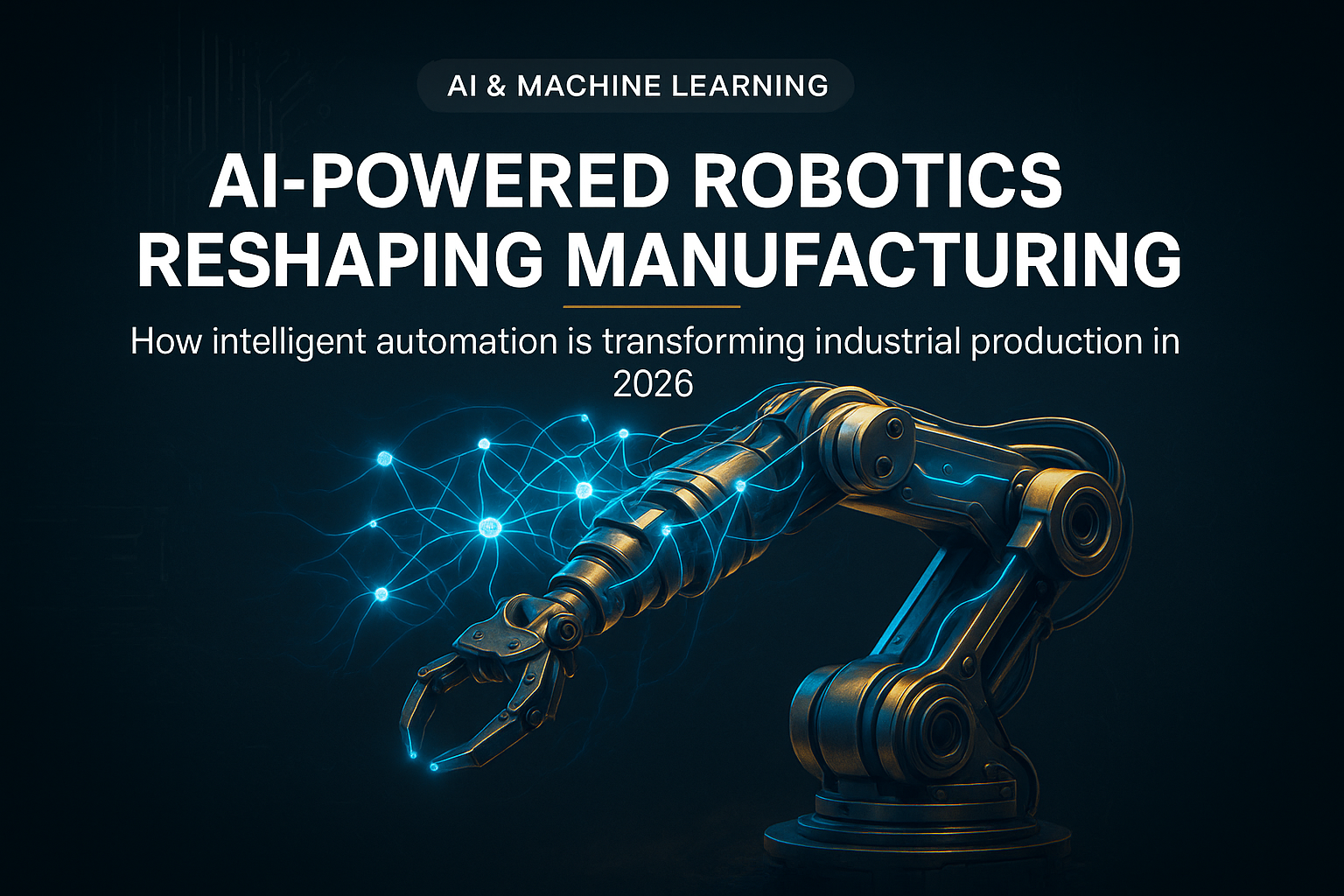
The AI-Powered Robotics Revolution: How Intelligent Automation Is Transforming Manufacturing in 2026
The robotics automation industry is experiencing a seismic shift powered by artificial intelligence and machine learning. In 2026, the convergence of advanced AI, sophisticated sensor technology, and collaborative robotics is fundamentally reshaping how manufacturers approach production, efficiency, and workforce integration.
The Rise of Intelligent Industrial Automation
The manufacturing sector is witnessing unprecedented growth in AI-enhanced robotic systems that go far beyond traditional automation. Unlike conventional robots programmed for single, repetitive tasks, modern intelligent robots leverage machine learning algorithms to adapt, learn, and optimize their operations in real-time. This represents a quantum leap from rigid, task-specific machines to flexible, intelligent agents capable of handling complex, variable production environments.
According to industry analysts, the global robotics market is experiencing strong growth momentum, driven by manufacturers’ urgent need to address labor shortages, improve precision, and reduce operational costs. The integration of AI enables robots to make autonomous decisions, predict maintenance needs, and continuously improve performance without constant human reprogramming.
Collaborative Robots (Cobots) Leading Workplace Integration
Collaborative robots, or cobots, have emerged as a game-changing category within the robotics automation landscape. Unlike traditional industrial robots confined to safety cages, cobots are designed to work safely alongside human workers, creating hybrid production environments that combine human creativity with robotic precision.
In 2026, cobot adoption is accelerating across small and medium-sized enterprises (SMEs) that previously couldn’t afford or justify traditional automation. These systems feature built-in safety mechanisms, intuitive programming interfaces, and the ability to quickly retool for different tasks. The cobot market is expanding rapidly as manufacturers recognize that human-robot collaboration drives both productivity and employee satisfaction.
Leading robotics companies are enhancing cobots with advanced vision systems, force-torque sensing, and AI-powered task learning, enabling them to perform increasingly sophisticated operations—from precision assembly to quality inspection—while maintaining safe interaction with human colleagues.
AI Integration: The Game-Changing Factor
Machine learning is the critical differentiator elevating robotics from automation tools to intelligent partners. AI-powered robots can now:
- Predictive maintenance: Analyze sensor data to anticipate equipment failures before they occur, reducing unplanned downtime
- Dynamic adaptation: Adjust operations in response to environmental changes, material variations, or production demands
- Quality optimization: Use computer vision and deep learning to detect defects with superhuman accuracy
- Process improvement: Continuously learn from production data to identify efficiency gains and cost-saving opportunities
The integration of AI enables manufacturers to achieve levels of flexibility and optimization that were impossible with conventional automation. Robots can now handle product variations, adapt to supply chain disruptions, and optimize their own workflows—transforming manufacturing from a rigid, predetermined process into a dynamic, learning-based operation.
Market Growth and Business Impact
The robotics automation industry is experiencing strong expansion across multiple sectors. Manufacturing facilities are investing in intelligent automation to address critical challenges: aging workforces, rising labor costs, quality demands, and the need for rapid production scaling. According to industry reports, enterprises deploying AI-enhanced robotics are achieving significant competitive advantages through improved productivity, reduced defects, and faster time-to-market.
The economic impact extends beyond individual manufacturers. Supply chain resilience, nearshoring initiatives, and the ability to produce customized goods at scale are all becoming possible through intelligent automation. Businesses that successfully implement these technologies are positioning themselves as leaders in their industries, while those slow to adopt face increasing competitive pressure.
The Future: Autonomous Factories and Beyond
As we progress through 2026 and beyond, the trajectory is clear: autonomous, self-optimizing manufacturing systems are becoming reality. Future factories will feature networks of intelligent robots, AI-driven logistics systems, and predictive analytics platforms working in seamless coordination. These systems will require minimal human supervision while delivering unprecedented levels of efficiency, customization, and sustainability.
The convergence of robotics, AI, IoT sensors, and cloud computing is creating a new paradigm where factories become intelligent ecosystems capable of responding to market demands in near-real-time. Manufacturers investing in these technologies now are building competitive moats that will be difficult for competitors to overcome.
Conclusion: The Time to Act Is Now
The robotics automation industry in 2026 represents far more than incremental technological improvement—it’s a fundamental reimagining of how goods are produced. AI-powered robotics are no longer experimental technologies; they’re essential tools for manufacturers seeking to remain competitive in an increasingly demanding global market.
Organizations that embrace intelligent automation today will capture disproportionate value, while those that delay risk obsolescence. The question isn’t whether to automate, but how quickly you can integrate intelligent, adaptive systems into your operations. What role will AI-powered robotics play in your organization’s competitive strategy?
📖 **Recommended Sources:**
• **International Federation of Robotics (IFR)** – Global robotics market data, industry statistics, and trend analysis
• **Gartner Manufacturing & Supply Chain Reports** – Enterprise automation trends, ROI analysis, and technology adoption forecasts
• **McKinsey & Company – Automation & AI in Manufacturing** – Strategic insights on digital transformation and intelligent systems
• **CoinDesk & Industry Research** – Emerging technologies in automation and their business impact
ⓘ This content is AI-generated based on research through May 2026. Please verify specific claims and market statistics with current industry reports independently.