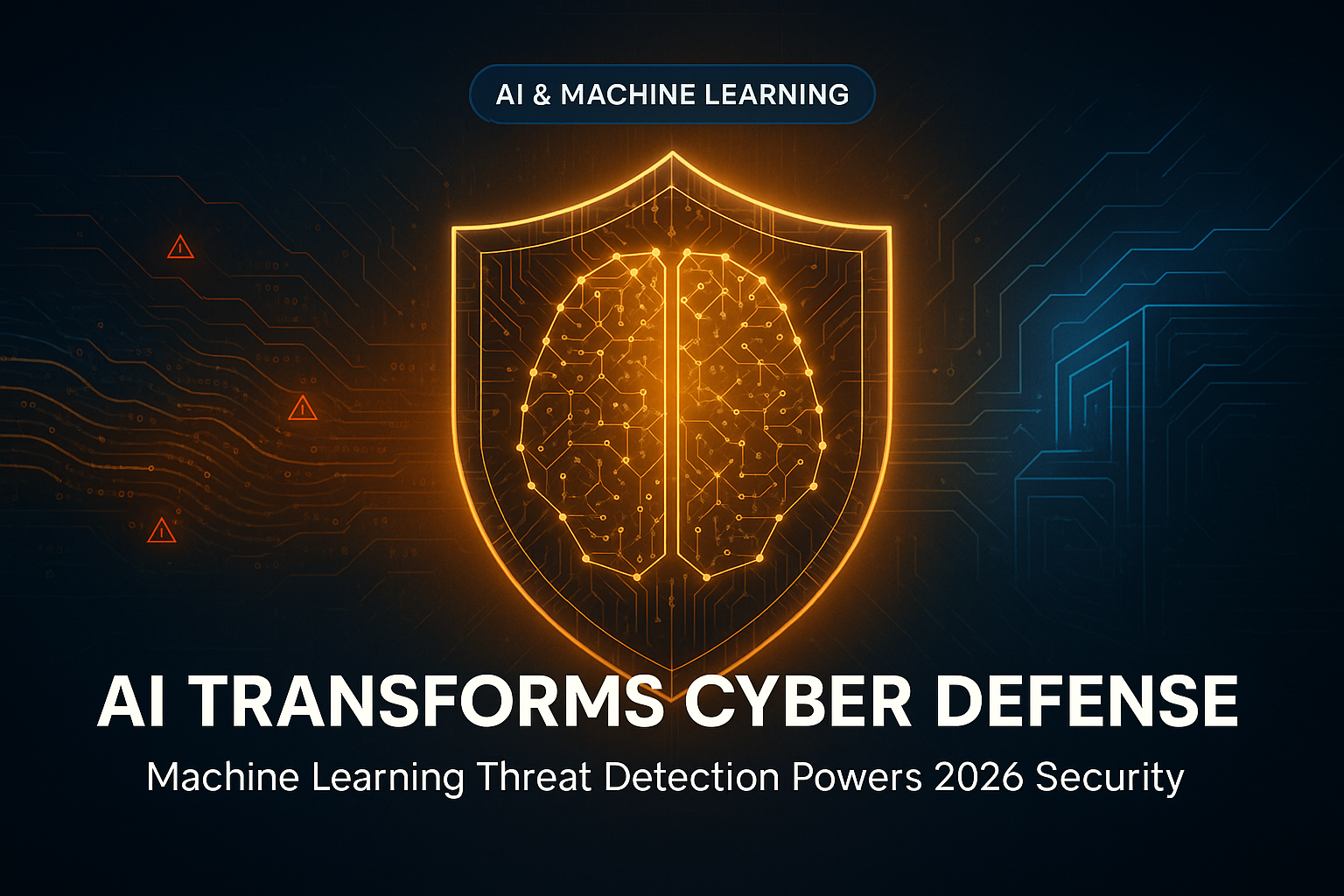
# AI-Powered Cyber Defense: How Machine Learning Transforms Threat Detection in 2026
The cybersecurity landscape is undergoing a fundamental transformation. Artificial intelligence and machine learning are no longer optional enhancements—they’ve become essential pillars of modern cyber defense, enabling organizations to detect threats faster, respond more intelligently, and stay ahead of increasingly sophisticated adversaries.
The Rise of AI-Powered Threat Detection
According to CSO Online’s analysis of emerging cybersecurity trends, AI-powered threat detection is fundamentally changing how security teams identify and respond to attacks. Machine learning algorithms now analyze vast amounts of telemetry data in real-time, identifying anomalies and suspicious patterns that human analysts might miss.
The key advantage? Speed and scale. Traditional rule-based security systems require manual updates each time a new threat emerges. Machine learning models, by contrast, continuously adapt and learn from new attack patterns, enabling organizations to detect zero-day vulnerabilities and novel attack vectors without waiting for signature updates. This represents a critical shift from reactive to proactive cyber defense.
Autonomous Response and Intelligent Automation
One of the most significant developments in 2026 is the emergence of agentic security operations centers (SOCs) powered by multi-agent AI orchestration. According to EY’s insights on next-generation security operations, autonomous AI agents can now isolate threats, contain breaches, and initiate remediation protocols without human intervention—while security teams focus on strategic decision-making.
This human-AI collaboration model is proving far more effective than either humans or machines working independently. AI handles the high-velocity detection and response tasks, while security analysts provide strategic oversight and handle complex, nuanced threats that require contextual judgment. The result? Dramatically reduced mean time to detection (MTTD) and faster incident response.
Closing the Post-Alert Gap
While detection speeds have improved significantly, The Hacker News recently highlighted a critical challenge: the “post-alert gap.” Detecting a threat quickly is only half the battle—organizations must also respond and remediate swiftly. AI-driven automation is closing this gap by automating response workflows, threat isolation, and evidence collection.
Machine learning models trained on historical incident data can now recommend optimal response strategies in milliseconds, helping security teams prioritize actions and allocate resources more effectively. This intelligence-driven approach reduces the window of vulnerability and minimizes potential damage from successful breaches.
Building Resilience Through Continuous Learning
The foundation of effective AI-powered cyber defense is continuous learning and adaptation. According to research highlighted by OpenAI on trusted access for cyber defense, the most advanced security operations are those that combine human expertise with machine intelligence in a feedback loop—where each detected threat informs the AI model, making future detection more accurate.
This creates a virtuous cycle: better detection → faster response → more data for training → even better detection. Organizations investing in this approach are seeing measurable improvements in security posture, reduced false-positive rates, and faster time-to-value from their security infrastructure.
The Path Forward: AI Security Best Practices
As AI becomes central to cyber defense, organizations must ensure they’re implementing these technologies responsibly. Maintaining strong cybersecurity fundamentals remains critical—AI amplifies the effectiveness of good security hygiene, but it doesn’t replace it. Strong access controls, regular patching, employee training, and incident response planning are still essential.
The most forward-thinking organizations are adopting a layered approach: combining AI-powered threat detection with traditional security controls, maintaining human oversight of critical decisions, and continuously validating that AI systems are performing as expected.
What This Means for Your Organization
The shift to AI-powered cyber defense isn’t a future possibility—it’s happening now in 2026. Organizations that have deployed machine learning-based threat detection and intelligent automation are seeing measurable improvements in detection speed, response time, and overall security effectiveness. Those still relying primarily on manual processes and rule-based systems are falling behind.
The investment required to modernize your security infrastructure is significant, but the cost of falling victim to a sophisticated cyber attack is far greater. As threats evolve and attack sophistication increases, AI-powered cyber defense has become a competitive necessity, not a luxury.
The question isn’t whether to adopt AI in your security operations—it’s how quickly you can implement it responsibly and effectively. Are you ready to transform your cyber defense strategy?
—
📖 **Recommended Sources:**
• **CSO Online** – “5 Trends Defining the Future of AI-Powered Cybersecurity” and “How AI is Transforming Threat Detection” – Current analysis of AI’s role in modern security operations and threat identification
• **EY** – “Agentic SOC: Multi-Agent Orchestration for Next-Gen Security Operations” – Expert insights on autonomous AI agents in security operations centers and human-AI collaboration models
• **OpenAI** – “Scaling Trusted Access for Cyber Defense” – Guidance on implementing AI responsibly in security infrastructure and maintaining human oversight
• **The Hacker News** – “Your MTTD Looks Great. Your Post-Alert Gap Doesn’t” – Real-world analysis of the critical gap between threat detection and response in modern security operations
ⓘ **This content is AI-generated based on current research through April 2026. Please verify specific claims and statistics independently with primary sources before implementation.**