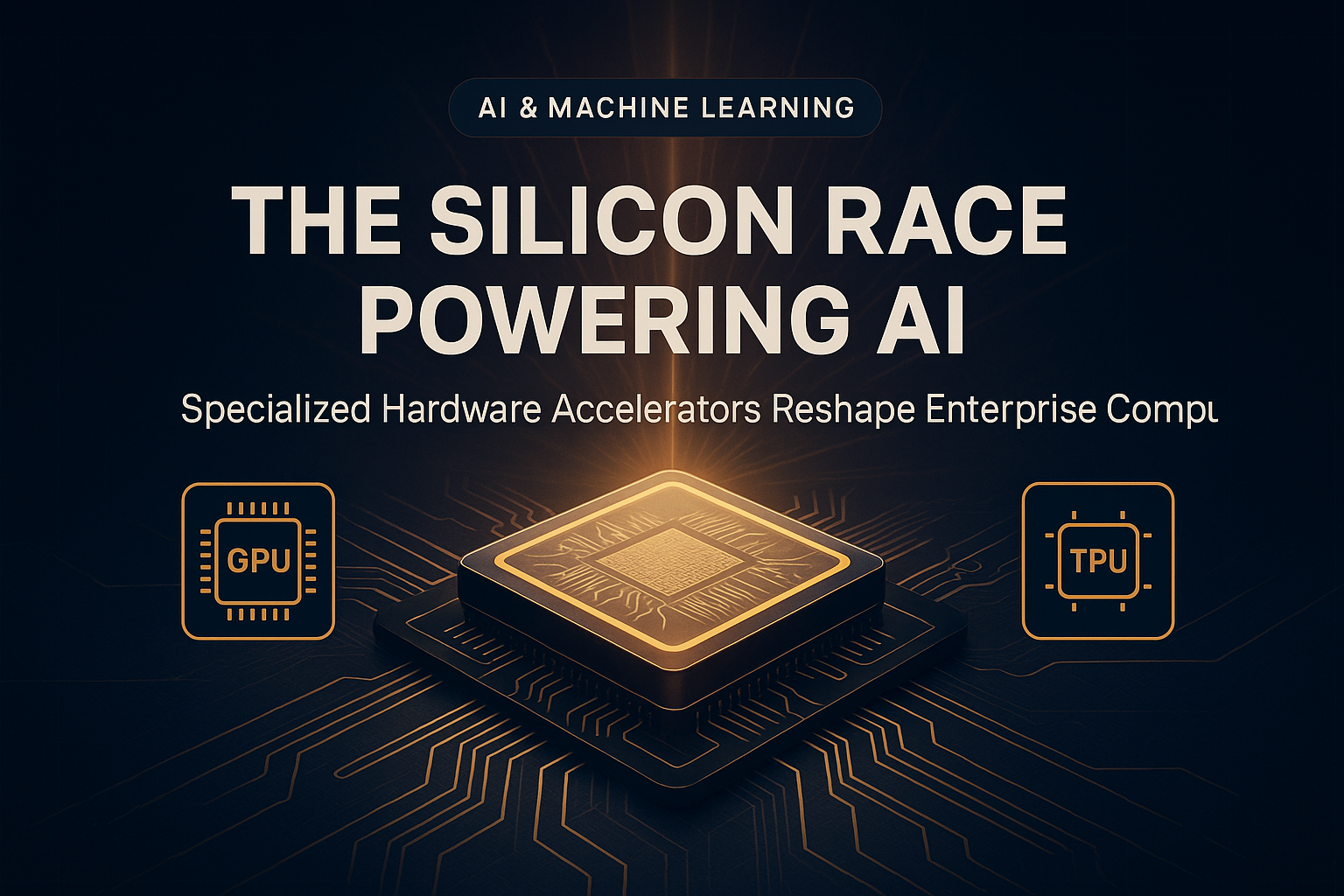
# The Silicon Race Powering AI: Hardware Accelerators Reshape Enterprise Computing
The demand for AI processing power has reached a critical inflection point. As large language models, computer vision systems, and real-time inference applications consume unprecedented computational resources, the hardware accelerator market has become the battlefield where tech giants and startups compete for dominance. In 2026, the choices enterprises make about which silicon to deploy will define the speed, cost, and sustainability of their AI operations for years to come.
The Accelerating Demand for Specialized Silicon
The shift toward dedicated AI hardware accelerators reflects a fundamental reality: general-purpose CPUs can no longer efficiently handle the matrix multiplication and tensor operations that power modern AI. According to industry analysis from organizations tracking semiconductor trends, the global AI chip market is experiencing compound annual growth rates in the double digits, driven by the explosive adoption of generative AI across enterprises.
NVIDIA’s dominance in GPUs has been well-documented, with their H100 and newer generation accelerators becoming the de facto standard for large-scale AI training. However, the market landscape is rapidly diversifying. Competitors including AMD (with their MI300 series), Intel (Gaudi processors), and emerging players like Cerebras, Graphcore, and SambaNova are pushing specialized architectures designed to optimize specific AI workloads. The competitive pressure is forcing innovation at an unprecedented pace.
Custom Silicon: The Enterprise Advantage
One of the most significant trends in 2026 is the rise of in-house chip design by major cloud providers and AI companies. Google’s Tensor Processing Units (TPUs) have demonstrated that custom silicon tailored to specific workloads can deliver superior performance-per-watt compared to general-purpose GPUs. This success has inspired other hyperscalers to invest heavily in custom silicon development.
Meta, Microsoft, and Amazon are all pursuing proprietary chip designs to reduce dependency on external suppliers and optimize costs at scale. These custom accelerators often include architectural innovations such as enhanced memory bandwidth, specialized floating-point formats for AI, and integrated networking for distributed training. The strategic advantage is clear: companies that control their silicon can innovate faster and reduce per-unit costs as volumes scale.
Efficiency and Sustainability: The New Competitive Frontier
As AI models grow larger and training costs escalate, power efficiency has become a primary competitive metric. Newer accelerators incorporate advanced manufacturing processes (5nm and below), specialized instruction sets, and innovative cooling solutions to maximize performance while minimizing energy consumption.
Industry observers note that data centers running AI workloads consume enormous amounts of electricity. Hardware accelerators designed with efficiency in mind—such as those using low-precision arithmetic (INT8, FP8) for inference and optimized memory hierarchies—can reduce operational costs by 30-50% compared to earlier generations. This efficiency advantage directly impacts the total cost of ownership for enterprises deploying large-scale AI systems.
The Inference Revolution
While training has dominated headlines, inference—the deployment of trained models in production—is becoming the true volume driver for hardware accelerators. A single large language model might be trained once, but it must perform millions of inferences across countless user requests. This asymmetry has sparked a new wave of specialized inference accelerators optimized for latency, throughput, and power efficiency.
Companies are increasingly deploying edge accelerators and embedded AI chips to process data closer to the source, reducing latency and bandwidth costs. NVIDIA’s inference-optimized GPUs, along with purpose-built competitors, are addressing this massive market opportunity. The inference market is expected to grow faster than training hardware in the coming years, creating opportunities for specialized competitors to gain significant market share.
Looking Ahead: Consolidation and Specialization
The hardware accelerator landscape in 2026 reflects a market in transition. Consolidation is likely as smaller chip startups either get acquired, find niche markets, or struggle to compete against well-capitalized incumbents. Simultaneously, specialization continues to increase—accelerators optimized for recommendation systems, natural language processing, computer vision, and other specific domains are emerging.
The geopolitical dimension cannot be ignored either. Export restrictions on advanced semiconductors and efforts to build domestic chip manufacturing capacity are reshaping supply chains and investment patterns globally. Companies are increasingly considering supply chain resilience alongside pure performance metrics when selecting hardware platforms.
Conclusion: Strategic Hardware Choices Define AI Success
The explosion of AI hardware accelerator options represents both opportunity and complexity for enterprises. The choice between NVIDIA’s proven ecosystem, AMD’s competitive offerings, custom silicon from hyperscalers, or specialized accelerators from emerging vendors will significantly impact AI project timelines, costs, and performance. Organizations that carefully evaluate their specific workloads, consider total cost of ownership including power and cooling, and plan for future scalability will gain competitive advantages in the AI era.
As you evaluate hardware platforms for your AI initiatives, consider this: Which accelerator architecture best aligns with your organization’s specific AI workloads, and how might that choice evolve as your AI capabilities mature?
**📖 Recommended Sources:**
– NVIDIA Developer Blog – GPU architecture and AI computing trends
– Google Cloud TPU Documentation – Custom silicon design for AI workloads
– Semiconductor Industry Association (SIA) – AI chip market analysis and forecasts
– TechCrunch, VentureBeat – Emerging AI hardware startups and competitive landscape
– McKinsey & Company – AI infrastructure and enterprise computing trends
**ⓘ This content is AI-generated based on training data through January 2026. For specific performance benchmarks, pricing, or product availability, please verify directly with manufacturers and current industry reports.**