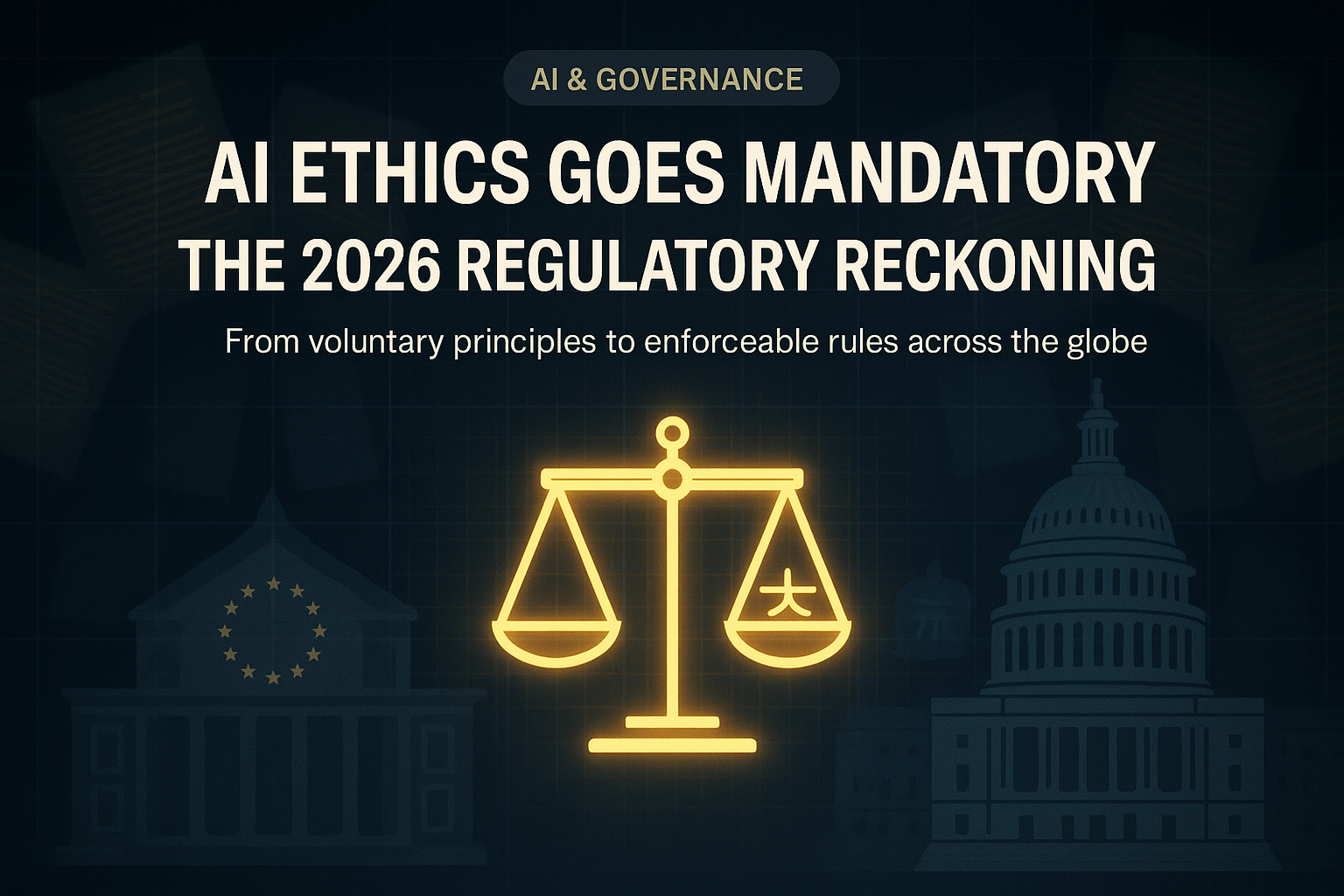
# AI Ethics Governance Goes Mandatory: How 2026’s Global Regulatory Shift Changes Everything
The era of voluntary AI ethics principles has ended. In 2026, the world’s most powerful jurisdictions have moved decisively toward enforceable regulation, transforming how companies develop, deploy, and govern artificial intelligence systems. This shift marks a fundamental turning point for the industry—one that demands immediate compliance attention from every organization building or using AI.
The EU AI Act Enforcement Milestone: August 2, 2026
The European Union’s AI Act reached a critical enforcement threshold on August 2, 2026, when transparency obligations for general-purpose AI systems became legally binding. According to industry tracking sources, providers and deployers of AI systems must now comply with Article 50 transparency requirements, which mandate clear disclosure of AI-generated content, chatbot interactions, and synthetic media.
This isn’t theoretical regulation—it carries real teeth. The EU AI Office and national market-surveillance authorities now have enforcement powers to audit compliance, investigate violations, and impose fines on non-compliant organizations. The framework also introduces risk-based obligations for high-risk AI systems, requiring companies to implement robust risk management, data governance protocols, human oversight mechanisms, and accuracy safeguards.
For global organizations, the EU regime has become the de facto global standard. Its comprehensive approach to AI governance—covering everything from algorithmic bias detection to transparency in automated decision-making—is influencing regulatory frameworks in other jurisdictions and setting expectations for corporate AI ethics programs worldwide.
China’s Dual-Track Ethics Governance Strategy
China has taken a distinctly different approach to AI governance in 2026, implementing a mandatory ethics review framework that operates before AI systems enter development. According to recent regulatory announcements, trial ethical-review measures for AI R&D projects took effect on April 3, 2026, requiring developers to conduct ethics assessments before commencing work on sensitive AI applications.
This pre-development review model reflects China’s emphasis on controllability, trustworthiness, and human welfare. The country also introduced broader voluntary ethics guidelines effective July 1, 2026, which establish safety standards and governance expectations for AI agent development and deployment. These guidelines complement mandatory requirements under China’s AI agent regulations, creating a layered governance structure that prioritizes risk prevention and human-centric design.
For international companies operating in or selling to China, understanding these dual-track requirements—mandatory pre-development review plus voluntary ethical guidelines—is essential for market access and regulatory compliance.
The U.S. Patchwork: States Lead Where Congress Stalls
Unlike the EU’s unified approach or China’s centralized framework, the United States has no comprehensive federal AI law regulating general-purpose AI as of September 2026. However, this regulatory vacuum has created a dynamic patchwork of state-level AI laws that are expanding rapidly and often conflicting.
U.S. states are moving faster than Congress on critical issues including chatbot disclosure requirements, frontier-model safety standards, and algorithmic pricing transparency. This fragmented landscape creates compliance challenges for national and multinational companies, as meeting requirements in one state may conflict with rules in another.
The one exception at the federal level is narrowly focused: legislation now covers non-consensual intimate imagery, including AI-generated deepfakes, addressing one specific harm category. But this leaves vast areas of AI governance—from hiring algorithms to content moderation systems—subject to an evolving mosaic of state regulations, each with different standards, timelines, and enforcement mechanisms.
Compliance Reality: The 2026 Landscape
Organizations operating globally in 2026 face a complex compliance matrix. Companies must navigate:
- EU transparency and risk-based obligations with significant fines for non-compliance
- China’s mandatory pre-development ethics reviews before launching AI projects
- Fragmented U.S. state requirements that vary by jurisdiction and industry
- Emerging standards from other regions adopting EU-inspired frameworks
This regulatory convergence is accelerating the shift from ethics as a marketing narrative to ethics as a business-critical compliance function. Leading organizations are establishing dedicated AI governance teams, implementing ethics review processes, maintaining detailed audit trails, and building transparency mechanisms into their AI systems from the ground up.
Looking Forward: The Era of Regulatory Consolidation
As we move deeper into 2026, expect further regulatory tightening. The EU model is influencing policy discussions in the UK, Canada, and other jurisdictions. China’s ethics frameworks will likely expand beyond AI agents to cover broader AI applications. And in the U.S., the pressure for federal preemption legislation will intensify as state-level fragmentation becomes increasingly burdensome for industry.
The competitive advantage in this environment belongs to companies that move fastest toward genuine AI ethics governance—not as compliance theater, but as embedded operational practice. Those that treat 2026’s regulatory shift as an opportunity to build trustworthy AI systems will emerge stronger than competitors scrambling to retrofit compliance into existing systems.
How is your organization adapting to 2026’s AI governance landscape? Are you prepared for multi-jurisdictional compliance, or is fragmented regulation still on your risk radar?
—
### 📖 Recommended Sources:
• **Perplexity AI Research** – Real-time analysis of global AI governance developments, including EU AI Act enforcement dates, China’s ethics review frameworks, and U.S. state-level regulatory trends as of September 2026
• **Tech Times & Industry Tracking** – Coverage of China’s mandatory pre-development AI ethics review (April 3, 2026) and July 1, 2026 voluntary ethics guidelines
• **EU AI Office & Regulatory Documentation** – Official enforcement details on Article 50 transparency obligations, risk-based classification, and compliance mechanisms effective August 2, 2026
• **U.S. AI Policy Analysis** – Documentation of state-level AI laws, federal legislative gaps, and patchwork compliance challenges in 2026
────────────────────
**ⓘ This content is AI-generated based on research data current through September 2, 2026. Please verify specific regulatory requirements with official government sources and legal counsel before implementing compliance programs.**