# AI-Driven Orchestration: How Software Development Practices Are Transforming in 2026
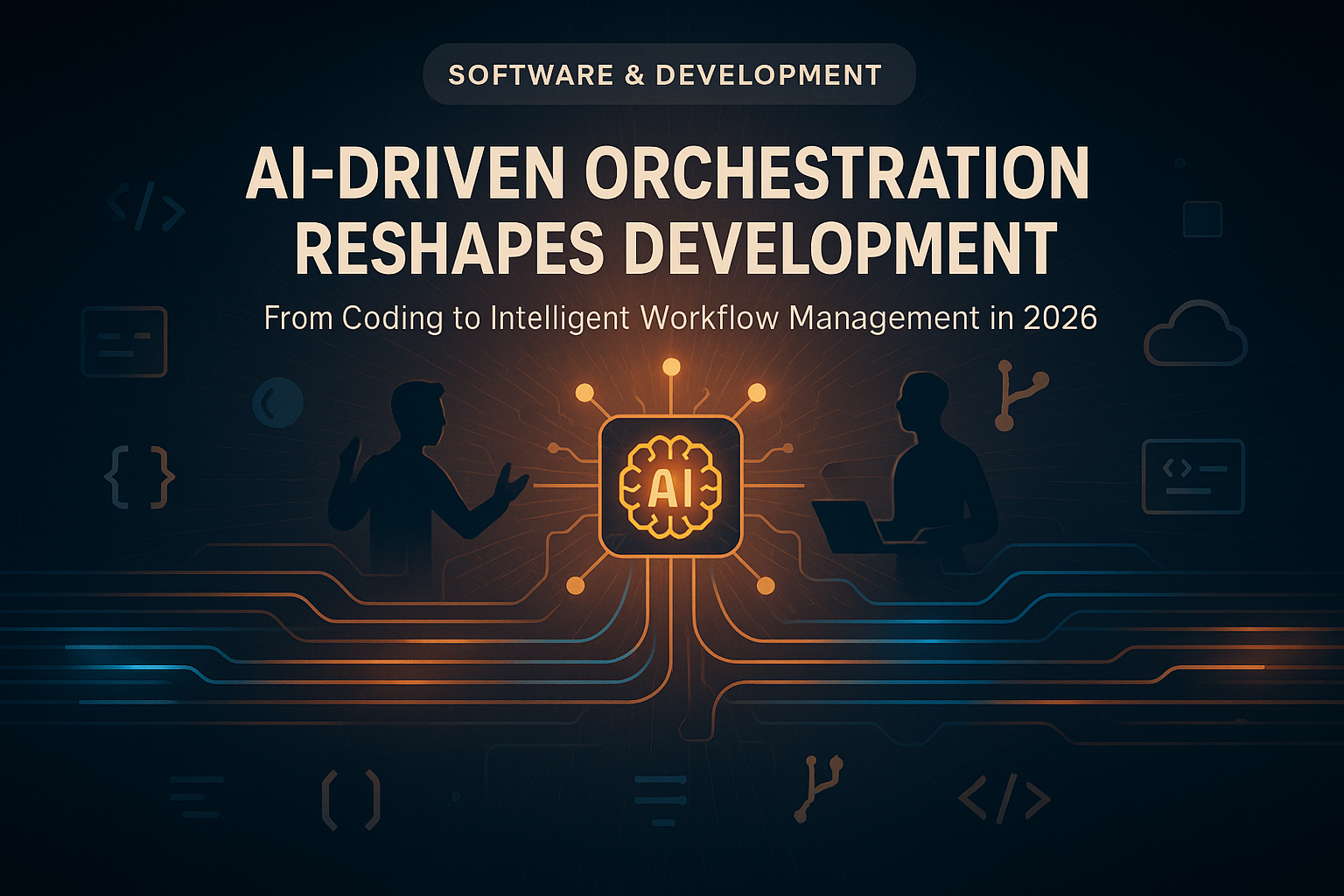
The software development landscape is undergoing a seismic shift. As we move deeper into 2026, the role of developers is fundamentally changing from hands-on code writers to intelligent orchestrators managing AI agents, cloud infrastructure, and complex deployment pipelines. This transformation isn’t just a trend—it’s reshaping how organizations build, secure, and deploy software at scale.
The Rise of Agentic AI in Development Workflows
Agentic AI is no longer an experimental concept—it’s becoming the operational backbone of modern development teams. According to industry analysis, 2026 marks the year when systemic effects of agentic AI adoption begin reshaping entire development workflows, not just individual coding tasks.
The primary human role in software development is increasingly becoming one of orchestration. Developers now focus on defining problems, evaluating AI-generated code output, providing strategic direction, and ensuring quality standards. AI agents handle the heavy lifting: writing code, running tests, suggesting optimizations, and even identifying security vulnerabilities before they reach production.
This shift has profound implications. Teams that previously needed 10 developers to ship features in two weeks can now accomplish similar work with fewer hands on keyboards and more minds on architecture, strategy, and quality assurance. The acceleration is real—and it’s forcing organizations to rethink hiring, training, and team structure entirely.
DevSecOps: Security as a First-Class Citizen
Security is no longer an afterthought bolted onto the deployment pipeline. DevSecOps has evolved from a buzzword into a fundamental practice, with application security now operating as a constant workflow that starts the moment code is written and remains active through production.
In 2026, organizations are embedding security checks at every stage:
- Code scanning at commit time using AI-powered analysis
- Dependency vulnerability detection integrated into CI/CD pipelines
- Runtime security monitoring with automated threat response
- Compliance automation ensuring regulatory requirements are met continuously
The traditional model of security teams conducting post-deployment audits is becoming obsolete. Instead, security is woven into the developer experience itself, with tools that guide developers toward secure coding practices without slowing down delivery. This shift reduces the attack surface while maintaining development velocity—a critical competitive advantage in 2026’s fast-moving landscape.
Cloud-Native and Infrastructure as Code Dominance
The cloud-native paradigm continues to mature, with Kubernetes, GitOps, and Infrastructure as Code (IaC) tools like Terraform becoming standard practice rather than advanced techniques. These technologies enable organizations to manage complex, distributed systems with declarative configuration rather than manual infrastructure management.
GitOps—where Git repositories become the single source of truth for infrastructure and application state—is reshaping how teams deploy and manage systems. This approach provides:
- Version control for all infrastructure changes
- Automated rollbacks if deployments fail
- Audit trails for compliance and troubleshooting
- Reduced manual intervention, lowering error rates
Serverless computing is also gaining traction, allowing teams to focus on business logic rather than server management. Combined with AIOps (AI-powered operations), these practices enable organizations to achieve remarkable scalability and reliability with smaller operations teams.
Low-Code and Rapid Development Acceleration
While AI agents handle complex coding tasks, low-code platforms are democratizing application development for less specialized teams. These platforms allow business analysts, citizen developers, and traditional developers to collaborate more effectively, reducing time-to-market for internal tools and standard applications.
The convergence of agentic AI and low-code platforms creates a powerful multiplier effect: AI agents can generate low-code configurations, teams can rapidly assemble business logic, and human developers focus on high-value architectural decisions. This layered approach to development is becoming the norm in forward-thinking organizations.
The Human Element: Orchestration Over Execution
Perhaps the most significant shift in 2026 is philosophical. Developers are becoming orchestrators rather than executors. This requires a different skill set:
- Problem decomposition: Breaking complex requirements into components AI agents can tackle
- Quality evaluation: Assessing AI-generated solutions for correctness, performance, and security
- Architecture thinking: Designing systems that leverage AI capabilities effectively
- Cross-functional collaboration: Working closely with product, security, and operations teams
Organizations that recognize this shift and invest in reskilling their teams will have a competitive advantage. Those clinging to traditional “code everything yourself” models risk falling behind in velocity and innovation.
Looking Ahead: The Convergence of Trends
The software development practices emerging in 2026 represent a convergence of multiple technological advances: agentic AI maturity, cloud-native infrastructure standardization, automated security integration, and low-code democratization. These forces are creating an environment where organizations can deliver more software, faster, with fewer defects and security vulnerabilities.
However, this transformation also brings challenges. Teams need new hiring criteria, different training programs, and updated quality assurance processes. Organizations that navigate these changes thoughtfully—investing in their people while embracing new tools and practices—will thrive in this new era.
The Question Every Development Leader Should Ask
As your organization plans for the rest of 2026, consider this: Are your development practices and team structures optimized for an AI-augmented, orchestration-focused workflow? Or are you still operating under assumptions from the pre-agentic-AI era?
The answer will likely determine your competitive position not just this year, but for years to come. The time to experiment, learn, and adapt is now.
—
**📖 Recommended Sources:**
• **Industry 2026 Outlook Reports** – Analysis of financial pressures, agentic AI adoption, and competitive transformation in software development
• **DevOps Trends 2026** – Comprehensive coverage of Kubernetes, GitOps, DevSecOps, AIOps, serverless computing, and infrastructure automation practices
• **Agentic AI in Development** – Research on how AI agents are reshaping coding workflows, code evaluation, and developer roles from execution to orchestration
ⓘ This content is AI-generated based on research conducted through March 2, 2026. Specific claims and trend data reflect current industry analysis and should be verified independently for mission-critical decisions.