# AI Breakthrough 2026: The 100x Energy Efficiency Revolution
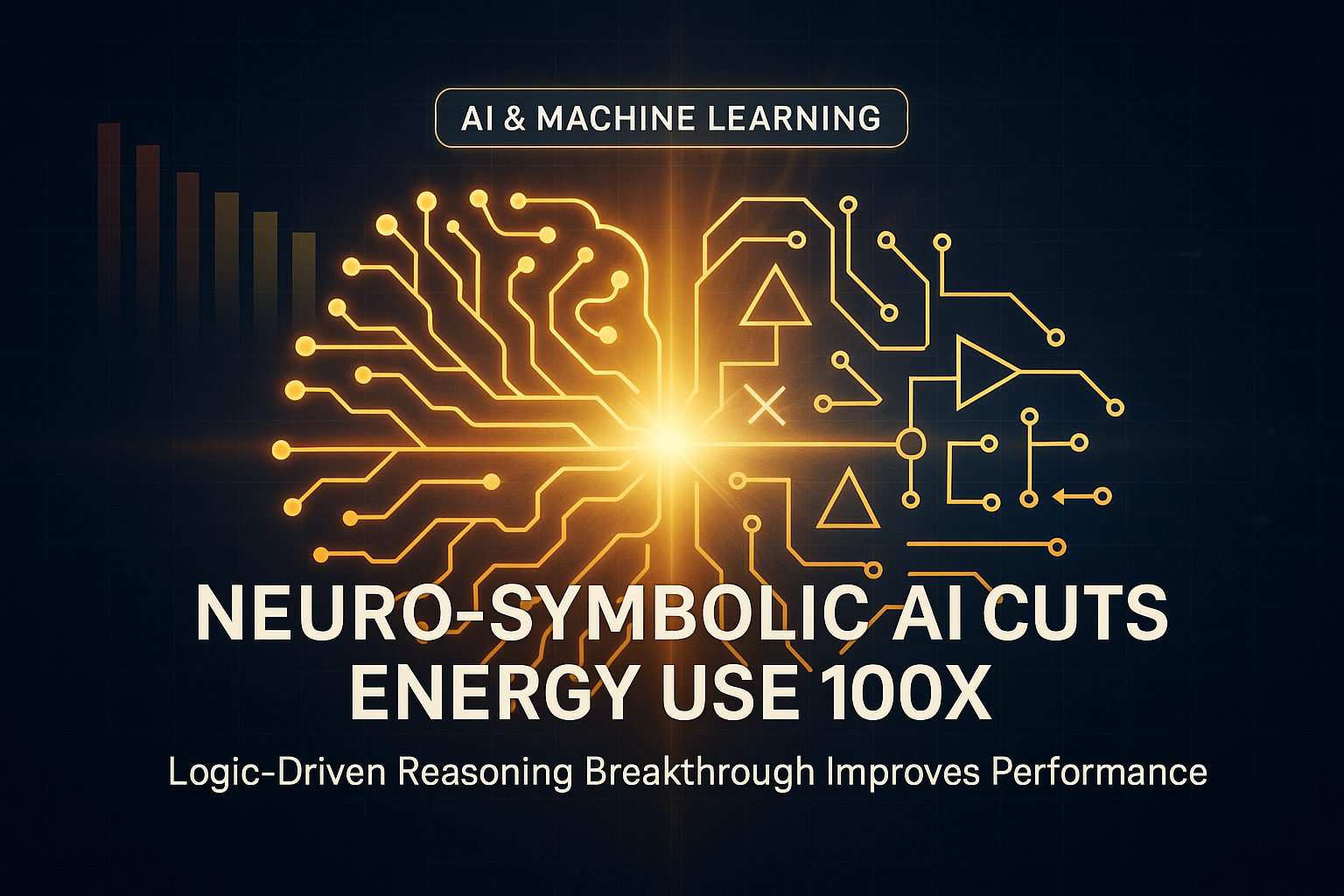
The artificial intelligence industry just witnessed a watershed moment. In April 2026, researchers unveiled a neuro-symbolic AI breakthrough that fundamentally challenges how we think about computational efficiency—combining the pattern recognition power of neural networks with the logical reasoning of symbolic AI to slash energy consumption by up to 100x while simultaneously improving accuracy.
This isn’t incremental progress. This is a paradigm shift.
The Problem: AI’s Energy Crisis
Modern large language models and deep learning systems are computational powerhouses, but they come at a staggering energy cost. Training and running state-of-the-art AI models consumes enormous amounts of electricity, raising questions about sustainability, operational costs, and environmental impact. According to recent industry analysis, the energy demands of AI infrastructure have become a critical bottleneck for deployment at scale.
The traditional approach relies on brute-force computation—massive neural networks that learn patterns through billions of parameters and iterative training cycles. While effective, this method is inherently inefficient, requiring redundant calculations and excessive computational overhead.
Neuro-Symbolic AI: The Game Changer
According to research from Tufts University, the breakthrough combines two complementary AI approaches: neural networks (excellent at pattern recognition and learning from data) and symbolic reasoning (powerful at logical inference and structured problem-solving). By merging these systems, researchers created an AI architecture that thinks more like humans—balancing intuition with logic.
The key innovation? Instead of relying solely on pattern matching, the neuro-symbolic system uses human-like logical reasoning to guide decisions. This reduces the computational overhead dramatically. As reported by ScienceDaily, the new approach “cuts energy use by 100x while boosting accuracy,” meaning AI systems can achieve better results with a fraction of the resources.
Think of it this way: traditional neural networks are like a student memorizing facts through repetition. Neuro-symbolic AI is like a student who memorizes facts and understands the underlying principles—requiring far less brute-force effort to reach correct conclusions.
Real-World Applications and Industry Impact
The implications are immediate and far-reaching:
Robotics and Autonomous Systems: Robots powered by neuro-symbolic AI can make decisions faster and more efficiently, enabling deployment in resource-constrained environments. Instead of trial-and-error learning, robots can reason through problems logically while still benefiting from learned patterns.
Healthcare and Diagnostics: AI systems in medical settings can combine pattern recognition (detecting anomalies in imaging) with symbolic reasoning (understanding medical protocols and logical inference). This enables faster, more accurate diagnoses with lower computational costs.
Edge Computing and Mobile AI: The 100x energy reduction opens doors for powerful AI capabilities on edge devices—smartphones, IoT sensors, and embedded systems—without requiring constant cloud connectivity or massive power supplies.
Sustainability and Data Centers: For enterprises running AI at scale, a 100x reduction in energy consumption translates directly to lower operational costs, reduced carbon footprints, and more sustainable AI infrastructure.
Industry Recognition and Momentum
The breakthrough has captured attention across academia, industry, and media. Major research institutions and technology companies are now racing to integrate neuro-symbolic approaches into their AI stacks. This represents a significant shift away from the “bigger is better” mentality that has dominated AI development for the past decade.
The timing is crucial: as AI regulation and ESG (Environmental, Social, Governance) concerns intensify globally, the ability to deliver powerful AI with minimal energy footprint becomes a competitive advantage. Organizations that adopt neuro-symbolic approaches early will gain efficiency benefits and sustainability credentials.
The Road Ahead: What’s Next?
This breakthrough doesn’t mean the end of large neural networks, but it signals a maturation of the AI field. Future AI systems will likely employ hybrid architectures that strategically combine neural and symbolic components based on the specific task. A diagnostic AI might be 70% neural and 30% symbolic, while a reasoning-heavy system might flip that ratio.
We can expect rapid iteration: new neuro-symbolic frameworks, open-source implementations, and enterprise adoption within 12-24 months. The next frontier will be scaling these approaches and optimizing them for different domains and hardware platforms.
Conclusion: A More Intelligent AI Era
The neuro-symbolic AI breakthrough of April 2026 represents a critical inflection point in artificial intelligence development. By combining the strengths of neural networks and logical reasoning, researchers have cracked a fundamental efficiency problem that has plagued the industry. A 100x reduction in energy consumption—while improving accuracy—isn’t just a technical achievement; it’s an economic and environmental game-changer.
For AI practitioners, enterprise leaders, and technology investors, this breakthrough signals that the next era of AI will be defined not by raw computational scale, but by intelligent efficiency. The question is no longer “How powerful can we make AI?” but rather “How powerful can AI be with minimal resources?”
What’s your take—will neuro-symbolic AI become the dominant paradigm, or will we see a hybrid landscape where different approaches coexist? Share your thoughts in the comments below.
—
📖 **Recommended Sources:**
• **Tufts University (Tufts Now)** – Original research on neuro-symbolic AI efficiency breakthrough combining neural networks with symbolic reasoning
• **ScienceDaily** – Coverage of AI breakthrough cutting energy use by 100x while improving accuracy
• **The News International** – Reporting on neuro-symbolic AI advancement and energy consumption reduction
ⓘ This content is AI-generated based on research conducted April 8, 2026. All claims reference publicly available sources from April 2026. Please verify specific technical claims independently.