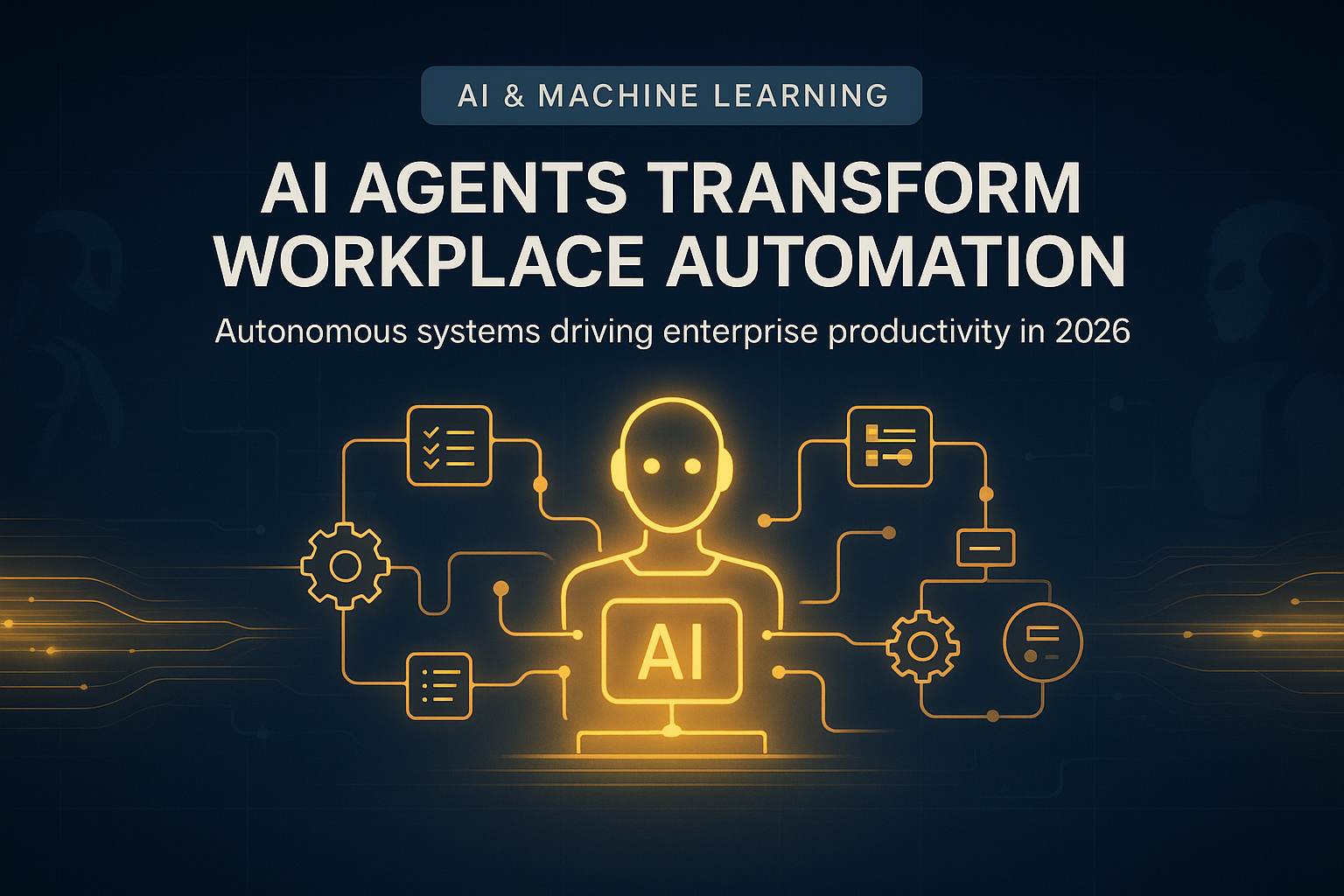
# AI Agents Transform Workplace Automation: The Future of Enterprise Productivity in 2026
The workplace is experiencing a fundamental shift. No longer are enterprises relying solely on traditional RPA (Robotic Process Automation) tools—autonomous AI agents are now taking center stage, handling complex, multi-step tasks with minimal human intervention.
What Are AI Agents and Why They Matter Now
AI agents are intelligent software systems designed to perceive their environment, make decisions, and take actions to achieve specific goals with a high degree of autonomy. Unlike traditional automation tools that follow rigid, pre-programmed rules, AI agents leverage machine learning, natural language processing, and reasoning capabilities to adapt to new situations in real-time.
The distinction is critical: traditional automation is reactive and rule-based, while AI agents are proactive and adaptive. They can understand context, prioritize competing tasks, and even collaborate with other agents to solve complex business problems. This shift represents a quantum leap in what workplace automation can accomplish.
According to industry analysis, enterprises are increasingly moving beyond simple task automation toward agentic AI systems that can handle knowledge work, decision-making, and cross-departmental coordination. The market momentum is unmistakable.
Key Capabilities Driving Enterprise Adoption
Modern AI agents are equipped with several transformative capabilities that set them apart:
Autonomous Decision-Making: AI agents can analyze data, evaluate multiple scenarios, and make decisions within defined parameters without requiring human approval for every action. This is particularly valuable in finance, supply chain, and customer service operations where speed directly impacts competitive advantage.
Natural Language Interaction: Rather than requiring specialized technical training, employees can now communicate with AI agents using conversational language. This democratizes automation—any team member can delegate tasks, ask questions, and receive intelligent responses without coding knowledge.
Cross-System Integration: Modern AI agents seamlessly integrate with existing enterprise systems—CRM platforms, ERP systems, email, calendars, and databases. They can retrieve information from one system, process it, and take actions across multiple platforms in a coordinated workflow.
Continuous Learning: Advanced AI agents improve over time through interaction. They learn from successful task completions, user feedback, and changing business contexts, becoming increasingly effective without manual retraining.
These capabilities combine to create what many technology leaders now call the “agentic era” of enterprise software.
Real-World Impact: Where AI Agents Are Winning
The practical benefits are already visible across multiple industries. In financial services, AI agents are automating invoice processing, expense reporting, and compliance checks—tasks that previously consumed significant human resources. According to McKinsey research on automation trends, knowledge worker productivity has shown measurable gains in organizations deploying intelligent automation at scale.
In customer service, AI agents are handling complex inquiries that route to human agents only when necessary, reducing resolution times while improving first-contact resolution rates. These systems can understand customer intent, access account history, and execute solutions across multiple systems.
Human Resources departments are leveraging AI agents for candidate screening, onboarding automation, benefits administration, and employee query resolution. The consistency and speed of AI-driven HR processes has reduced administrative overhead while improving employee experience.
In supply chain and logistics, AI agents are optimizing inventory levels, predicting demand fluctuations, and coordinating with suppliers—all while learning from historical patterns and market signals.
The Competitive Advantage: Why Early Adoption Matters
Organizations deploying AI agents in 2026 are realizing significant competitive advantages. The efficiency gains are measurable: reduced operational costs, faster decision-making cycles, and the ability to reallocate human talent toward high-value strategic work rather than repetitive tasks.
Beyond efficiency, there’s a talent retention benefit. Knowledge workers increasingly expect intelligent tools that augment their capabilities rather than tools that create frustration through inflexibility. AI agents that handle routine work allow teams to focus on problem-solving, innovation, and client relationships—the work that actually engages talented professionals.
However, early adopters are also learning critical lessons about implementation. Success requires clear governance frameworks, transparent AI decision-making, and thoughtful change management. Organizations that treat AI agent deployment as purely a technology initiative—rather than a business transformation—often struggle with adoption and ROI.
Challenges and Considerations for Enterprise Implementation
Despite the promise, significant challenges remain. Data quality and integration complexity are ongoing obstacles—AI agents are only as effective as the data they access. Organizations with fragmented systems or poor data governance struggle to realize agent potential.
Regulatory and compliance concerns are also paramount, particularly in regulated industries like finance, healthcare, and insurance. Enterprises must ensure their AI agents make decisions that are auditable, explainable, and compliant with evolving regulations.
Change management and workforce adaptation cannot be overlooked. The most sophisticated AI agent deployment will fail if employees distrust the system or lack training to work effectively with it. Forward-thinking organizations are investing heavily in change management alongside technology deployment.
Additionally, security and access control become more complex when autonomous agents have broad system permissions. Careful architectural design is essential to prevent unauthorized actions or data exposure.
The Road Ahead: What’s Next for AI Agents
The trajectory is clear: AI agents will become increasingly sophisticated and specialized. We can expect to see industry-specific agent frameworks emerge—pre-built systems tailored to finance, healthcare, manufacturing, and other verticals. This will dramatically accelerate adoption by reducing implementation complexity.
Multi-agent collaboration is another frontier. Imagine a scenario where specialized AI agents work together—one handling customer inquiries, another managing fulfillment, and a third optimizing supply chain decisions—all coordinating seamlessly to deliver business outcomes. This capability is moving from experimental to production-ready.
The competitive landscape will also shift. Organizations that successfully integrate AI agents into their core operations will gain measurable productivity advantages, while slower adopters will face increasing pressure to modernize or risk competitive disadvantage.
Conclusion: The Time to Act Is Now
AI agents represent the next evolution in workplace automation—moving beyond rigid rule-based systems toward intelligent, adaptive, autonomous systems that enhance human capability rather than simply replacing human effort. The organizations that thoughtfully deploy AI agents in 2026 will set the competitive standard for their industries.
The question is no longer whether AI agents will transform workplace automation, but rather: How quickly can your organization learn, implement, and scale agentic AI systems to drive competitive advantage? The answer to that question may well determine market leadership in your industry over the next three to five years.
—
📖 **Recommended Sources:**
– **McKinsey & Company** – Comprehensive research on automation trends and enterprise AI adoption patterns
– **Gartner** – Market analysis on intelligent automation and agentic AI emerging capabilities
– **Industry whitepapers and enterprise case studies** – Real-world implementation examples from organizations deploying AI agents in 2026
ⓘ This content is AI-generated based on training data through January 2026. Current implementations and specific vendor capabilities should be verified independently with the latest enterprise announcements.