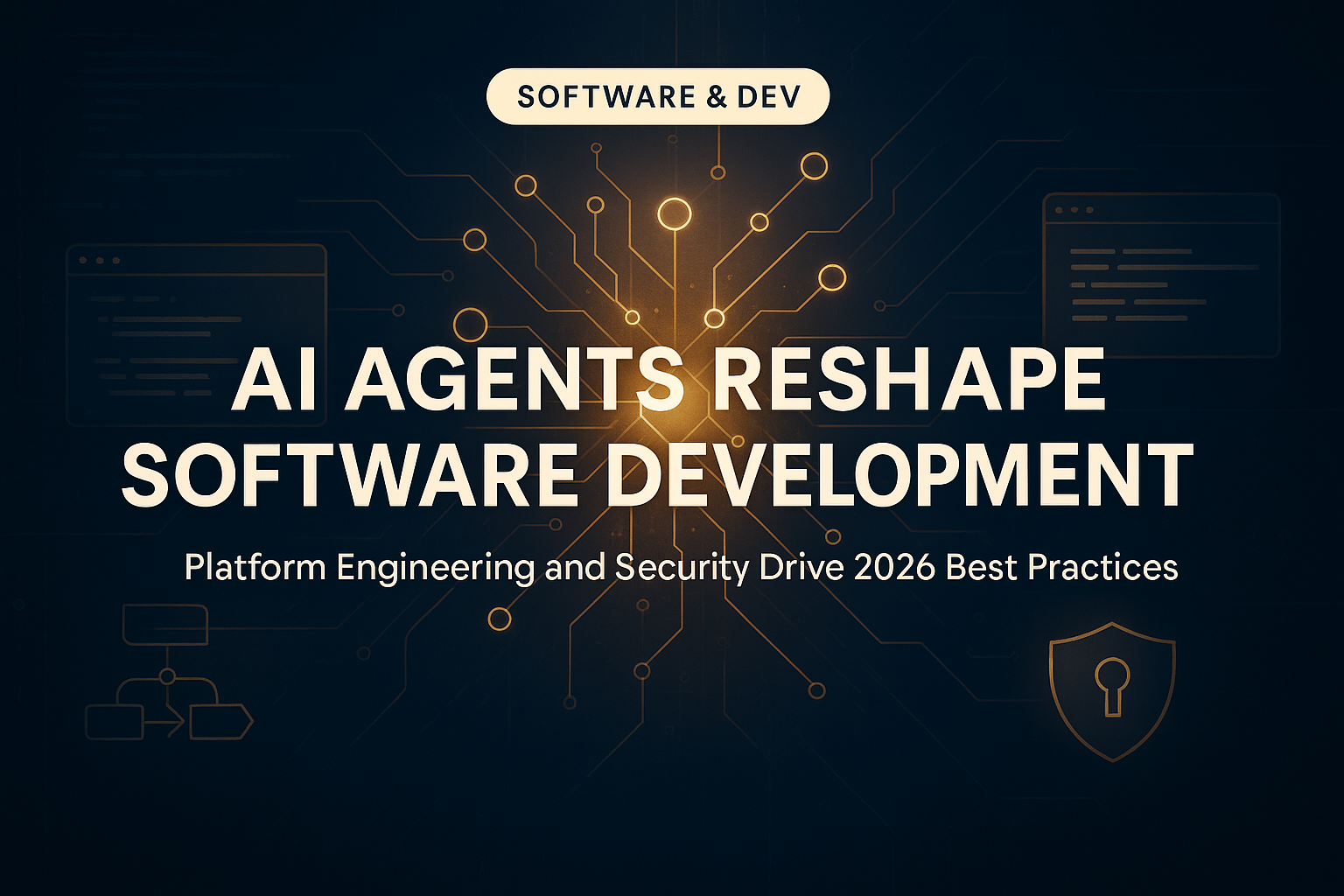
AI Agents and Platform Engineering Redefine Software Development Practices in 2026
The software development landscape is undergoing a fundamental transformation. AI agents are graduating from experimental tools to first-class platform citizens, fundamentally changing how teams build, deploy, and maintain applications. In 2026, the most forward-thinking organizations are reimagining their development practices around three pillars: intelligent automation, platform engineering, and proactive security.
AI Agents as Core Development Infrastructure
Gone are the days when AI was a nice-to-have feature bolted onto development workflows. By 2026, mature platforms treat AI agents like any other infrastructure component — with proper monitoring, versioning, and governance built in from day one.
These agents are handling increasingly complex tasks: automated code reviews, intelligent test generation, dependency management, and even architectural decision-making. Rather than replacing developers, they’re amplifying human capabilities by handling repetitive cognitive work and flagging issues before they become expensive problems.
The shift represents a maturity milestone. Teams that previously experimented with ChatGPT integrations are now deploying specialized agents trained on their codebase and architectural patterns. This allows for context-aware suggestions, faster onboarding for junior developers, and more consistent code quality across distributed teams.
Platform Engineering: The New Competitive Advantage
Platform engineering has evolved from infrastructure automation to a strategic business practice. In 2026, leading organizations operate internal developer platforms (IDPs) that abstract complexity while maintaining control and visibility.
These platforms serve as the connective tissue between developers, operations, and security teams. They standardize deployment processes, enforce policy compliance automatically, and provide self-service capabilities that reduce friction. A developer can spin up a new service, configure monitoring, and establish security baselines without context-switching between multiple tools.
The business impact is significant: faster time-to-market, reduced operational overhead, and fewer security incidents. Companies like Spotify, Netflix, and Amazon have long recognized that platform engineering is a competitive moat — in 2026, this is becoming table stakes for enterprises serious about velocity and reliability.
Software Supply-Chain Security Takes Center Stage
The emphasis in 2026 is expanding beyond traditional application security to comprehensive software supply-chain protection. This means securing not just your code, but every dependency, library, container image, and third-party component that flows into production.
The threat landscape has evolved. Nation-state actors and sophisticated threat groups now target the supply chain deliberately — compromising popular open-source packages, injecting malicious code into build pipelines, and exploiting trust relationships between organizations. In response, leading teams are implementing:
- Software Bill of Materials (SBOM) tracking for complete visibility into dependencies
- Cryptographic signing of artifacts throughout the build and deployment pipeline
- Zero-trust verification of all code contributions and external integrations
- Automated vulnerability scanning integrated into continuous integration workflows
This isn’t optional anymore. Regulatory frameworks like the EU Cyber Resilience Act and executive orders on software security are making supply-chain protection a compliance requirement. Organizations that treat it as a checkbox exercise will find themselves at a disadvantage compared to those building security into their development culture.
The Convergence: DevOps, Agile, and Continuous Everything
Modern teams in 2026 operate with a blend of proven methodologies. Agile and Scrum provide the organizational framework, while DevOps and continuous integration/deployment (CI/CD) enable rapid, safe delivery. The key difference from previous years is the integration of AI agents and platform engineering into these workflows.
A typical development cycle now looks like this: a developer writes code, AI agents perform automated analysis and testing, platform engineering tools manage deployment to multiple environments with policy enforcement, and security scanning runs continuously throughout. The feedback loop is tighter, the safety net is stronger, and the entire process is more observable.
Teams that resist this convergence find themselves struggling with velocity and reliability. Those that embrace it — and invest in the tooling and culture to support it — are shipping features faster while maintaining higher quality and security standards.
The Human Element: Culture and Continuous Learning
Technology alone doesn’t drive these changes. Teams that succeed in 2026 prioritize continuous learning and psychological safety. Developers need time and resources to understand new tools, experiment with AI agents, and contribute to platform engineering improvements.
The best organizations are treating software development as a craft that evolves continuously. They’re investing in training, creating communities of practice around platform engineering, and fostering a culture where security is everyone’s responsibility — not just the security team’s.
Looking Ahead: What’s Next
As we move through 2026 and beyond, expect further convergence between development tools and AI capabilities. Intelligent development environments that understand your entire codebase, project context, and organizational standards will become standard. Platform engineering will become increasingly sophisticated, handling not just deployment but cost optimization, performance tuning, and resource allocation.
The organizations that thrive will be those that view software development practices not as a checklist of tools, but as a living system that evolves with technology and business needs.
How is your organization adapting to these shifts in software development practices? Are you investing in AI agents and platform engineering, or does your team still operate with more traditional approaches? The choices you make now will significantly impact your competitive position in the coming years.
📖 **Recommended Sources:**
– **SerpAPI Research Data** – Current software development trends and methodologies for 2026
– **Platform Engineering Community** – Insights on IDP adoption and best practices
– **Software Supply Chain Security** – CISA, NIST, and EU Cyber Resilience Act guidance on securing dependencies
ⓘ This content is AI-generated based on research data through June 2026. Please verify specific claims and regulatory requirements independently with official sources.