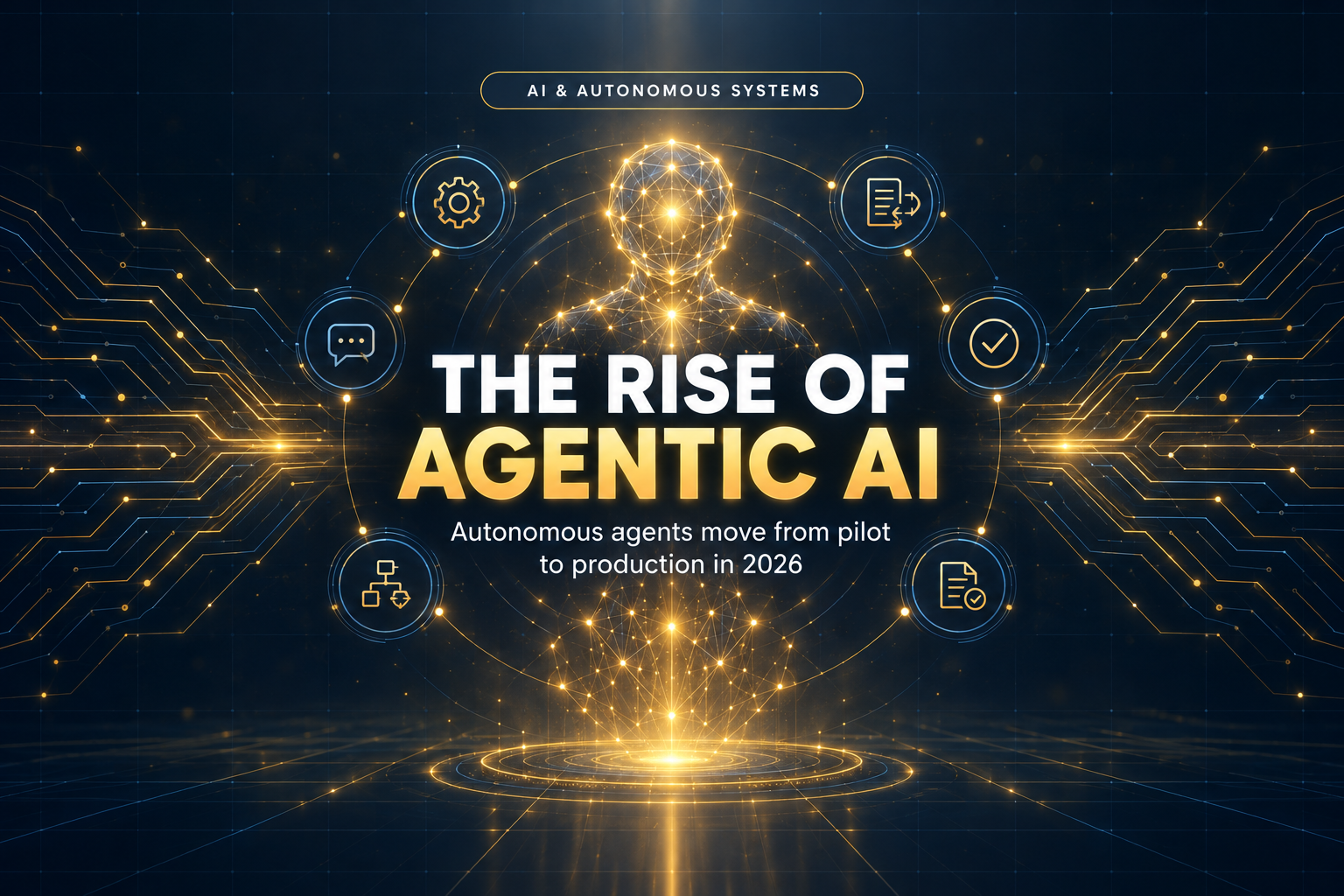
The era of AI that merely answers questions is over. In 2026, software has learned to act — planning, executing, and completing multi-step work across enterprise systems with minimal human intervention, and the numbers behind this shift are staggering.
Agentic AI has rapidly become the defining enterprise technology story of the year. According to McKinsey’s 2026 State of AI survey, 40% of large organizations with revenues over $1 billion are now actively scaling AI agents, up sharply from just 27% a year earlier. Gartner had forecast that roughly 40% of enterprise applications would carry task-specific agents by the end of 2026, up from under 5% in 2025 — a prediction that industry trackers now say is tracking closely to reality. What started as isolated chatbot experiments has evolved into what Wipro and Infosys are calling the “Internet of Agents” — a connected ecosystem where autonomous software discovers information, negotiates, and executes tasks across organizational boundaries.
From Pilots to Production: The Scale of Adoption
The adoption curve in 2026 has been dramatic, if uneven. According to Deloitte, 74% of organizations plan to adopt agentic AI within two years, while PwC reports that 79% of senior executives say their companies have already adopted AI agents in some form, with 88% planning to increase agentic AI spending over the next 12 months.
Real-world deployment numbers back up the enthusiasm. At Baidu World 2026, the company revealed that its internal daily active AI agents surged 640% — from 5,000 to 37,000 — over just twelve months, while weekly tasks completed by those agents jumped from 84,000 to more than one million. Microsoft reported that active agents within its Microsoft 365 ecosystem increased 15-fold year-over-year, rising 18-fold among large enterprises, according to the company’s 2026 Work Trend Index. Meanwhile, OpenAI’s agentic coding tool Codex went from under 10% of the average worker’s AI output in August 2025 to nearly 100% by mid-2026, with its influence expanding beyond engineering into legal and recruiting functions.
Yet there’s an important caveat. Separate surveys cited by TechRepublic found that fewer than one in ten companies are actually running agents in production at scale, despite near-universal executive interest. The gap between stated intent and operational reality remains one of the defining tensions of this moment.
What Makes 2026 Different: Orchestration and the Agent Economy
Unlike earlier generations of task-specific bots, today’s agentic systems are built for orchestration — specialized agents collaborating across models, data sources, and enterprise systems to complete entire workflows rather than single tasks. Google made its Gemini agent generally available as what it calls a “universal agent for work,” capable of routing jobs to the best-fit underlying model. Microsoft shipped Agent 365 in May 2026 to embed agents directly into business operations, while Salesforce and Workday are extending their platforms to support agent-powered CRM and workforce management.
This shift is also reshaping consumer-facing commerce. OpenAI expanded its Agents API for computer use and introduced ChatGPT Wallet, partnering with American Express, Mastercard, and Visa to let agents complete purchases on behalf of users with biometric security. Not every company is embracing this trend equally — United Airlines announced in November that it would block unauthorized third-party AI agents from booking or changing flights on its platforms, citing privacy, security, and regulatory concerns. The airline’s stance illustrates a broader industry debate about where autonomous agents should — and shouldn’t — be allowed to act independently.
The Trust and Governance Gap
For all the momentum, trust remains agentic AI’s biggest unsolved problem. Only 36% of customers trust agentic AI with their data, according to industry research, and McKinsey reports that 62% of companies cite security as the key obstacle to scaling these systems safely. Just 21% of companies describe their governance model for autonomous agents as mature, even as the majority plan wider deployment within two years.
Gartner’s warnings have been pointed: the firm predicts that more than 40% of agentic AI projects will be canceled by the end of 2027, not because the underlying technology fails, but because organizations skip the governance discipline — defined autonomy levels, audit trails, and human approval checkpoints for consequential actions — that separates a reliable production agent from a risky experiment. This has spawned an entirely new tooling category: agent identity and permissions management, rollback systems, and even AI “auditors” built specifically to monitor other AI agents.
Industry leaders increasingly describe the winning approach as “bounded” agentic AI — systems with restricted permissions, a clearly defined scope, and measurable business cases, rather than fully autonomous agents operating without oversight. The SnapLogic-commissioned Agentic Enterprise Readiness Index found organizations scoring an average of 76 out of 100 on readiness, with governance and trust cited as a particular strength — yet more than a third of U.S. respondents admitted their investment is outpacing their ability to actually govern and operationalize these systems.
Looking Ahead
Gartner now projects that a third of enterprise software will include agentic AI capabilities by 2028, with at least 15% of day-to-day work decisions made autonomously — up from essentially zero just a few years ago. The trajectory suggests agentic AI isn’t a passing trend but a structural shift in how enterprise computing works, moving organizations from reactive software toward systems that can reason, act, and self-correct. The winners won’t necessarily be those with the most agents deployed, but those who connect agents to real operational systems, measure outcomes rigorously, and build the trust infrastructure needed to scale safely.
Agentic AI in 2026 has proven it can deliver real operational value — from procurement workflows completed in minutes instead of days to coding tasks handled almost entirely by autonomous systems. But the technology’s ultimate success will be determined not by how autonomous these agents become, but by how well enterprises govern that autonomy. As your organization evaluates where AI agents fit into your operations, what’s the one process you’d trust an autonomous agent to run entirely on its own — and where would you still insist a human stay in the loop?
📖 Recommended Sources:
• Gartner – Press releases and 2026 Hype Cycle for Agentic AI research on enterprise adoption forecasts and project cancellation predictions
• McKinsey & Company – 2026 State of AI survey data on enterprise agent scaling and governance gaps
• TechRadar / Wipro & Infosys commentary – “Internet of Agents” enterprise ecosystem analysis
• InfotechLead (Omdia analysis of Baidu World 2026) – Baidu’s internal agentic AI deployment metrics
• SnapLogic/3GEM – 2026 Agentic Enterprise Readiness Index
ⓘ This content is AI-generated based on training data through January 2026 and supplemented with live research. Please verify specific claims independently.