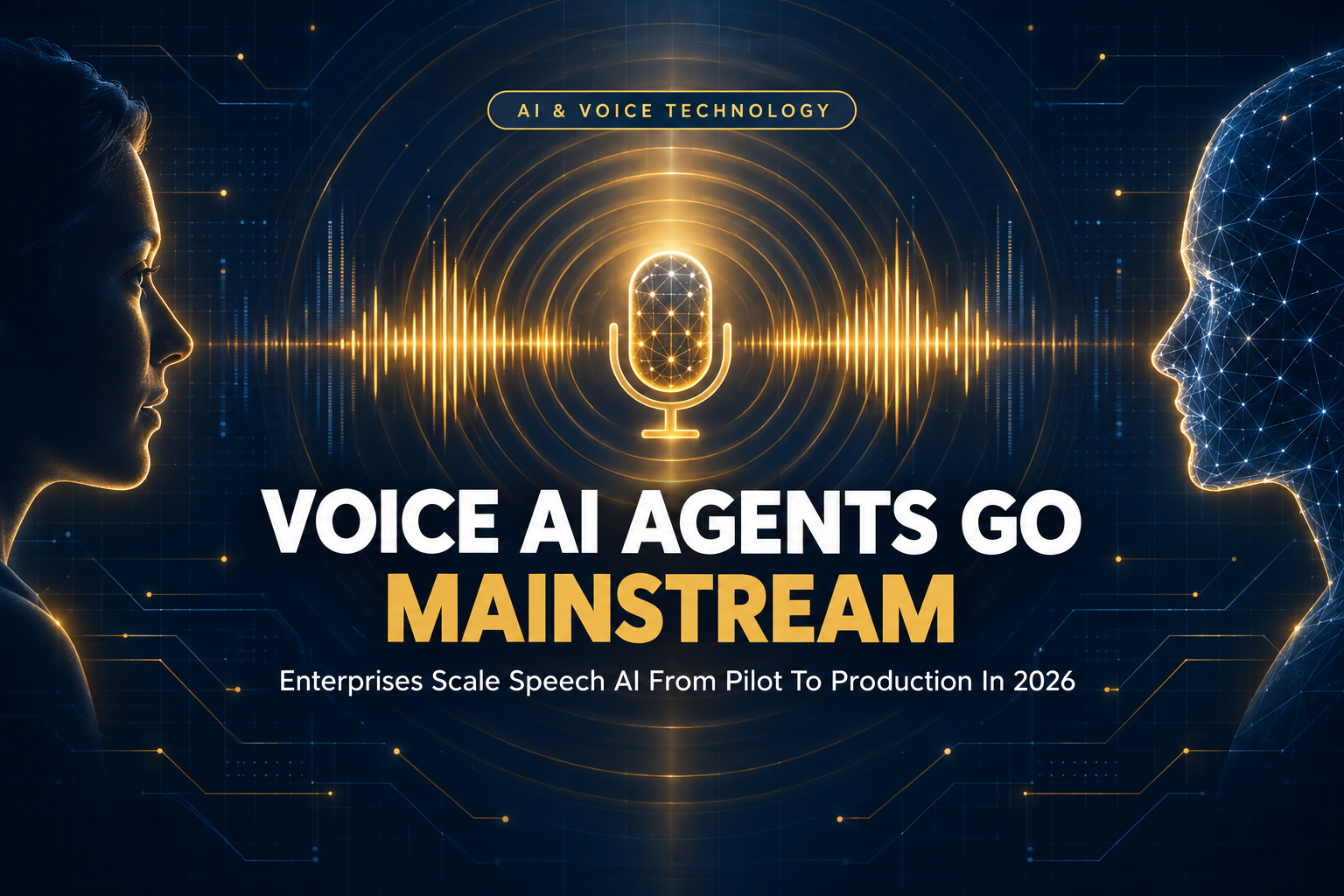
Fewer than 10% of enterprise voice interactions are handled autonomously today. According to Gartner, that figure will top 70% by 2030 — and the transition is already visible in call centers, back offices, and commuter headsets around the world.
Speech AI voice agents have quietly crossed a threshold in late 2026. What began as experimental chatbots with clunky “press 1 for sales” logic has evolved into conversational systems that reason through complex requests, hand off seamlessly to humans, and operate across customer service, internal operations, and personal productivity. For technology leaders and investors, the question is no longer whether voice AI works — it’s how fast organizations can scale it responsibly.
From Pilot Projects to Production-Scale Deployment
The shift from experimentation to real deployment is the defining story of 2026. Speaking at the Bengaluru Tech Summit, Gnani AI’s Chief Revenue Officer Vasuta Agarwal told attendees that enterprise adoption of voice AI has accelerated markedly over the past six months, with companies moving beyond pilots toward large deployments tied to measurable returns. Her company’s AI agents, deployed with clients including Oyo and Air India Express, now handle an estimated 80% to 90% of customer conversations, routing only the most complex cases to human representatives.
ElevenLabs India head Karthik Rajaram, speaking at the same summit, described how AI voice agents are reshaping India’s business process outsourcing industry — letting BPOs grow revenue without proportionally expanding headcount. He cited ecommerce platform Meesho, where voice AI reportedly resolves around 90% of merchant queries. This human-plus-AI hybrid model, rather than full replacement, appears to be the emerging standard across customer-facing industries.
Speech Reasoning Models Expand What Voice AI Can Do
The technical leap enabling this shift is the rise of speech reasoning models — systems that interpret spoken input, reason through multi-step requests, and generate contextual responses in real time, rather than simply transcribing and matching keywords. OpenAI’s GPT-Realtime-2, released earlier in 2026, exemplifies this category, and Gartner has named speech reasoning models among its Top 10 Strategic Technology Trends for 2027.
Gartner’s 2026 CIO survey adds important nuance: among voice-input technology use cases, only 18% were exclusively customer-facing, while 35% were purely internal and 47% spanned both. Voice AI, in other words, is becoming infrastructure for internal workflows — appointment scheduling, field operations, technical support, and employee assistance — not just a call-center tool.
That internal-facing momentum is visible in enterprise software too. Levenza, a San Francisco-based personal AI agent company serving over 300 clients including Oliver Wyman, Goodwin, and Hg Capital, recently acquired voice AI lab Fluid Inference to add natural voice interaction to its Teams, Slack, and Outlook-based agents. Employees can now speak to their AI assistant while commuting to get a morning briefing, triage urgent emails, or rearrange meetings hands-free — extending voice AI’s reach well beyond the contact center.
Infrastructure Is Catching Up to Ambition
None of this is possible without dramatic gains in the underlying inference stack. Together AI recently added Qwen3 TTS, an open text-to-speech model, to its serverless inference platform, delivering first audio in as little as 97 milliseconds with support for ten languages and nine distinct voices. Sub-100ms latency matters enormously for natural-feeling conversation — it’s the difference between a voice agent that feels responsive and one that feels robotic.
Industry researchers tracking the “Speech Agent Arena” have noted that models from Google’s Gemini family and Cartesia are currently trading places at the top of real-time benchmarks, underscoring how competitive — and fast-moving — the foundation model layer has become. Meanwhile, customer support and experience automation ranks as the single leading generative AI use case among enterprise decision-makers, according to industry survey data, reinforcing why voice is becoming the preferred delivery layer for agentic AI.
Real-World ROI Is Already Measurable
Perhaps the most compelling evidence comes from organizations already in production. The Idaho Housing and Finance Association replaced its legacy IVR system with an AI voice agent platform and now reports saving an estimated $750,000 annually while handling roughly 4,000 inbound calls a day and cutting average call time by 20%, according to the company’s CIO. These are the kinds of concrete, auditable outcomes that are convincing more conservative industries — finance, housing, insurance — to move past proof-of-concept.
Pricing models are evolving in response. Vendors increasingly charge by outcome or by minute rather than flat seat licenses, reflecting a maturing market where buyers expect to pay for resolved conversations, not software access. Search interest data shows buyers are actively comparing platforms like Retell, ElevenLabs, Bland, Vapi, and Synthflow — a sign that voice AI has moved from novelty to procurement category.
What Comes Next
As speech reasoning models improve and latency continues to shrink toward human conversational speed, expect voice AI to expand further into regulated and high-stakes environments — healthcare intake, financial services, and public sector support — where accuracy, privacy, and auditability are non-negotiable. Regulatory frameworks are already adapting; new FCC rules affecting AI-generated voice communications took effect in late November 2026, signaling that compliance will become as important a differentiator as latency or language coverage. The vendors that win the next phase won’t just have the best-sounding voice — they’ll have the clearest audit trail.
Voice AI has stopped being a futuristic demo and become a line item on enterprise technology roadmaps. The organizations moving fastest aren’t trying to eliminate human agents entirely — they’re building systems where AI absorbs routine volume and humans handle judgment calls, nuance, and escalation. As this hybrid model scales toward Gartner’s projected 70% autonomy threshold, the real competitive advantage will belong to companies that figure out the handoff, not just the automation. Is your organization ready for voice to become the primary interface for customer and employee interaction?
📖 Recommended Sources:
• Gartner – 2026 CIO survey and Top 10 Strategic Technology Trends for 2027, including voice AI autonomy forecasts
• Economic Times (ETCIO) – Bengaluru Tech Summit coverage featuring Gnani AI and ElevenLabs India executives
• Futurum Group – Analysis of Together AI’s Qwen3 TTS launch and real-time voice inference stack
• Bland AI / HackerNoon / ITBrief – State of AI Voice Agents report and Levenza-Fluid Inference acquisition coverage
ⓘ This content is AI-generated based on training data through January 2026 and supplemented with live research. Please verify specific claims independently.