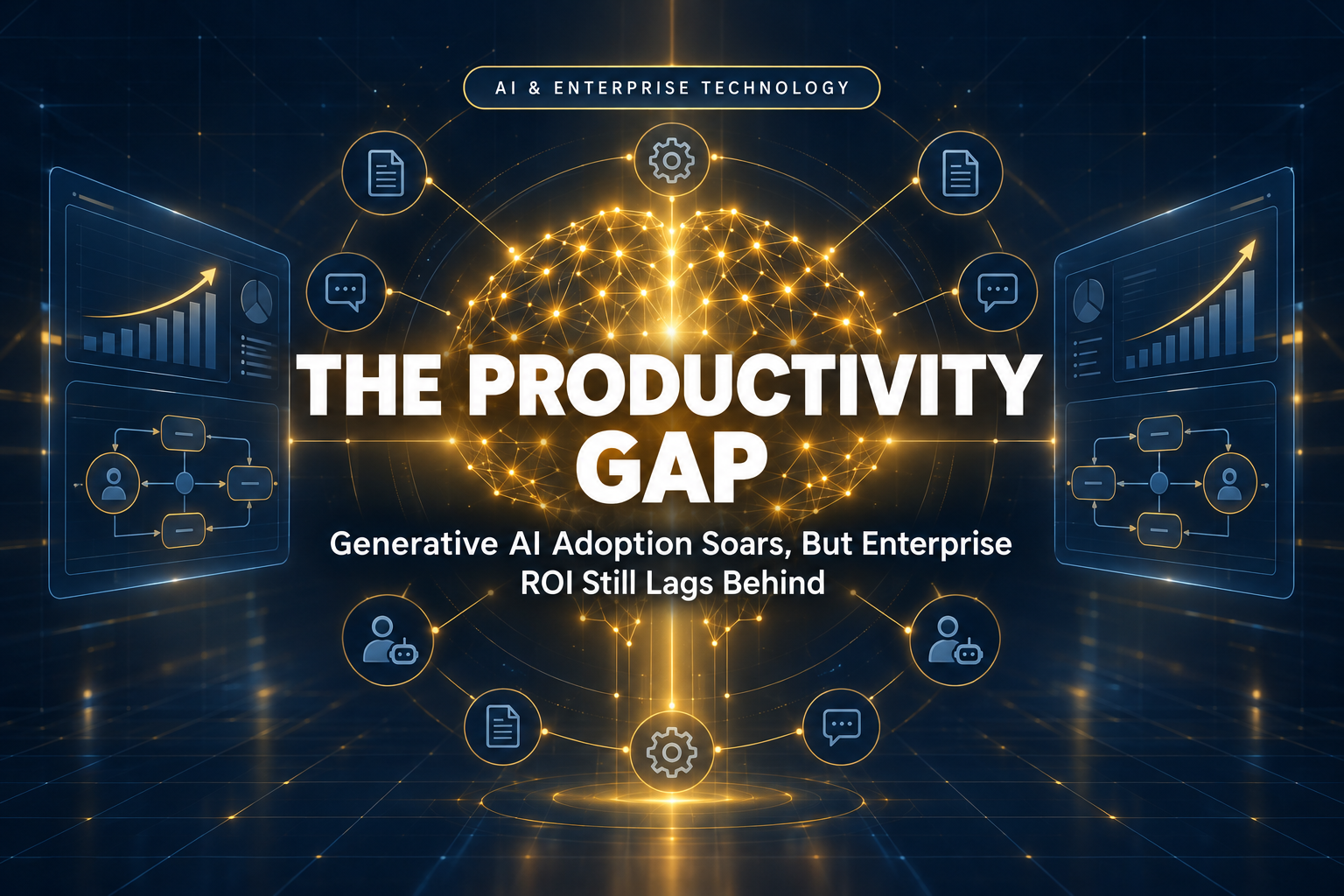
Nearly every large enterprise now uses generative AI somewhere in its operations — yet a growing body of research suggests that widespread adoption and measurable productivity gains are two very different things. As we close out 2026, the gap between AI deployment and AI value has become the defining story of enterprise technology strategy.
The numbers tell a striking story. According to the South African AI Index 2026, produced by World Wide Worx, 93% of large enterprises are now using generative AI, up from 67% in 2025 and just 45% in 2024. But perception of positive business impact among those users has actually declined, dropping to 51% in 2026 from 83% the previous year. Adoption is accelerating. Confidence in outcomes is not.
Productivity Remains the Clear Winner — When Measured Properly
Despite the mixed sentiment, productivity is still the single biggest value driver enterprises report from generative AI. A global study from Tata Consultancy Services (TCS), surveying 1,333 senior business and technology leaders across 25 countries, found that 84% of executives cite productivity as AI’s top benefit — well ahead of revenue uplift or customer experience gains.
Separately, research conducted by Omdia on behalf of Schneider Electric found increased productivity is the leading driver of enterprise AI adoption (35%), ahead of cost reduction (25%) and time savings (22%). Notably, 60% of companies with implemented AI projects report ROI meeting or exceeding expectations, with some seeing returns of 5–10x. The catch: this is true only for companies that have moved beyond pilots into live deployment.
That distinction matters enormously. The World Wide Worx index found that among enterprises using AI in live business processes, 80% saw a positive productivity impact — compared to just 44% among those still experimenting. The lesson is clear: productivity gains materialize at the deployment stage, not the pilot stage.
The Measurement Problem Is Bigger Than the Technology Problem
Much of the disconnect between adoption and perceived value comes down to measurement gaps rather than model quality. The same World Wide Worx research found that only 27% of enterprises could actually measure the value gained from their AI investments — but among those that could, 78% rated the productivity impact positively, versus just 37% of companies unable to quantify outcomes.
This mirrors a broader industry concern. Reporting this month noted that MIT research found the vast majority of generative AI deployments have yet to produce measurable profit-and-loss impact, reinforcing that ROI tracking — not capability — is now the central bottleneck for enterprise AI strategy. As the TCS study notes, 39% of enterprises admit they are “still assessing whether AI initiatives generate enough value relative to token and compute costs,” highlighting how cost-accounting frameworks are struggling to keep pace with deployment speed.
From Copilots to Agentic Workflows
The technology itself is evolving quickly, shifting the productivity conversation from simple assistants toward autonomous, multi-step execution. Microsoft’s Work Trend Index describes a progression from AI copilots, to agents completing tasks under human direction, toward environments where employees set direction while agents execute larger portions of workflows.
This shift is visible in recent product launches: Microsoft shipped Agent 365 to integrate AI agents directly into business operations, while IBM and Microsoft jointly announced Imagine Enterprise, a platform for building and governing industry-specific AI agents. Google has also made its Gemini agent generally available as what it calls a “universal agent for work,” capable of routing tasks across model families.
Adoption of these more autonomous systems is accelerating fast among the largest organizations. Large enterprises with over $1 billion in annual revenue saw agent-scaling rates jump to 40%, up from 27% the year prior. Yet caution persists — the TCS study found only 10% of global enterprises currently allow AI agents to execute decisions without human approval, and just 9% have agents that can securely orchestrate workflows across enterprise applications. Security, risk, and governance remain the primary gating factors, ranking ahead of cost or deployment speed in executive decision-making.
Shadow AI and the Trust Deficit
One of the more uncomfortable findings in this year’s research is the rise of unsanctioned AI usage. The South African AI Index 2026 reported that 75% of organizations now experience “shadow AI” use — employees using generative tools outside of official IT channels — up sharply from 52% in 2025. Combined with findings that only 36% of customers trust agentic AI with their data, it’s clear that trust and governance infrastructure are lagging well behind employee enthusiasm for the technology.
Accuracy and reliability remain the top-cited barrier to broader AI use, named by 64% of respondents in the World Wide Worx study. This reinforces a theme seen across recent industry analysis: productivity gains should never be inferred from demos or raw generation speed. A proper evaluation compares baseline and post-adoption metrics — cycle time, error rates, rework, and total cost — rather than assuming output volume equals value.
The Future Outlook
Looking into 2027, expect the productivity conversation to mature from “are we using AI” to “can we prove what it’s doing for us.” Enterprises that build rigorous before-and-after measurement frameworks — rather than relying on anecdotal satisfaction — will be the ones that convert generative AI’s early promise into durable competitive advantage. The organizations moving fastest are also investing heavily in governance and provider-independence planning, with 90% of TCS survey respondents saying model independence matters for investment decisions, even though only 7% currently have formal provider-switching continuity plans in place.
Generative AI has unquestionably become core infrastructure for the modern enterprise, but 2026 has proven that deployment alone doesn’t guarantee transformation. The organizations separating signal from hype are the ones pairing agentic AI capabilities with disciplined measurement, security governance, and a willingness to move beyond pilots into live, accountable production use. As your organization plans its 2027 AI roadmap, the real question isn’t whether to adopt generative AI — it’s whether you can actually prove it’s working. What metrics is your team using to measure AI’s real impact on productivity?
📖 Recommended Sources:
• TCS Global AI Study (2026) – Survey of 1,333 senior executives across 25 countries on enterprise AI adoption, productivity, and governance
• World Wide Worx – South African AI Index 2026 – Research on enterprise generative AI adoption rates and realized business value
• Omdia / Schneider Electric Global Research (2026) – Study on enterprise AI infrastructure, ROI, and deployment drivers
• Microsoft Work Trend Index & Stanford AI Index – Analysis of the shift from AI copilots to autonomous agentic workflows and AI incident tracking
ⓘ This content is AI-generated based on training data through January 2026. Please verify specific claims independently.