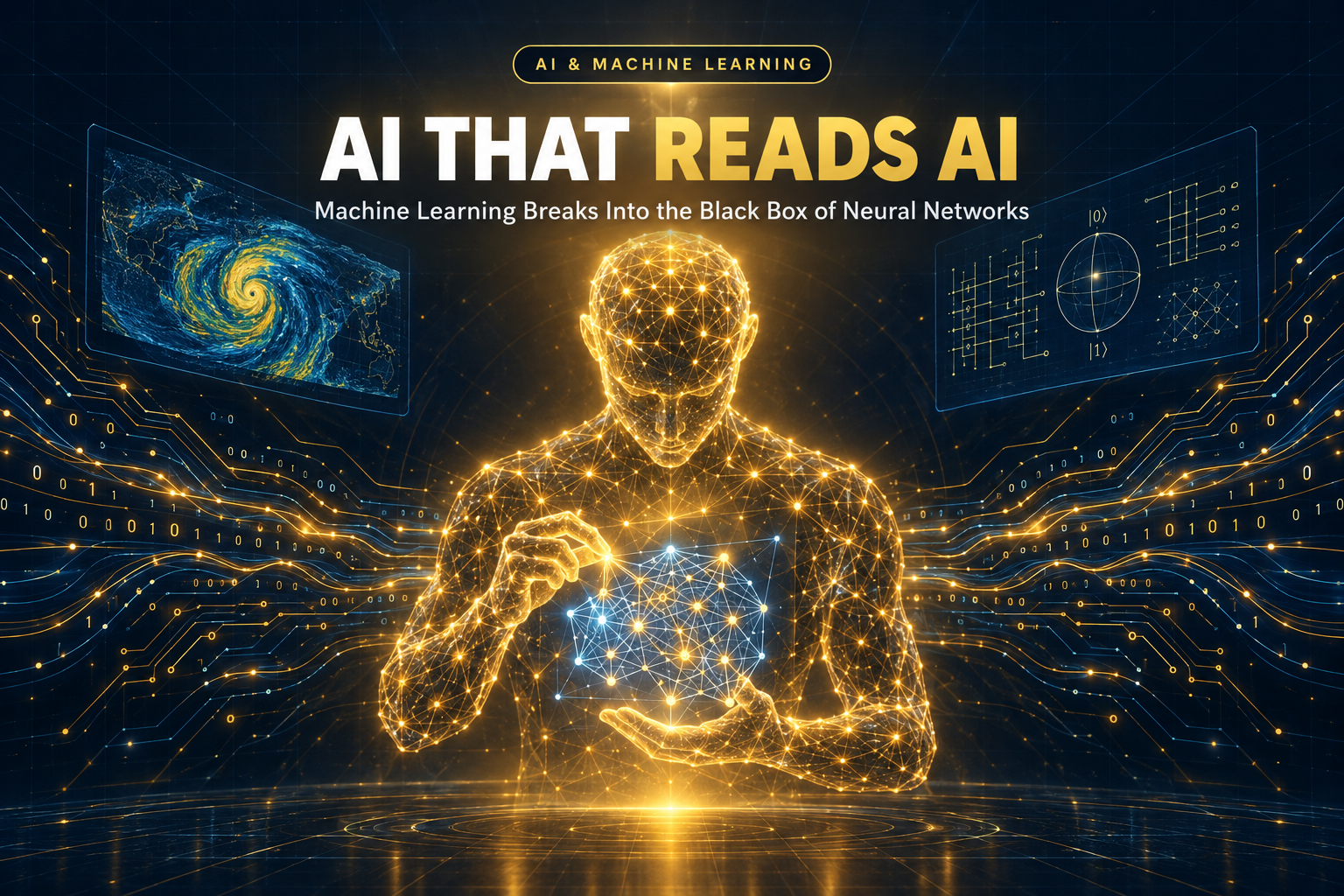
Imagine one AI system quietly opening up another’s “brain,” reading its raw internal wiring, and rewriting parts of it to make it smarter — without ever being told how that system was built. That’s no longer hypothetical. It happened this month.
Machine learning research just crossed a threshold that few expected this soon. In a preprint posted November 2 and widely reported by Nature, MIT researchers demonstrated that a general-purpose AI model can interpret the internal values of a completely different neural network well enough to predict what its components do — and then edit those components to boost performance, including mathematical reasoning. This single development, alongside a wave of parallel advances in efficiency, weather prediction, and quantum-enabled ML, signals that 2026 is becoming a defining year for how machine learning systems are built, understood, and scaled.
The “AI Mechanic” That Rewrites Other Neural Networks
According to Nature, the MIT team showed that an AI model — referred to in reporting as GPT-6 Astra — can read the raw weights and activations of other neural networks and infer what different internal components are doing, then intervene to improve them. Graduate student and co-author Rikiya Takehi described the approach as treating neural networks “like files that can be read, reasoned about, and changed,” even without fully understanding how they work end-to-end.
This matters enormously for the field of interpretability — the effort to make AI’s “black box” decision-making legible to humans. Historically, researchers have had to manually probe which weights activate under which conditions, a painstaking process. Automating even part of that workflow could, as Takehi put it, mean “much less data, much less compute, and much less time to teach our models a specific skill.”
Not everyone is declaring victory, though. Fazl Barez, an AI-safety researcher at the University of Oxford quoted in Nature, cautioned that the safety benefits of this approach remain “largely untested,” and it’s unclear whether the model is doing anything beyond applying patterns learned during its own training. The research is still a preprint awaiting peer review — but the implications for AI safety research and model efficiency are significant enough that the broader research community is already debating what comes next.
Efficiency Gains Are Reshaping How Models Get Built
While interpretability grabbed headlines, a quieter revolution is happening in how large models are trained and scaled. Recent technical research highlighted in AI/ML research roundups points to a cluster of innovations aimed at cutting the enormous compute costs behind modern model development.
Simplified Mixture-of-Experts (MoE) architectures — approaches that strip down redundant “hyper-connection” mechanisms between expert sub-networks — are demonstrating that complexity long assumed necessary for routing efficiency can actually be trimmed without sacrificing benchmark accuracy. Separately, advanced on-policy distillation methods are allowing smaller “student” models to learn from larger “teacher” models faster by treating expert weights as priors rather than fixed targets.
For businesses deploying AI at scale, this is not academic. Training cost reduction directly affects which organizations can compete in building frontier-capable models, and techniques that preserve performance while cutting compute requirements could meaningfully lower the barrier to entry for mid-sized AI labs and enterprises alike.
Machine Learning Is Extending the Limits of Weather Prediction
One of the most practically significant applications of recent ML research isn’t in chatbots at all — it’s in forecasting the weather. MIT-affiliated researchers have developed a machine learning technique designed to improve forecasts in what meteorologists call the “predictability desert” — the notoriously difficult window spanning roughly two weeks to a month out, where traditional physics-based models lose reliability.
As reported by the Boston Globe, the new approach could give communities, farmers, and emergency planners significantly more lead time to prepare for extreme weather events, from cold snaps to flooding. This represents a powerful example of machine learning applied to real-world infrastructure rather than purely digital products — a trend likely to accelerate as climate volatility raises the stakes for accurate long-range forecasting.
Quantum Machine Learning Reaches a Milestone
Machine learning’s next frontier may increasingly intersect with quantum computing. Nippon Telegraph and Telephone (NTT) recently demonstrated a complete, functional machine learning workflow running on its optical quantum computer “MoQuren,” using a new software development kit that lets developers define ML processes without manually designing quantum circuits — showcased publicly at NTT R&D FORUM 2026.
Separately, quantum computing startup Moth set a new data-encoding record, successfully encoding and retrieving a complex image across all 120 qubits of an IBM Quantum “Nighthawk” processor — more than twelve times the previous benchmark. As Moth’s Harry Kumar noted, breakthroughs in data encoding are essential groundwork for quantum machine learning applications that could eventually complement classical AI training pipelines, particularly as the industry eyes fault-tolerant quantum systems by the end of the decade.
What This Means for the Road Ahead
Taken together, these developments point to a machine learning landscape maturing on multiple fronts simultaneously: toward interpretability that could make models safer and cheaper to refine, toward architectural efficiency that lowers the cost of frontier-scale training, and toward domain-specific applications — from weather forecasting to quantum-native ML — that extend AI’s reach well beyond text and image generation. None of these advances are finished products; the MIT interpretability work alone remains an unreviewed preprint. But the direction of travel is unmistakable, and organizations that track these shifts early will be better positioned to adopt them responsibly.
Machine learning research is no longer just about bigger models — it’s about smarter, more transparent, and more efficient ones. As AI systems start interpreting and improving each other, where do you think the biggest opportunities — and risks — will emerge first: in enterprise AI deployment, scientific discovery, or AI safety itself?
📖 Recommended Sources:
• Nature (Nov 13, 2026) – “This AI ‘mechanic’ can peer inside the black box of other neural networks,” covering MIT’s GPT-6 Astra interpretability preprint
• MIT News / Boston Globe – Coverage of MIT’s machine learning breakthrough for extending weather forecast accuracy into the “predictability desert”
• Quantum Zeitgeist – Reporting on NTT’s optical quantum computer ML SDK demonstration and Moth’s record-setting quantum data encoding with IBM hardware
• AI/ML Research Digest (Nov 14, 2026) – Summary of MoE simplification (SimpleHC) and on-policy distillation efficiency research
ⓘ This content is AI-generated based on training data through January 2026 and live research conducted via Perplexity and SerpAPI. Please verify specific claims independently, particularly preprint findings that have not yet undergone peer review.