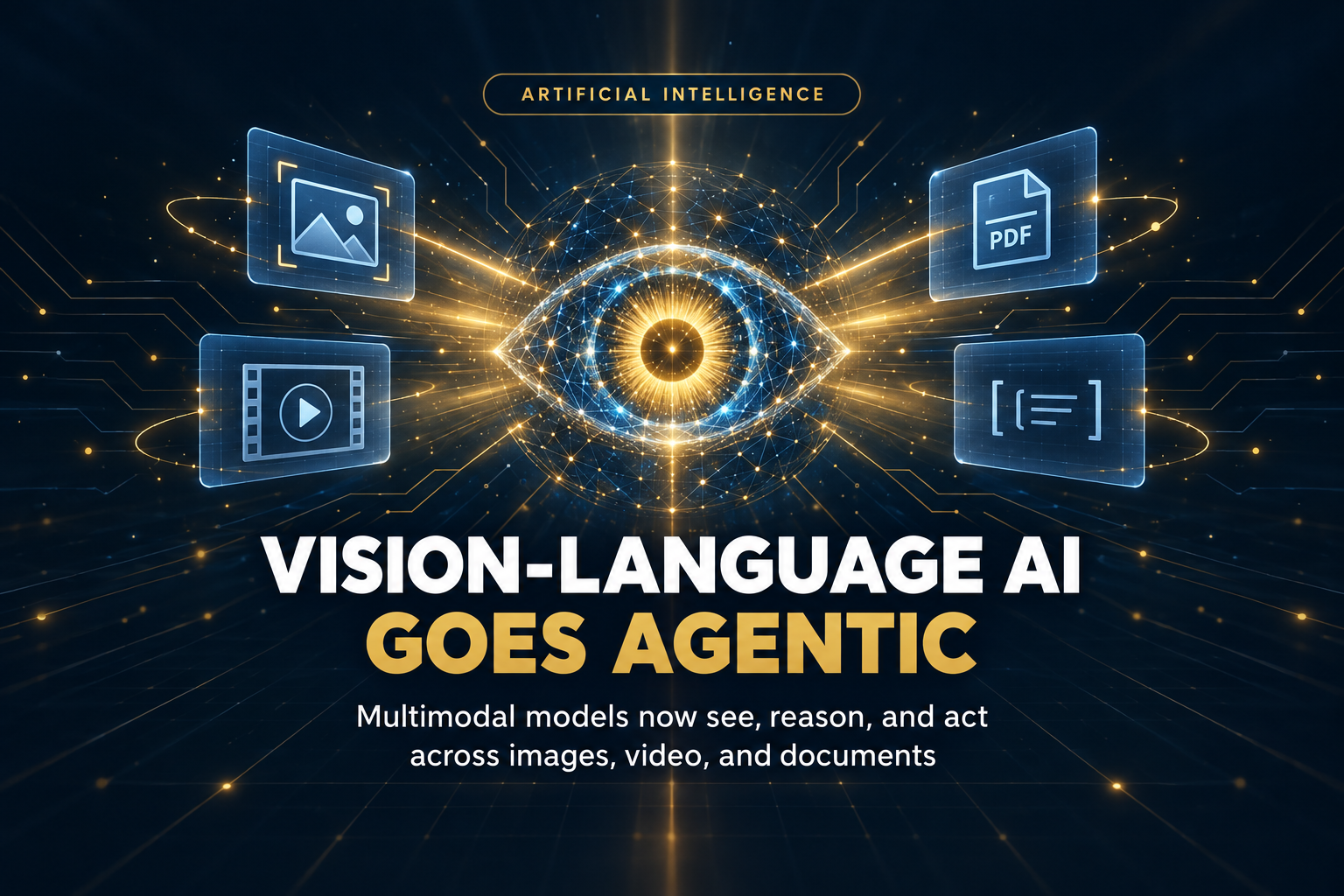
The question defining AI architecture in late 2026 isn’t whether machines can see and read — it’s whether they should think about vision at all as a separate skill. New research suggests the answer is no, and that shift is quietly rewriting how vision-language models get built.
Multimodal AI has crossed a threshold. What began a few years ago as systems that could caption a photo or answer simple questions about an image has evolved into architectures that reason across images, video, PDFs, and structured documents — then take action. As of mid-November 2026, the vision-language model (VLM) landscape is being reshaped by three converging forces: deeper architectural integration, agentic decision-making capabilities, and a push toward smaller, edge-ready models. For technology leaders and investors, understanding this shift matters because it determines where real enterprise value — and real competitive risk — will emerge over the next 12 to 24 months.
Vision Is Moving Inside the Language Model
For years, the standard VLM design bolted a separately pretrained vision encoder onto a large language model. That’s changing. A joint NYU–Meta FAIR study found that vision components trained directly within the early layers of an LLM can match the performance of traditional pre-fusion encoders while reducing the time it takes to generate a first token — a critical latency metric for real-time applications.
The research goes further, suggesting that separate vision pretraining may not even be necessary when compute is held constant. This has fueled momentum behind “encoder-free” designs, where the language-model backbone handles visual processing directly rather than delegating it to a bolted-on module. Researchers caution that the “encoder-free versus encoder-based” framing oversimplifies several independent design choices — pretraining strategy, dedicated visual capacity, and where in the network visual computation happens — but the direction is clear: tighter integration, lower latency, and simpler deployment pipelines.
Interestingly, a separate November study found that vision-language training appears to leave “vision-shaped” internal representations that improve a model’s performance on text-only spatial reasoning tasks — navigation, mental rotation, paper folding — even when no image is present at inference time. In other words, teaching a model to see may be making it reason better, period.
From Captioning to Decision-Making
Perhaps the most consequential shift is functional, not architectural. Google’s Gemini Decisions API illustrates where the category is heading: rather than simply describing what’s in an image, the system evaluates closed-set choices — yes/no answers, multiple choice, rubric scoring — across text, images, audio, video, and PDFs, returning probabilities and scores across up to 1,000 questions per request.
This reframes VLMs as decision infrastructure, not just perception tools. Instead of asking a model “what’s in this photo,” enterprises can now ask it to score insurance claims, rank compliance risks, or evaluate product photos against a rubric — and get calibrated, auditable outputs. That distinction matters enormously for regulated industries like insurance, finance, and healthcare, where probability-scored decisions are far more actionable than free-text descriptions.
The Scale-Down Race: Small Models, Big Capability
While frontier labs chase scale — Meituan’s LongCat-2.5 reportedly reaches 1.6 trillion total parameters in a mixture-of-experts multimodal design — an equally important trend is happening at the opposite end of the spectrum. Compact VLMs are now combining image description, OCR, bounding-box detection, segmentation masks, and structured form extraction in models small enough to run on-device.
This matters for real-world deployment. Mobile, embedded, and edge use cases — field service inspections, retail shelf audits, warehouse automation — don’t tolerate cloud-dependent latency or per-call API costs at scale. NVIDIA’s Nemotron 3.5 Super VL, now available through Amazon SageMaker JumpStart in both full-precision and quantized formats, reflects the same push: giving enterprises flexibility to deploy multimodal inference wherever the workload demands it, from data center to edge device.
Enterprise Reality: Experimentation Outpacing Scaled Value
The business case for VLMs is compelling but uneven. According to industry research tracked across 2026 enterprise AI surveys, roughly 89% of organizations now use AI in at least one business function, yet only about 22% have successfully scaled AI deployments across multiple business units — a gap that applies directly to multimodal initiatives.
The strongest near-term use cases are concrete and workflow-specific:
- Manufacturing — defect detection, visual quality inspection, safety monitoring
- Insurance and finance — claims assessment, document extraction, fraud detection
- Retail — shelf monitoring, visual search, merchandising audits
- Healthcare — medical-image assistance and clinical document processing
- Logistics — equipment diagnostics and warehouse automation
Frontier adopters that embed VLMs into existing operational systems — rather than deploying them as standalone image-analysis tools — report meaningfully higher returns than organizations treating multimodal AI as an isolated experiment. The constraint isn’t model capability anymore; it’s governance, integration cost, and the ability to measure outcomes like claims-processing time, inspection cost per unit, and exception rates rather than just accuracy benchmarks.
What Comes Next
Expect the architectural convergence between vision and language to continue accelerating through 2027, with open-weight multimodal agent models — such as BAAI’s AREX-2 — giving developers viable alternatives to closed frontier APIs for building reasoning-and-tool-use pipelines. At the same time, the decision-API pattern pioneered by Gemini is likely to be replicated across the industry, pushing VLMs further from “description tools” toward embedded components of automated judgment and workflow orchestration. The organizations that win will be those that match model capability to specific, measurable business processes rather than chasing the largest or most general-purpose system available.
Multimodal AI is no longer a research curiosity bolted onto chatbots — it’s becoming core infrastructure for how enterprises see, interpret, and act on visual information at scale. As vision and language architectures continue merging and decision-grade outputs become standard, the real differentiator won’t be which model sees best, but which organization integrates that sight into decisions that matter. Where is your organization placing its first multimodal AI bet — and is it solving a real workflow problem, or just a demo?
📖 Recommended Sources:
• NYU–Meta FAIR research on integrated vision encoders – architectural study on vision processing inside LLM backbones
• Google Gemini Decisions API documentation – multimodal decision-scoring infrastructure
• IDC FutureScape 2026 and enterprise AI adoption research – statistics on AI scaling and business impact
• NVIDIA Nemotron 3.5 Super VL on Amazon SageMaker JumpStart – deployment-optimized multimodal model release
ⓘ This content is AI-generated based on training data through January 2026, supplemented with live research. Please verify specific claims independently.