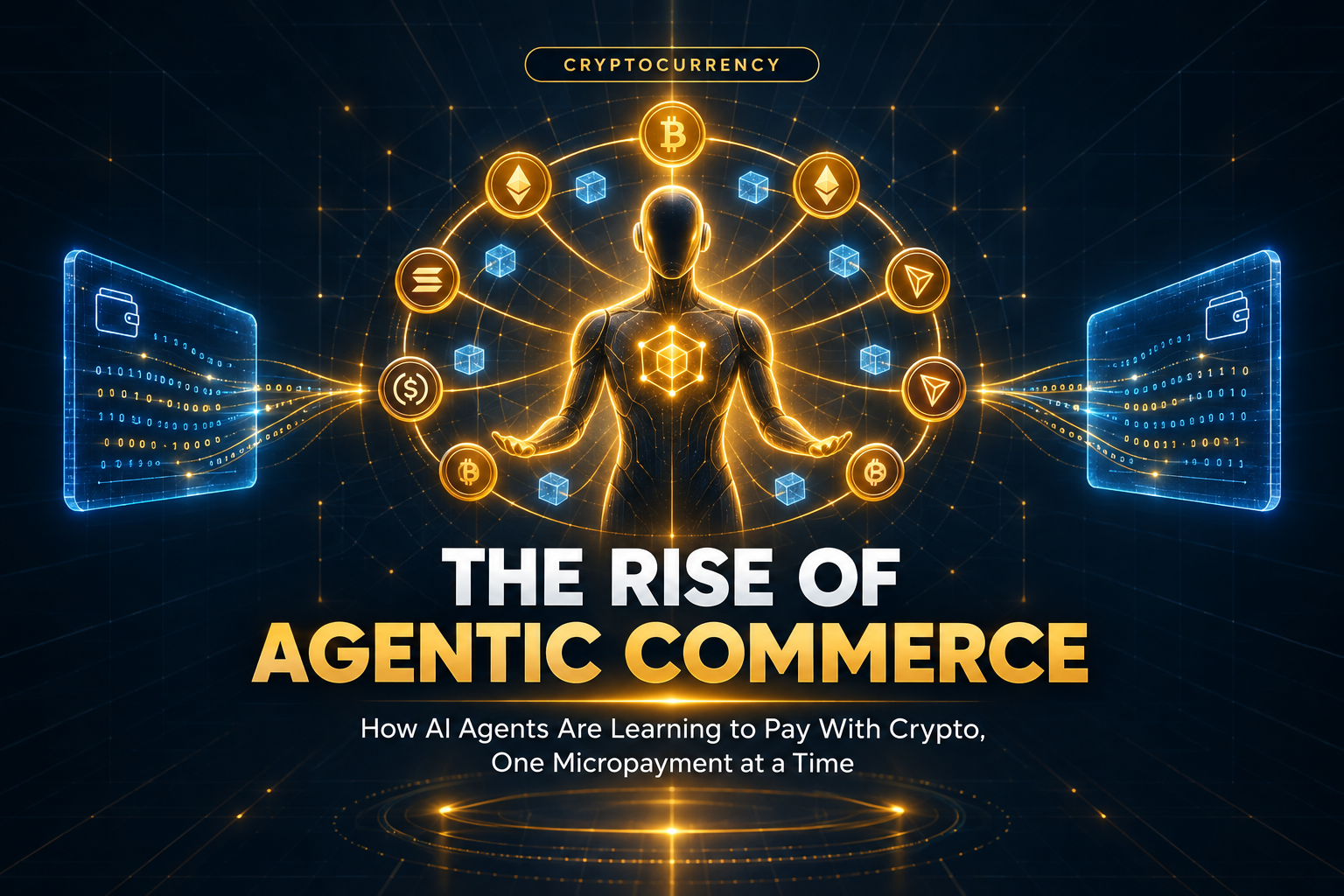
AI agents made more than 196 million crypto payments in 2026—and almost none of them were for anything a human would call “shopping.”
The idea of autonomous AI agents transacting independently in crypto has moved from theoretical to measurable. We now have hard data on how machines actually spend money when given a wallet and a task. The results are reshaping how blockchain infrastructure, payment networks, and e-commerce platforms think about the next wave of digital commerce—even if the reality looks different from the sci-fi vision of robots buying groceries.
The Numbers Behind the Agent Economy
According to Fireblocks, the x402 payment protocol—which revives the long-dormant HTTP “402 Payment Required” status code—had processed more than 196 million transactions across 12 blockchains, settling over $42 million in value as of early November 2026. That sounds like a thriving machine economy until you look at transaction size: more than 87% of these payments fell between $0.0001 and $0.10, with other industry samples showing over 90% priced below a single cent.
In October 2026 alone, agents executed roughly 5.1 million transactions worth just $274,000 total. That’s the defining tension of agentic commerce right now: massive transaction counts, minimal economic value. Agents aren’t buying sneakers or booking flights autonomously. They’re paying fractions of a cent for API calls, web searches, token-safety checks, and other micro-services—essentially tollbooth payments for data access rather than consumer purchases.
Base currently handles about 45% of these transactions, with Solana at roughly 34%, and nearly all value on Base settling in USDC. Stablecoins have become the default currency for machine-to-machine payments precisely because they offer programmable, 24/7, borderless settlement without the friction of card networks or bank rails.
Three Layers, Not One Protocol
Rather than a single winner-take-all standard, 2026 has revealed agentic commerce splitting into three distinct layers: authorization, checkout, and settlement.
- Authorization is handled by frameworks like Google’s AP2, Visa’s Trusted Agent Protocol, and Mastercard’s Agent Pay—systems that prove which human authorized an agent and under what spending limits.
- Checkout runs through protocols like the OpenAI-Stripe Agentic Commerce Protocol (ACP), which lets agents discover products and assemble carts using scoped, merchant-specific payment tokens instead of exposing raw card data.
- Settlement is where crypto enters: stablecoins, wallets, and rails like x402 move the actual money, often bypassing traditional card networks entirely for digital-service payments.
This layered architecture suggests the future isn’t one universal “agent payment protocol” but an interoperable stack where card networks, banks, and crypto rails each own a piece of the transaction lifecycle. For blockchain-native builders, this means the real opportunity lies in session-based payment channels, programmable wallets with spending policies, and identity standards for agents—not necessarily a single dominant chain.
Trust, Liability, and the “Zombie Wallet” Problem
Despite the transaction volume, big institutional money remains cautious. A recent Forbes Tech Council piece bluntly argued “an agent cannot be a payee,” highlighting unresolved questions around liability when an autonomous system makes an erroneous or manipulated payment. Reports have also flagged a “dark side” to this growth: wallets funded and drained within minutes, some showing patterns consistent with bot loops, speculative testing, or exploit attempts rather than genuine commercial activity.
Notably, the median time between funding a new wallet and its first x402 payment fell to just 18 minutes in Q3 2026, with two-thirds of newly funded wallets spending within an hour. That speed cuts both ways—it demonstrates how frictionless machine payments have become, but it also raises red flags about oversight, since humans can’t meaningfully review transactions happening at that velocity.
The industry’s answer has been policy-controlled wallets: programmable spending limits, merchant allowlists, transaction simulation before execution, and instant revocation capabilities. The emphasis has shifted from “give the agent a private key” to building guardrails that constrain what an agent can do even if it’s compromised or misdirected by malicious web content—a real risk given how easily large language models can be prompt-injected.
What Comes Next
The current data suggests agentic commerce is real at the transaction-count level but still early at the economic-value level. The next meaningful shift will likely come from agents moving beyond micropayments for information toward higher-value activity: automated trading, treasury management, and physical-world settlement triggered by oracles confirming delivery or completed work. Expect increased convergence between crypto-native rails like x402 and traditional finance infrastructure from Visa, Mastercard, and Stripe, as both camps race to own the “last mile” of machine-initiated payments.
For now, the agent economy looks less like autonomous shopping sprees and more like a vast, high-frequency toll system—billions of tiny transactions keeping the machine internet running. Whether that evolves into genuine agentic consumer commerce, or stays confined to API tolls and data fees, will depend on who solves the trust and liability puzzle first.
As AI agents gain more spending autonomy, who should bear responsibility when something goes wrong—the user, the developer, or the agent itself?
📖 Recommended Sources:
• Fireblocks – “Agent Economy by the Numbers: x402 Data” analysis of transaction volume and settlement trends
• Forbes Tech Council – “An Agent Cannot Be a Payee” on liability and trust gaps in agentic payments
• Google, Visa, Mastercard, OpenAI/Stripe – public documentation on AP2, Trusted Agent Protocol, Agent Pay, and ACP frameworks
ⓘ This content is AI-generated based on training data through January 2026, supplemented with live research. Please verify specific claims independently.