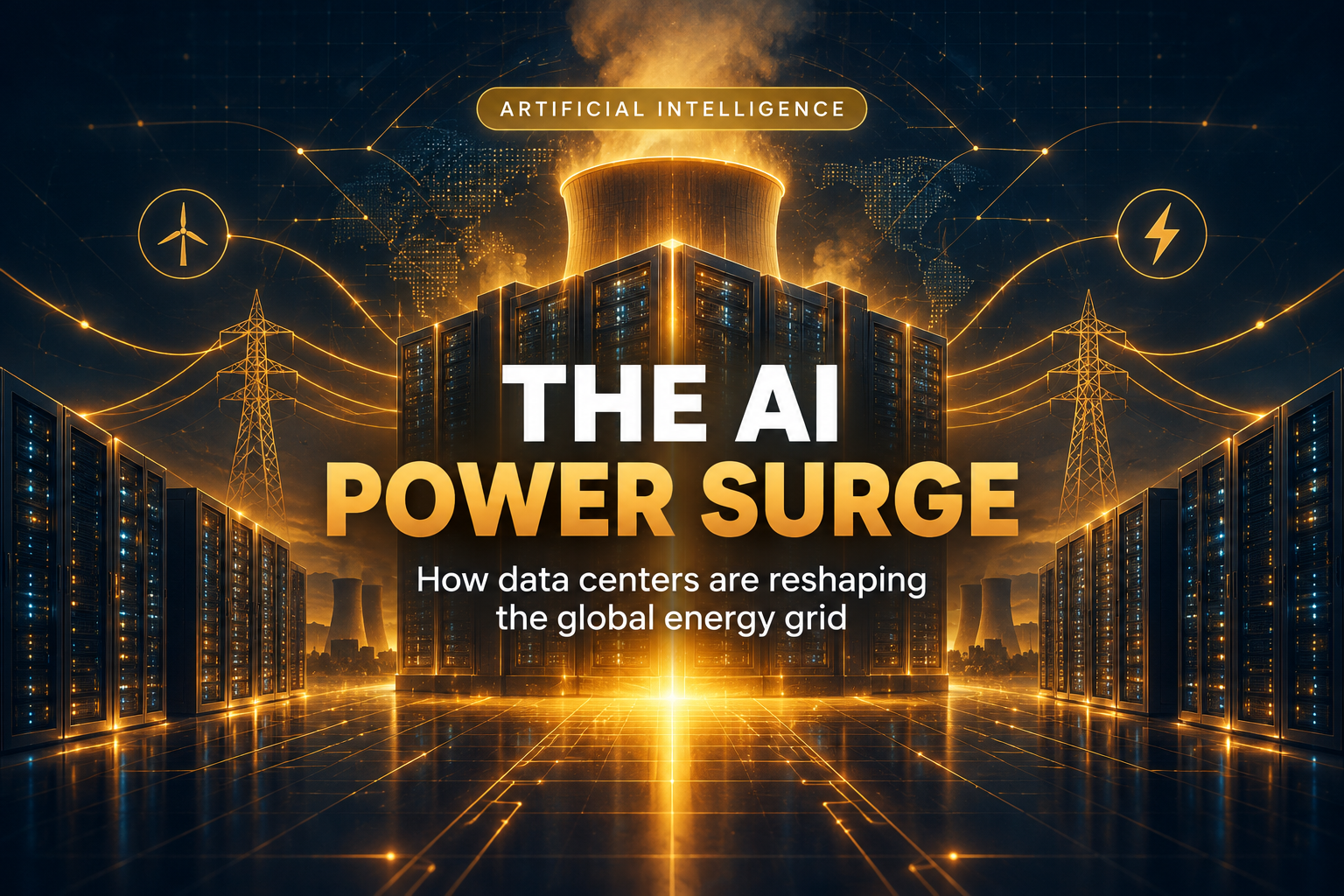
The electricity bill for the AI revolution just came due — and it’s bigger than almost anyone predicted even two years ago.
As of late October 2026, the scale of AI’s energy appetite has moved from theoretical concern to operational emergency for utilities, hyperscalers, and policymakers alike. According to the International Energy Agency (IEA), global data-center electricity consumption is projected to rise from roughly 485 TWh in 2025 to 950 TWh by 2030 — nearly doubling in five years and pushing data centers toward 3% of global electricity demand. AI-focused facilities specifically are expected to triple over that window. This isn’t a distant forecast anymore; it’s reshaping how power grids, utilities, and tech giants plan their next decade.
The Numbers Behind the Surge
The growth trajectory is staggering by any historical energy-sector standard. Goldman Sachs projects global data-center power demand will climb 160–170% between 2025 and 2030, with more than 60% of that growth concentrated in the United States. U.S. data-center load alone is estimated to jump from about 31 GW in 2025 to 41 GW in 2026, and then to 66 GW by 2027.
Server-level power density tells an even sharper story: it increased roughly 11-fold between 2020 and 2025, and could grow another fourfold by 2027 as next-generation AI chips demand more power per rack. A single continuously operating 1-gigawatt AI data center now consumes approximately 8.76 TWh annually — comparable to the electricity use of a mid-sized country. These figures underscore why AI infrastructure has become as much an energy story as a computing one.
Hyperscalers Go Nuclear — Literally
Facing grid interconnection queues that can stretch years, the largest cloud providers are no longer waiting for utilities to catch up — they’re becoming power developers themselves.
Microsoft signed a landmark 20-year agreement with Constellation Energy to restart Three Mile Island Unit 1 in Pennsylvania, dedicating the reactor’s output largely to its data-center fleet. Amazon followed with a 20-year power purchase agreement tied to Calvert Cliffs in Maryland, covering 690 MW including future capacity expansions. Google has pursued similar arrangements with Constellation supporting nuclear uprates, while Meta has sought up to 4 GW of new nuclear capacity, backing small modular reactor (SMR) developers including Oklo and other advanced-nuclear startups.
This marks a fundamental shift in the commercial nuclear model: hyperscalers are now acting as anchor customers financing reactor restarts and uprates that wouldn’t otherwise pencil out economically. As one industry analysis from Al Jazeera put it, the real question facing AI’s expansion isn’t compute — it’s “who will pay for it.”
Natural Gas Fills the Speed Gap
While nuclear offers long-term, carbon-free baseload power, it can’t be built fast enough to match AI’s near-term growth curve. That’s where natural gas — delivered through behind-the-meter generation — has become the pragmatic bridge strategy.
Chevron agreed to supply 2.67 GW of behind-the-meter power to a Microsoft data center in West Texas under a 20-year deal, with generation potentially starting in 2028. Meta is reportedly investing in 10 natural-gas plants totaling 7.5 GW to support its expansion, including a 932-MW facility in Alberta developed with Pembina. Google contracted for up to 590 MW through 2048 to support a new gas plant from Black Hills Corporation, representing roughly $1.8 billion in new generation investment.
These behind-the-meter arrangements let hyperscalers sidestep congested transmission networks and multi-year interconnection backlogs — but they also raise unresolved questions about emissions, local air quality, and whether private power deals shift infrastructure costs onto everyday ratepayers.
The Grid Innovation Race
The scramble for power is accelerating technical innovation across the entire electricity sector. Utilities and developers are experimenting with private microgrids that combine gas turbines, fuel cells, batteries, and renewables at the campus level, enabling data centers to operate semi-independently of public grids. Meanwhile, the concept of 24/7 carbon-free energy matching — tracking clean power on an hourly basis rather than annual averages — is gaining traction as nuclear’s steady output makes hourly matching more achievable.
According to TechCrunch, this pressure is paradoxically pushing meaningful innovation into an historically slow-moving U.S. grid, from faster permitting pathways to new transmission financing models. The data-center boom, in other words, may end up modernizing infrastructure that was overdue for an upgrade regardless of AI.
What Comes Next
The next 18 months will likely determine whether the current build-out strategy is sustainable. Watch for continued SMR pilot announcements, expanded gas turbine orders amid ongoing equipment shortages, and growing political scrutiny over electricity price increases tied to data-center growth in key swing states ahead of the 2026 midterms. Expect also a widening gap between hyperscalers with the balance-sheet strength to self-finance power generation and smaller AI companies that remain dependent on constrained public grids — a dynamic that could reshape competitive dynamics across the entire AI infrastructure market.
The AI boom was never just a story about chips and models — it’s increasingly a story about turbines, transformers, and transmission lines. As compute demand continues its exponential climb, the companies that secure reliable, scalable power may end up with as much competitive advantage as those with the best algorithms. The question now facing the industry: will the race for AI power ultimately modernize the grid for everyone, or create a two-tiered energy system where tech giants buy their way around the constraints the rest of us still face?
📖 Recommended Sources:
• International Energy Agency (IEA) – Global and U.S. data-center electricity demand projections through 2030
• Goldman Sachs – Forecasts on global data-center power demand growth and U.S. load estimates
• TechCrunch – Analysis on data-center-driven grid innovation
• Al Jazeera – Reporting on electricity as AI’s core bottleneck and financing questions
ⓘ This content is AI-generated based on research through October 2026. Please verify specific claims independently.