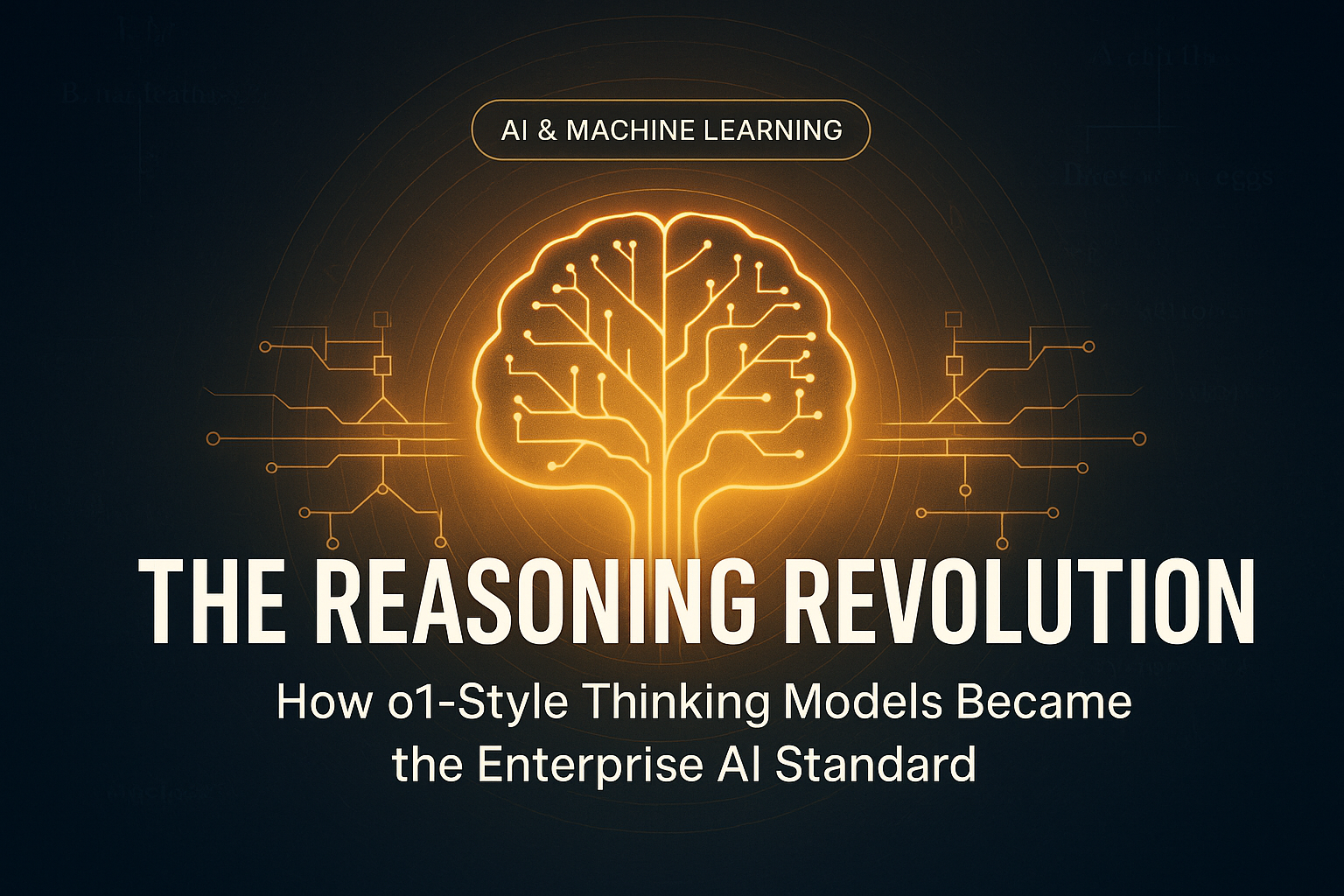
The era of AI models that simply predict the next word is over — in 2026, the frontier belongs to systems that stop, think, and reason before they answer.
When OpenAI introduced o1 in late 2024, it marked a philosophical shift in how large language models operate: rather than generating an instant response, the model would internally deliberate, weighing multiple paths before committing to an answer. Two years later, that idea hasn’t just survived — it has become the default architecture across the entire AI industry. According to recent research into the competitive landscape, reasoning capability is no longer a specialized feature bolted onto a chatbot; it’s the baseline expectation for any frontier model claiming enterprise relevance. This shift matters enormously right now because businesses are moving past pilot projects and demanding AI that can handle genuinely complex, multi-step work — and that requires more than fast autocomplete.
From Novelty to Infrastructure: The Reasoning Model Arms Race
What started as OpenAI’s differentiator has become table stakes. OpenAI’s o3 and o4-mini models pushed extended reasoning into coding, mathematics, science, and visual perception, demonstrating that deliberate “thinking” dramatically improves performance on hard, multi-step problems. Notably, OpenAI retired o3 from ChatGPT in August 2026 — not because reasoning failed, but because the capability has been absorbed into newer, unified GPT-generation models rather than kept as a separate product line.
Every major lab has followed a similar trajectory. Google’s Gemini line emphasizes “adaptive thinking,” letting the system dial reasoning effort up or down based on task difficulty, paired with context windows approaching a million tokens for reasoning across massive codebases and research corpora. Anthropic’s Claude models now feature configurable “extended thinking,” with Opus-tier models ranking strongly on coding and agentic benchmarks. Meanwhile, DeepSeek has made open-weight reasoning a strategic weapon, combining strong math and coding performance with dramatically lower inference costs — a combination that has forced premium labs to justify their pricing more aggressively.
The Real Innovation Isn’t the Label — It’s the Architecture
The more important story beneath the branding is architectural. Five shifts define where reasoning AI stands today:
- Adaptive test-time compute — models now decide for themselves how much internal “thinking” a query deserves, saving cost on simple requests while going deep on hard ones.
- Reasoning plus tool use — leading systems blend deliberation with web search, code execution, and computer control, moving from “answering machines” toward autonomous reasoning agents.
- Long-context reasoning — context windows near or beyond one million tokens let models reason across entire codebases or document sets in a single pass.
- Multimodal reasoning — visual and image understanding are now standard, not optional add-ons, as seen with o3’s perception capabilities and DeepSeek’s newer vision-enabled models.
- Cost-performance competition — “Flash”-style and open-weight models are driving reasoning toward cheaper, higher-throughput deployment even as premium models spend more compute on the hardest problems.
In short, the distinction between a “regular” chatbot and a “reasoning model” is dissolving. The competitive frontier is now about efficiency, tool reliability, and long-horizon autonomy — not whether a model carries a special reasoning label.
Why This Matters for Business, Not Just Benchmarks
The enterprise adoption data tells a nuanced story. According to McKinsey’s 2026 research, roughly nine in ten organizations now use AI in at least one business function, yet only about 37% report a positive EBIT impact, and just 6% qualify as true “AI high performers” capturing substantial bottom-line value. This gap is the defining tension of the reasoning-model era: employees report significant personal productivity gains, but that time savings frequently fails to translate into enterprise-level financial return.
Reasoning models specifically shine in complex, multi-step domains — software engineering, compliance analysis, financial modeling, and agentic workflows that coordinate across multiple systems. McKinsey also found that 40% of large companies (over $1 billion in revenue) have scaled AI agents, up from 27% the year before, suggesting that reasoning-capable systems are increasingly embedded in production workflows rather than confined to experimentation. Separately, Gartner has projected that 40% of enterprise applications will include task-specific AI agents by the end of 2026, compared with less than 5% in 2025 — a signal of how quickly reasoning and agentic capabilities are being baked directly into business software.
The catch is that model capability alone doesn’t guarantee ROI. Organizations that redesigned workflows around AI were reported to be over five times more likely to capture enterprise-level value than those that simply layered a chatbot on top of existing processes. For leaders evaluating o1-class or newer reasoning systems, the message is clear: these models are components of redesigned operations, not plug-and-play productivity software.
Real-World Signals: Coding, Research, and Beyond
Software development remains the most mature proving ground for reasoning AI. Benchmarks comparing frontier systems — including Claude Opus on SWE-bench Verified against OpenAI’s latest coding-focused models and Google’s Gemini 3 Pro — show razor-thin margins at the top, indicating the field has reached a point where raw benchmark leadership shifts monthly rather than yearly. This intensifying competition is good news for enterprise buyers: pricing is falling even as capability climbs, particularly as DeepSeek’s lower-cost reasoning models push the entire market toward better cost-performance ratios.
Beyond code, reasoning models are increasingly deployed for research synthesis, contract and risk analysis, and multi-step agentic planning — tasks where a single wrong assumption early in a chain can cascade into a flawed final answer. This is precisely the failure mode that deliberate, step-by-step reasoning is designed to reduce, even though it doesn’t eliminate hallucination or poor judgment entirely.
What Comes Next for Reasoning AI
Looking ahead, expect the line between “reasoning model” and “general model” to disappear entirely as unified systems absorb deliberation, tool use, and multimodal perception into a single default mode of operation. The next competitive battleground will likely center on reasoning efficiency — delivering deep, reliable thinking without the latency and cost penalties that have limited reasoning models to narrow, high-value use cases. Expect continued downward pressure on pricing from open-weight entrants, tighter integration between reasoning and enterprise data systems, and growing scrutiny on measurable ROI rather than benchmark bragging rights.
The o1-style reasoning breakthrough didn’t just produce smarter chatbots — it redefined what enterprises should expect from AI: systems that can plan, verify, and course-correct rather than merely generate. As this capability becomes ubiquitous across OpenAI, Google, Anthropic, and DeepSeek, the real differentiator will shift from “which model thinks best” to “which organization knows how to put that thinking to work.” Is your organization still using AI as a faster typist, or has it started treating reasoning models as an actual problem-solving partner?
📖 Recommended Sources:
• McKinsey & Company – 2026 research on enterprise AI adoption, EBIT impact, and agent scaling across global organizations
• OpenAI – Model release notes detailing o1, o3, o4-mini, and the retirement of o3 from ChatGPT in August 2026
• Gartner – 2026 forecast on task-specific AI agent adoption in enterprise applications
• Anthropic / Independent Benchmarks – SWE-bench Verified comparisons of Claude Opus, GPT coding models, and Gemini 3 Pro
ⓘ This content is AI-generated based on training data through January 2026, supplemented with live research. Please verify specific claims independently.