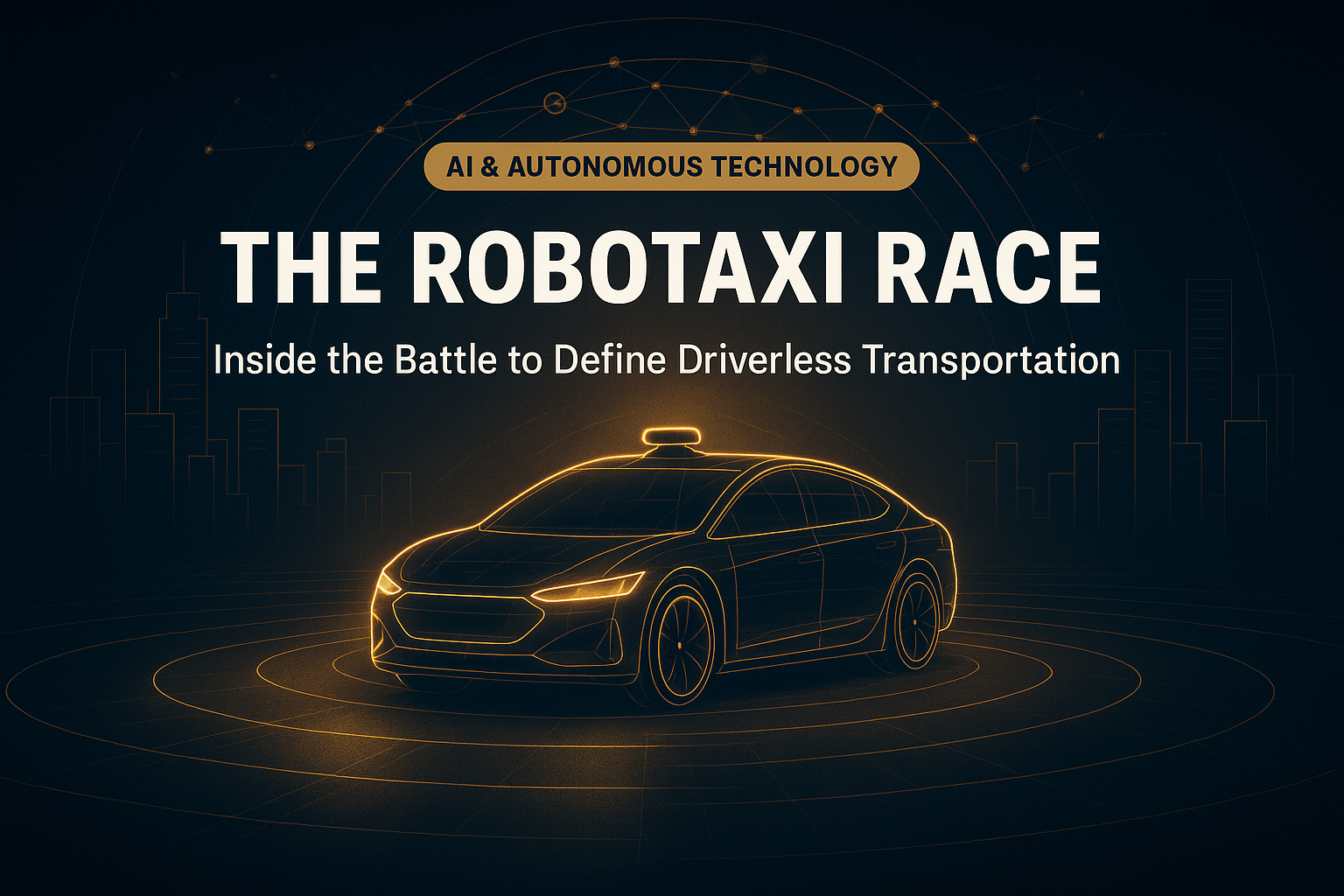
The robotaxi has quietly gone from Silicon Valley fantasy to Tuesday-night commute. As of October 2026, two companies are locked in a race that will define how — and whether — Americans trust machines to drive them home.
Autonomous vehicle (AV) technology has crossed a threshold that industry watchers have anticipated for over a decade: genuine commercial scale. This isn’t a pilot program in a closed parking lot anymore. It’s hundreds of thousands of paid rides every week, real fleets navigating real cities, and regulators scrambling to write rules for a reality that arrived faster than expected. The competitive dynamics between the two leading players — Waymo and Tesla — reveal not just who’s “winning,” but what it actually takes to commercialize AI-driven transportation at scale.
Waymo’s Commercial Lead Is Substantial — and Measurable
While Tesla’s robotaxi ambitions generate more headlines, Waymo remains the clear leader in operational maturity. The Alphabet-owned company now operates more than 1,100 autonomous vehicles authorized for commercial use in Texas alone, including its newer “Ojai” vehicle generation, and reports more than 500,000 paid rides per week nationally, according to recent industry reporting.
That scale isn’t accidental — it reflects years of accumulated autonomous driving experience. Waymo has logged approximately 270 million fully autonomous commercial miles across U.S. markets, a dataset that continues to refine its machine learning models in ways smaller fleets simply cannot match. The company’s technology stack relies on a multi-sensor approach combining cameras, lidar, and radar, giving its perception systems redundant layers of environmental data that purely vision-based systems lack.
Infrastructure is scaling alongside the fleet. Lyft recently opened a dedicated depot in Nashville — complete with charging, cleaning, and maintenance capacity for hundreds of Waymo vehicles — ahead of a planned service expansion there. This kind of logistical buildout, unglamorous as it sounds, is often the real bottleneck in scaling autonomous ride-hailing, not the AI models themselves.
Tesla’s Camera-Only Bet and the Austin Expansion
Tesla’s approach diverges sharply from Waymo’s sensor-redundant philosophy. The company has built its Full Self-Driving and Robotaxi systems around a camera-and-neural-network architecture, betting that vision-based AI, trained on massive real-world driving data, can eventually match or exceed lidar-equipped competitors without the added hardware cost.
The results are promising but still narrower in scope than Waymo’s. Tesla’s Austin fleet of Cybercabs and modified Model Y vehicles has grown from 45 vehicles at launch to 169 authorized commercial vehicles as of early October, according to Texas regulatory filings cited by CNBC. Independent fleet trackers suggest the broader Texas footprint may be larger, though these figures come from unofficial sources rather than primary regulatory data.
Tesla recently extended its Austin Robotaxi service hours to 11 p.m., pushing into nighttime operation — a notoriously difficult edge case for autonomous systems. Elon Musk has pointed specifically to the challenge of detecting pets and other low-visibility hazards in dark conditions as a key engineering hurdle the company is actively addressing. It’s a useful reminder that the last mile of autonomy is often the hardest — not highway driving, but the messy unpredictability of real neighborhoods at night.
Importantly, Tesla’s current service remains a controlled, company-operated pilot concentrated in select areas rather than an open platform where private Tesla owners can broadly dispatch their own vehicles for paid rides — a long-promised feature that has yet to materialize at scale.
Regulation Is Catching Up to the Technology
Perhaps the most consequential development in 2026 isn’t technological at all — it’s regulatory. California has enacted legislation (building on Assembly Bill 1777, effective July 2026) requiring robotaxi operators, including Waymo, Tesla, and Zoox, to provide U.S.-based remote-driver support and maintain local incident-response technicians.
Looking further ahead, operators could face fines of up to $10,000 per vehicle starting in 2028 if a robotaxi blocks emergency responders for more than 30 minutes, according to reporting from TechCrunch and The Silicon Review. This signals a meaningful shift in how regulators think about AV safety: the conversation is moving beyond “can the car drive itself” toward how autonomous fleets behave during emergencies, incidents, and interactions with first responders — a far more complex operational challenge than lane-keeping or object detection.
This regulatory evolution matters enormously for enterprise and investor audiences tracking the sector. Compliance infrastructure — remote operations centers, incident response teams, emergency coordination protocols — is becoming as critical to commercial viability as the underlying AI models themselves.
What This Means for the Broader AI and Mobility Industry
The Waymo-Tesla rivalry is a useful lens for understanding a broader truth about applied AI: model performance and commercial deployment are two very different battles. Tesla’s camera-only neural networks may represent genuinely sophisticated AI engineering, but Waymo’s half-million weekly rides demonstrate that sensor redundancy, operational infrastructure, and regulatory relationships can matter just as much as algorithmic elegance.
For enterprises exploring AI deployment in any safety-critical domain — logistics, manufacturing, healthcare robotics — this is the real lesson of 2026’s robotaxi race: technical capability must be matched by operational scaffolding, regulatory engagement, and infrastructure investment before AI can be trusted at scale.
The Road Ahead
Expect the next 12–18 months to bring continued fleet expansion from both companies, additional city launches, and increasingly specific regulatory frameworks addressing everything from emergency vehicle interactions to data transparency. Waymo’s infrastructure-heavy strategy and Tesla’s vision-only approach represent genuinely different bets on how autonomy should be achieved — and the market, rather than any single technological breakthrough, will likely determine which philosophy scales best. Watch for how competitors like Zoox, and automakers integrating conversational AI like GM’s partnership with Google Gemini, reshape consumer expectations for in-vehicle intelligence alongside autonomous driving itself.
The robotaxi race is no longer a question of if autonomous vehicles will become mainstream — it’s a question of whose approach, which cities, and how fast regulators can keep pace with the technology. As Waymo and Tesla pursue fundamentally different paths to the same destination, which strategy do you think will ultimately win consumer trust: sensor-redundant caution, or vision-only ambition?
📖 Recommended Sources:
• CNBC – Coverage of Tesla’s Cybercab fleet expansion and Austin robotaxi scaling challenges
• TechCrunch – Reporting on California robotaxi regulations and emergency-responder fine structures
• Business Insider – Lyft’s Nashville depot buildout for Waymo fleet infrastructure
• Electrek / Teslarati – Tesla Robotaxi nighttime service expansion and FSD engineering updates
ⓘ This content is AI-generated based on training data through January 2026, supplemented with live research. Please verify specific claims independently.