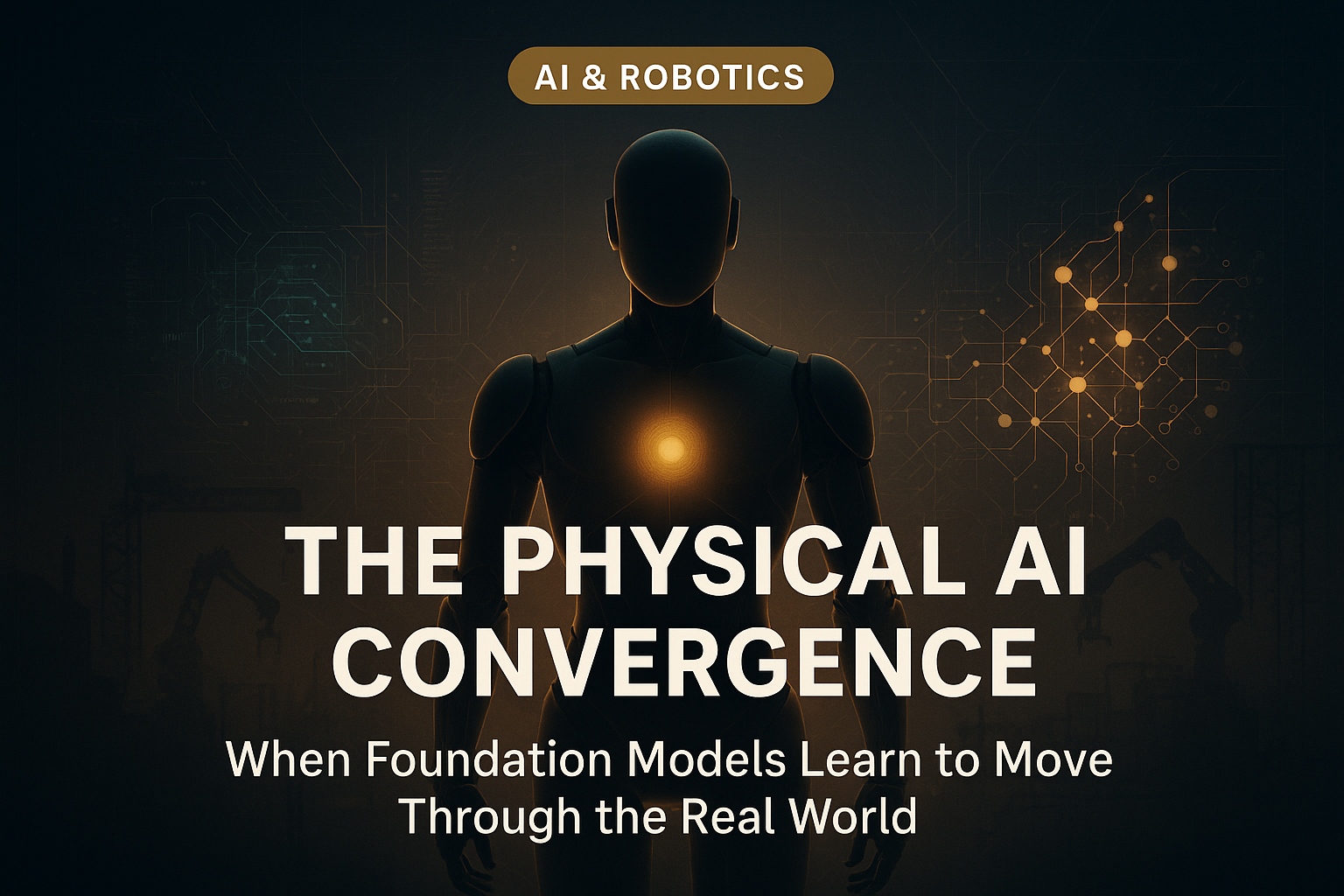
Jensen Huang didn’t mince words at NVIDIA’s recent keynote: “Physical AI has arrived — every industrial company will become a robotics company.” It’s a bold claim, but as of October 2026, the data backs it up.
For years, “AI” and “robotics” advanced on separate tracks — one living in data centers, the other on factory floors. That separation is collapsing. We’re now watching physical convergence: the merging of large-scale foundation models, dexterous hardware, simulation environments, and real-world training into a single integrated technology stack. The result is machines that don’t just execute pre-programmed motions — they perceive, reason, and adapt in physical space the way large language models reason in text.
From Demos to the Factory Floor
The shift from flashy demo reels to actual deployment is the defining story of 2026. According to industry tracking cited by Humanoid Analytics, Chinese manufacturers accounted for roughly 97% of global humanoid robot shipments in the first half of 2026, with an estimated 19,100 units shipped in that period and full-year forecasts ranging from 60,000 to 90,000 units depending on the analyst.
Meanwhile, in the U.S., Tesla has passed 50,000 cumulative Optimus units and Figure AI has surpassed 10,000 deployments across partner warehouses — numbers that would have seemed implausible just two years ago. These aren’t research prototypes anymore; they’re machines doing sorting, inspection, and material handling in live operational environments.
This matters because shipment volume signals something crucial: manufacturers are confident enough in reliability and safety to scale production, not just build showcase units. As one recent industry analysis put it, physical AI robots can increasingly be “produced with the reliability and quality control of smartphones or cars” — a framing that would have sounded absurd even in 2023.
The Technology Powering Convergence
What’s actually changed under the hood? The core innovation is the embodied foundation model — a single AI system that connects perception, language understanding, and physical action.
Key components driving this convergence include:
- Vision-language-action (VLA) models that let a robot interpret a spoken instruction, observe its surroundings, and translate both into motor commands
- Diffusion-based motion policies that generate smooth, adaptive movement trajectories instead of rigid, pre-scripted paths
- Proprioception and tactile sensing, giving robots real-time awareness of joint position, contact force, and grip quality
- Simulation-to-real training pipelines, where robots learn millions of scenarios virtually before refining skills in messy, real-world conditions
- Cross-embodiment transfer, allowing a skill learned on one robot body (say, a quadruped) to generalize to a humanoid or robotic arm
This is precisely why “physical AI” has overtaken “humanoid robotics” as the preferred industry term. The intelligence layer is increasingly body-agnostic — it’s designed to operate across drones, warehouse arms, quadrupeds, and bipedal humanoids alike, rather than being locked into one chassis.
China’s Training Infrastructure Boom
Perhaps the most underappreciated development is the sheer scale of physical training infrastructure now coming online. According to reporting from TBS News and People’s Daily, China had more than 70 operational embodied-AI training facilities by the end of June 2026, with over 40 more under construction or planned.
These aren’t simulation labs — they’re real-world “robot gyms” where machines practice everyday tasks under supervision before graduating into actual jobs. In Hangzhou, for example, four robots from an initial cohort of 30 have already completed training and moved into roles including museum guidance, facility assistance, and factory inspection work. This “robot school to robot job” pipeline mirrors how large language models moved from pretraining to fine-tuning to deployment — except here the training data is physical interaction, not text.
Industrial Adoption Is Leading the Charge
Automotive manufacturing remains the proving ground for physical AI. Hyundai is reportedly training Boston Dynamics’ Atlas robots on tasks like parts sequencing and assembly-line support, while China’s Dongfeng has announced plans to trial humanoid production in its own plants by the end of 2026. These moves reflect a broader pattern: companies are starting with constrained, high-value industrial tasks — inspection, sorting, parts handling — rather than attempting fully unstructured, general-purpose work on day one.
Service and hospitality applications are following close behind. DYNA Robotics, for instance, has positioned its latest platform for laundry folding, food prep, and hotel operations — multi-step tasks requiring sustained autonomy rather than single repetitive motions. Singapore has gone a step further, opening a dedicated training center to prepare humanoid robots for police and public-safety roles, with operational deployment targeted around 2028.
What’s Still Unsolved
It’s worth being clear-eyed here: shipment numbers do not equal full autonomy. Many of these deployments remain supervised, task-specific, or dependent on carefully controlled environments. The hardest unsolved problems — reliable manipulation of unfamiliar objects, safe operation around people, long-duration battery and actuator performance, and graceful error recovery without human intervention — are still active research frontiers, not solved engineering challenges. Claims of “human-level” performance should be treated as roadmap targets rather than verified capabilities.
The Road Ahead
The trajectory is unmistakable: 2026 isn’t about proving a humanoid can do one impressive trick — it’s about building the data pipelines, training facilities, manufacturing scale, and deployment networks required for robots to perform many tasks, reliably, over and over. As foundation models continue absorbing multimodal physical data at scale, expect the line between “AI company” and “robotics company” to blur further, exactly as Huang predicted. Industries from logistics to eldercare to public safety are quietly positioning themselves for a labor landscape where physical AI is a standard operational layer, not a novelty.
The convergence of digital intelligence and physical embodiment may prove to be as transformative as the original AI boom itself — only this time, the output isn’t text on a screen, it’s action in the real world. As this convergence accelerates, the real question for businesses and policymakers isn’t whether physical AI will arrive in their sector — it’s how prepared they’ll be when it does. What role do you think physical AI will play in your industry over the next two years?
📖 Recommended Sources:
• Humanoid Analytics – Market tracking and analysis on global humanoid robot shipments and the race for general-purpose physical AI (September 2026)
• TBS News / People’s Daily – Reporting on China’s embodied-AI training facility infrastructure and robot-to-workplace pipelines
• NVIDIA (Jensen Huang keynote) – Industry commentary on the arrival of physical AI and its implications for industrial companies
• The AI Insider – Coverage of DYNA Robotics and Singapore’s humanoid training center for public-safety applications
ⓘ This content is AI-generated based on training data through January 2026, supplemented with live research. Please verify specific claims independently.