Enterprise generative AI has quietly crossed a threshold: it’s no longer a question of if companies are using it, but whether they can prove it’s paying off. According to recent McKinsey research, adoption has become nearly universal — yet the gap between deployment and demonstrable financial return is now the defining challenge of the AI era.
As of late September 2026, the enterprise AI conversation has fundamentally shifted. Two years ago, the story was about experimentation — chatbots, pilots, proof-of-concepts scattered across departments. Today, the story is about scale, governance, and accountability. Organizations that once measured success by how many employees had access to a copilot are now being asked by CFOs and boards to show measurable impact on cost, revenue, or productivity. That pressure is reshaping how generative AI gets built, deployed, and funded inside the enterprise.
The Adoption-ROI Gap Is Real — and Measurable
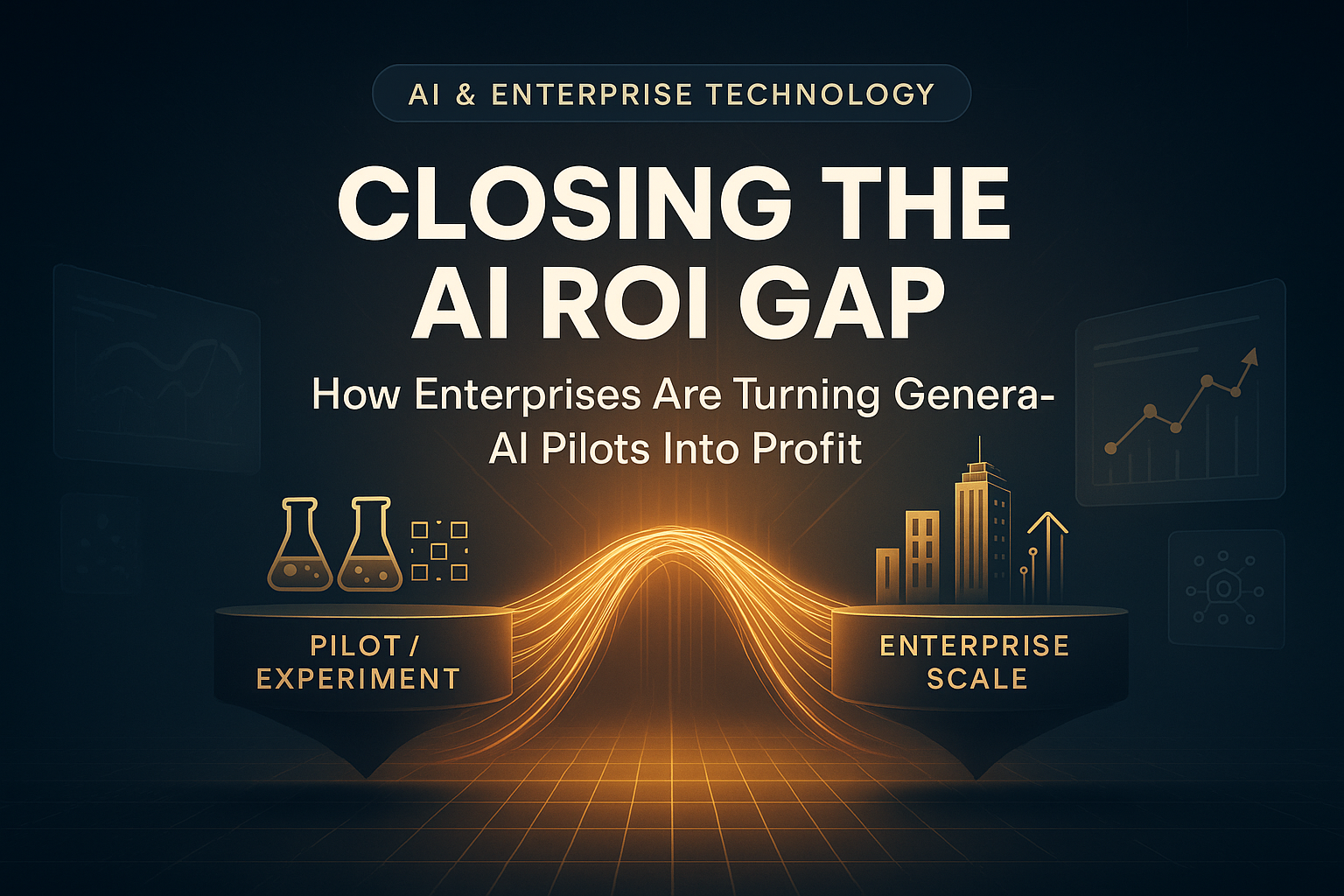
The numbers tell a story of enthusiasm outpacing proof. According to McKinsey’s 2026 State of AI research, roughly 79% of organizations report using generative AI in at least one business function, and 44% have scaled AI across the enterprise, up from 38% the prior year. Yet only 37% report a measurable positive impact on EBIT, and just 6% of organizations qualify as true “AI high performers” — defined as companies where AI contributes at least 5% of earnings before interest and taxes.
This isn’t necessarily a contradiction. A separate industry dataset found that 74% of organizations have achieved ROI from at least one generative AI use case, while reported cost savings average around 15.7% and productivity improvements approach 24.69% in successful deployments. The takeaway: individual workflows are often generating real value, but that value isn’t yet aggregating into enterprise-wide financial transformation. As one ISG study bluntly put it, “AI is changing how work gets done, but business value still lags.”
AI Agents Are the New Enterprise Battleground
If 2024 and 2025 were the years of generative content — text, images, code snippets — 2026 is becoming the year of agentic AI. According to KPMG’s Q3 2026 AI Pulse report, 62% of organizations are now building, deploying, or actively developing AI agents, a sharp rise from 53% just one quarter earlier. Industry analysts project that task-specific AI agents will be embedded in roughly 40% of enterprise applications by year-end, compared to under 5% just twelve months prior.
This shift matters because agents move generative AI from a passive assistant role into autonomous workflow orchestration — executing multi-step tasks across CRM, ERP, customer service platforms, and internal productivity tools without constant human prompting. Enterprise buyers have taken notice: generative AI now ranks as the top technology priority for 33% of enterprise buyers, ahead of predictive analytics, data integration, and even agentic automation itself as a standalone category.
Where the Real Returns Are Showing Up
Not every use case is created equal. The applications generating credible, defensible ROI share common characteristics: high transaction volume, clear baseline metrics, labor-intensive information processing, and human-in-the-loop review already built into the workflow.
The strongest adoption — and returns — are concentrated in:
- Knowledge management in legal, business, and professional services (usage near 58%)
- Software engineering and IT operations, where generative AI usage in the tech sector hits roughly 58% and 56% respectively
- Marketing and sales, particularly in consumer goods and retail (around 51% adoption)
- Customer service, through agent-assist tools, automated case resolution, and conversation summarization
- Back-office functions like finance, procurement, and HR, where repetitive, measurable workflows make ROI easier to isolate
One frequently cited example involves enterprises replacing costly external marketing software with internally built generative AI applications, avoiding an estimated $200,000–$250,000 in annual licensing fees — a tangible, auditable win that boards can understand immediately, unlike vaguer “productivity” claims.
Governance Is Becoming the Real Differentiator
Perhaps the most important 2026 development isn’t a new model or feature — it’s discipline. According to KPMG, 74% of organizations now build cost reviews directly into AI approval processes, 70% use dedicated AI monitoring dashboards, and 43% have implemented usage or token budgets to control runaway inference costs. This marks a maturation from “let’s experiment everywhere” to “let’s fund what works and kill what doesn’t.”
This governance shift is also a response to risk. Security researchers have flagged that enterprise AI adoption is outpacing governance in some organizations, with excessive agent permissions and gaps in AI-specific incident response creating new categories of operational risk. As agents gain more autonomy to act on enterprise systems, the guardrails around identity, access, and auditability are becoming as important as the models themselves.
The Road Ahead
Looking toward 2027, the enterprises pulling ahead won’t be the ones with the flashiest pilots — they’ll be the ones that treat generative AI like any other capital investment: rigorously measured, tightly governed, and ruthlessly prioritized toward use cases with provable payback. Expect continued consolidation around agentic architectures, deeper integration with proprietary data systems rather than generic chatbot interfaces, and a growing premium on AI governance talent as boards demand the same financial scrutiny applied to any other major technology spend.
The generative AI enterprise story in 2026 isn’t about whether the technology works — it clearly does for the right use cases. It’s about whether organizations have the operational discipline to move from scattered wins to systemic value. As adoption approaches saturation and the differentiator shifts from access to execution, one question remains for every leadership team: is your organization measuring AI’s return, or just its usage?
📖 Recommended Sources:
• McKinsey & Company – 2026 State of AI survey data on enterprise adoption, scaling, and EBIT impact
• KPMG – Q3 2026 AI Pulse report on AI agent deployment and governance practices
• ISG (Information Services Group) – Study on AI business value versus adoption gaps
• IBM – Enterprise AI ROI research and forward-deployed AI teams analysis
ⓘ This content is AI-generated based on training data through January 2026, supplemented with live research. Please verify specific claims independently.