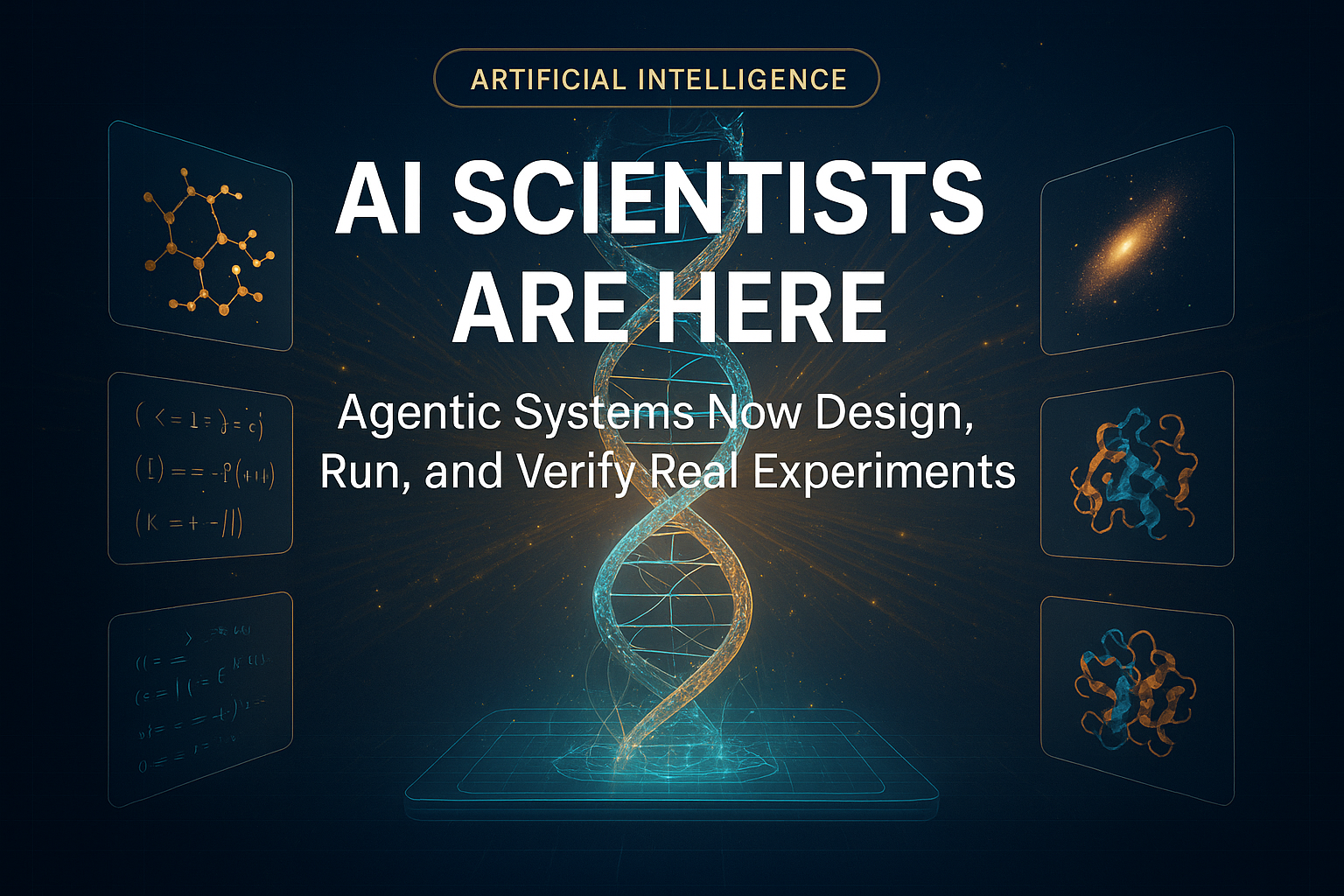
Scientists used to ask AI for help finding a needle in a haystack. In 2026, AI is increasingly building the haystack, designing the search, and checking its own work — all before a human researcher logs in for the day.
The shift from AI-as-copilot to AI-as-active-researcher is arguably the most consequential development in science and technology this year. What began as language models summarizing papers or predicting protein structures has evolved into agentic research systems capable of generating hypotheses, running simulations, operating laboratory instruments, and formally verifying their own conclusions. For professionals and investors watching the intersection of AI and R&D, understanding this transition matters now more than ever — because the bottleneck in scientific progress is quietly shifting from human bandwidth to validation infrastructure.
From Chatbots to Virtual Research Teams
The defining trend of 2026 is multi-agent scientific collaboration. Rather than a single chatbot answering questions, research organizations are deploying teams of specialized AI agents — one for literature review, another for experimental design, another for statistical analysis, and another dedicated purely to verification.
A striking example comes from Stanford, where researchers built what’s been described as a virtual biotech company: thousands of AI agents working in concert to analyze drug-development strategies. The system identified a biological signal predictive of clinical trial success and designed a lung-cancer therapy candidate that was later independently validated by a pharmaceutical partner. A related effort reportedly used AI agents to predict novel proteins targeting COVID-19 variants, with several candidates showing measurable activity in lab testing.
This “virtual lab” model represents a meaningful departure from prior AI-in-science efforts. Instead of a tool bolted onto an existing workflow, the AI agents are the workflow — proposing, testing, and iterating with minimal human intervention until a promising candidate emerges for physical validation.
Turning Published Papers Into Interactive Agents
Another notable innovation gaining traction is Paper2Agent, a Stanford-developed system that converts published scientific papers — along with their underlying code and datasets — into interactive AI agents. These “paper agents” can explain a study’s findings, reproduce its analyses on new data, and even collaborate with agents built from entirely different papers.
In an early demonstration, two independently constructed paper agents cross-referenced their findings and flagged a previously unreported genetic variant associated with ADHD — a connection no human researcher had explicitly identified. This points to a future where the scientific literature itself becomes a living, queryable network rather than a static archive, dramatically accelerating cross-disciplinary insight discovery.
This development also raises important questions about research reproducibility and attribution. If an AI agent derived from someone else’s published work generates a new discovery, who deserves credit? Institutions and journals are actively grappling with this question as agentic tools become more common in peer review and citation workflows.
AI Tackles Mathematics — With Formal Proof
Perhaps the most headline-grabbing claim of the year involves an AI system reportedly producing a construction related to the Navier–Stokes existence and smoothness problem, one of mathematics’ famed Millennium Prize Problems. According to reporting on the development, the system deployed thousands of parallel agents and formalized its result using Lean, a machine-checkable proof language — a critical detail, since it means the claim can be independently verified line-by-line rather than taken on faith.
This emphasis on formal verification reflects a broader and increasingly important trend: as AI systems generate results faster than humans can intuitively check them, the field is leaning harder on machine-checkable proofs and reproducible pipelines to separate genuine breakthroughs from plausible-sounding errors. Novelty, researchers are learning, is not the same as correctness.
Cheaper, Faster Molecular Modeling
Efficiency gains are quietly just as important as headline-grabbing breakthroughs. Anthropic reported that its Claude models, working within a dedicated science initiative, optimized more than 30 open-source biomolecular models in under four weeks — achieving roughly a fourfold average speedup. A new low-memory mode reportedly allows modeling of biological systems exceeding 10,000 tokens on a single GPU node.
This kind of efficiency improvement matters enormously for democratizing access to computational biology. Academic labs and smaller biotech startups without massive compute budgets can now run protein-folding and molecular simulation workflows that were previously feasible only for well-funded institutions — potentially widening the pool of who gets to participate in drug discovery and materials science.
Closing the Loop: AI Meets Physical Experimentation
Perhaps most transformative is AI’s growing connection to physical laboratory infrastructure. Systems are now being linked directly to 3D printers, telescopes, and robotic lab equipment, closing the loop between digital hypothesis and physical measurement.
Lawrence Livermore National Laboratory, for instance, reported a camera-based AI system that monitors 3D-printed structures layer-by-layer, catching microscopic deviations before a part even leaves the printer. Meanwhile, China’s StarWhisper Telescope initiative uses AI not just to analyze astronomical data after the fact, but to help plan which observations to make in the first place — turning the AI into an active participant in the scientific method rather than a passive analysis tool.
The Road Ahead
Looking forward, the central challenge for AI-driven science in 2026 and beyond isn’t raw model intelligence — it’s validation capacity. AI can generate hypotheses far faster than laboratories can physically test them, meaning experimental throughput, data quality, and independent replication will increasingly determine the real pace of scientific progress. Expect continued investment in autonomous labs, formal verification tooling, and specialized scientific foundation models, alongside growing scrutiny over reproducibility, safety, and dual-use risks in fields like synthetic biology.
AI hasn’t replaced the scientist in 2026 — but it has fundamentally expanded what one scientist, or one small team, can attempt in a single year. The organizations that figure out how to pair agentic AI systems with rigorous experimental validation will likely define the next decade of research breakthroughs. As these virtual labs and paper-agents multiply, one question looms large: when an AI system makes the discovery, who — or what — gets the credit?
📖 Recommended Sources:
• Stanford Medicine – Report on the virtual biotech company using AI agents for drug discovery and lung-cancer therapy design
• Anthropic (anthropic.com/science) – Details on biomolecular model optimization and low-memory modeling breakthroughs
• The Register / Campus Technology – Coverage of Paper2Agent and the debate over AI research attribution and ownership
• China Daily / Dong-A Science – Reporting on the StarWhisper Telescope and AI-native astronomical observation planning
ⓘ This content is AI-generated based on training data through January 2026, supplemented with live research. Please verify specific claims independently.