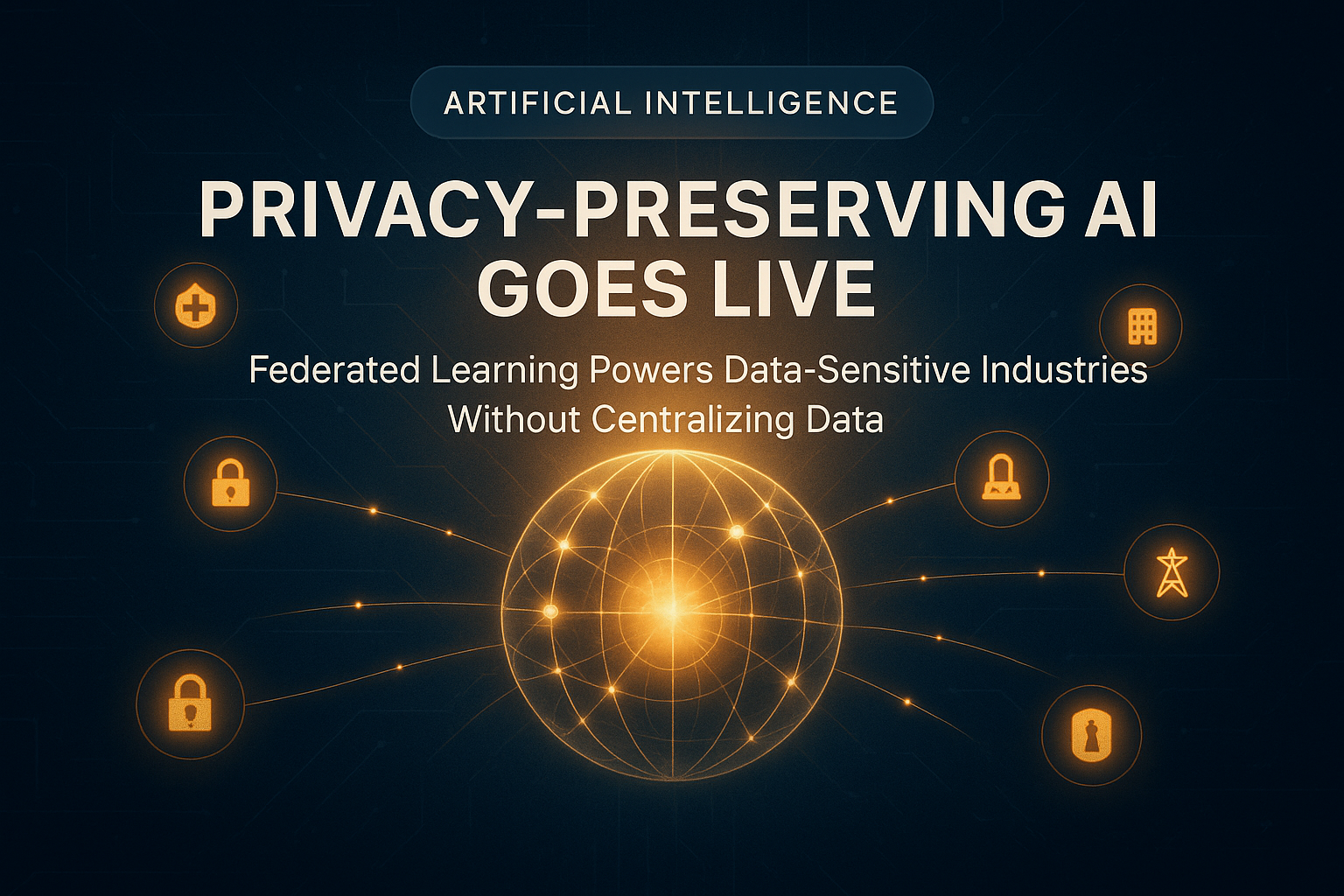
Sensitive data no longer needs to leave the building for AI to learn from it — and in 2026, that shift is finally showing up in production systems, not just research papers.
Federated learning (FL) has spent years as a promising academic concept: train models locally, share only mathematical updates, and never move the raw data. Now, according to recent industry analysis, FL is transitioning into a production-oriented distributed AI approach, particularly in industries where data simply cannot be centralized due to regulation, competitive sensitivity, or sheer scale. For enterprises wrestling with data privacy laws, cross-border data restrictions, and mounting pressure to deploy AI responsibly, federated learning is emerging as one of the few architectures that satisfies both innovation and compliance demands simultaneously.
The Technical Leap: Hybrid Privacy Architectures
The federated learning of 2026 looks very different from its earlier, single-technique versions. Developers are now combining differential privacy, secure aggregation, homomorphic encryption, and trusted execution environments (TEEs) into layered privacy stacks rather than relying on any one method alone.
This matters because federated learning, on its own, does not guarantee privacy — gradients and model updates can still leak sensitive information if left unprotected. Newer hybrid systems use asynchronous aggregation paired with lightweight differential privacy and selective homomorphic encryption to reduce the accuracy and latency penalties that made earlier cryptographic approaches impractical. GPU-based confidential computing is also gaining traction as a complementary layer, protecting model updates even during active training rather than only in transit.
A notable technical breakthrough came from MIT researchers, who developed a method to accelerate a privacy-preserving AI training technique by roughly 81% — a significant efficiency gain that directly addresses one of federated learning’s biggest historic complaints: speed. Faster training without sacrificing privacy guarantees removes a major adoption barrier for time-sensitive enterprise use cases.
Where Enterprises Are Actually Deploying It
Adoption remains selective and use-case driven rather than broadly horizontal, concentrated in industries where data is both distributed and legally or competitively impossible to pool:
- Healthcare: Hospitals and research institutions are jointly training diagnostic models — including clinical imaging systems for conditions like kidney stones — while patient records never leave local systems. Companies like Owkin have built entire platforms around federated approaches to oncology, immunology, and drug discovery research across institutions.
- Financial services: Fraud detection, anti-money-laundering analytics, and credit-risk modeling benefit from cross-institution learning where customer data legally cannot be pooled.
- Telecommunications: Operators use federated approaches for churn prediction and network security, leveraging geographically distributed datasets while preserving subscriber confidentiality.
- Industrial and manufacturing systems: Federated intrusion detection combines behavioral signals across facilities without exposing raw operational data.
A recent 2026 patent-landscape analysis found federated learning filings tied to hospital and clinical datasets jumped from just 3 in 2023 to a peak of 82 in 2025 — a signal of accelerating institutional investment even before full commercial maturity arrives.
The Platform Layer vs. the Solution Layer
It’s worth distinguishing between two categories of players shaping this space. Google, Apple, and NVIDIA function primarily as infrastructure and platform enablers — contributing foundational research on on-device learning, privacy-preserving personalization, and the GPU/confidential-computing backbone that makes federated training computationally feasible at scale.
Meanwhile, companies like Owkin and Rhino Health operate as healthcare-specific solution providers, building deployable federated platforms for hospitals and pharmaceutical partners. This bifurcation mirrors how cloud computing matured: infrastructure giants build the rails, specialized vendors build the trains that run on them. Enterprises evaluating vendors should apply different metrics accordingly — infrastructure providers on developer adoption and deployment capacity, healthcare-specific vendors on clinical validation and institutional partnerships.
Remaining Obstacles Before Broad Production Use
Despite genuine momentum, federated learning faces persistent friction points that prevent it from becoming a default enterprise architecture overnight.
Non-IID data — the reality that data distributions differ substantially across hospitals, business units, or devices — continues to degrade global model performance without careful personalization layers or domain-aware aggregation techniques like FedProx. Security threats including model poisoning, backdoor attacks, and malicious coordinators require defenses that go beyond privacy mechanisms alone. And governance complexity — determining data ownership, controller-processor responsibilities, privacy-budget accounting, and audit trails — remains a genuine barrier for legal and compliance teams evaluating FL deployments.
Perhaps most importantly, much of the 2026 innovation remains at the demonstration or applied-research stage. Independent, standardized operational benchmarks and long-term production evidence are still catching up to the pace of technical publication.
What’s Next for Privacy-Preserving AI
Looking ahead, federated learning is unlikely to be adopted as a standalone technique — instead, expect it to become one component within broader privacy-enhancing technology stacks that combine encryption, confidential computing, and robust aggregation protocols. Communication-efficient protocols, including one-shot and low-round training methods suited for bandwidth-constrained environments, along with federated fine-tuning of large language models using lightweight client-side adapters, represent the next frontier of research already underway in 2026.
Federated learning won’t replace centralized AI training everywhere — but for the industries where data simply cannot move, it’s becoming the only credible path to building AI at all. As regulatory pressure intensifies and data-sensitive sectors face growing scrutiny, the question isn’t whether federated learning will matter, but how quickly organizations can move from experimentation to dependable production deployment. What would it take for your organization to trust a model it never fully controls the training data for?
📖 Recommended Sources:
• MIT News – Research on accelerating privacy-preserving AI training methods by approximately 81%
• Owkin – Healthcare and life-sciences federated learning platform for oncology, immunology, and drug discovery
• IJCAI 2026 Proceedings – Peer-reviewed federated learning research and applications
• Patent landscape analyses (PatSnap) – Federated learning filings across hospital and genomic datasets
ⓘ This content is AI-generated based on training data through January 2026 and supplemented with live research. Please verify specific claims independently.