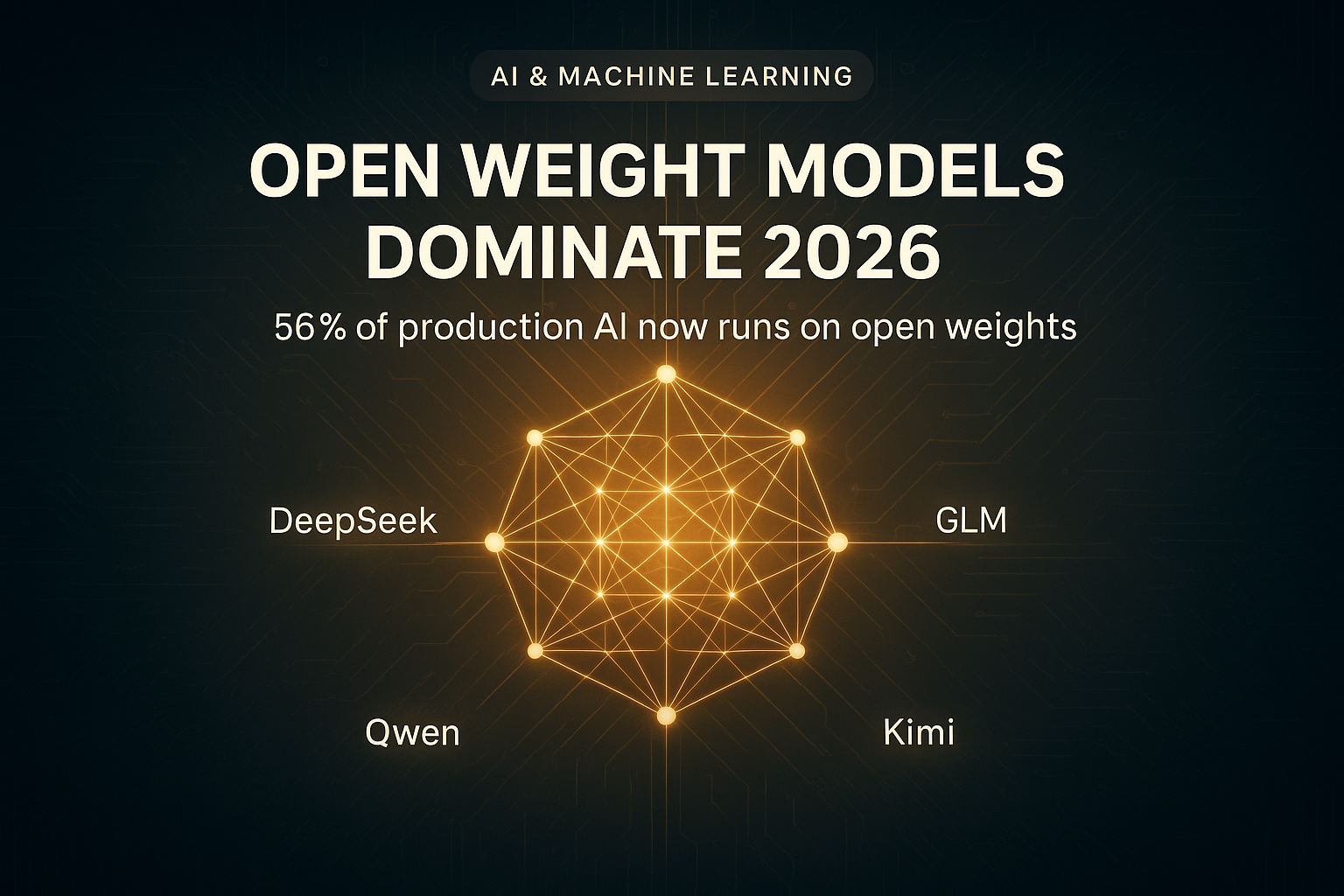
The open-weight AI model ecosystem has reached an inflection point. As of August 2026, open-weight models now account for 56% of production token volume, marking a fundamental shift in how enterprises deploy artificial intelligence. What was once a niche alternative to proprietary models has become the default infrastructure choice for cost-conscious, sovereignty-focused, and technically sophisticated organizations.
This transformation isn’t just about adoption numbers—it represents a complete reimagining of AI infrastructure, governance, and trust in the enterprise.
The Frontier Gap Has Collapsed to Just 4.4 Months
One of the most striking findings from 2026 is that the performance gap between frontier proprietary models and leading open-weight alternatives has narrowed dramatically. According to analysis of OpenRouter traffic patterns and benchmark timelines, the average lag between cutting-edge closed models and top-tier open-weight releases is approximately 4.4 months—down from years in previous cycles.
This convergence fundamentally changes the economics of AI deployment. For coding, knowledge work, and multimodal reasoning tasks, organizations can now choose open-weight models without accepting significant performance compromises. On managed platforms like Amazon Bedrock, open-weight models from DeepSeek, Alibaba’s Qwen, Zhipu’s GLM, and Moonshot’s Kimi are treated as first-class infrastructure, with identical support for tool calling, structured outputs, and streaming capabilities as proprietary alternatives.
The implication is clear: performance parity is no longer the barrier to adoption. Today, the decision to deploy open-weight models is driven by cost, sovereignty, and control—not capability gaps.
The Dominant Players: Chinese Labs Lead the Charge
The 2026 open-weight ecosystem is dominated by a handful of large, sparse Mixture-of-Experts (MoE) models, with Chinese AI laboratories driving the frontier. Here’s the current landscape:
Qwen (Alibaba) has emerged as the most versatile open-weight family. The Qwen 3.8 series offers a dense 27B variant for local deployment on single GPUs, plus a massive 2.4 trillion-parameter sparse MoE version for frontier-level multimodal reasoning. Qwen models power privacy-respecting frontends like Proton Mail’s AI features and are deeply integrated into sovereign hosting providers across Europe.
DeepSeek positioned itself as the MIT-licensed open-weight champion. Both DeepSeek V4 Flash and V4.1 Flash carry permissive MIT licensing, enabling EU jurisdictions and other regions to run models via local providers without data leaving compliance perimeters. This has made DeepSeek the preferred choice for organizations operating under strict data residency requirements.
GLM (Zhipu AI) released GLM 5.2 with MIT-licensed open weights in June 2026, explicitly framed as a response to tightening US export controls. The subsequent GLM 5.3 release in August added a custom license with stricter conditions, but public checkpoints remain widely available. GLM’s focus on coding and cybersecurity has made it invaluable for developer tools and security research platforms.
Kimi K3 (Moonshot AI) stands out as the first open-weight model to reach 2.8 trillion parameters with sparse MoE design, where 104 billion parameters activate per token. Kimi K3’s availability on Amazon Bedrock and GitLab Duo Agent Platform demonstrates how open-weight models are now integrated directly into enterprise developer workflows.
Meta’s Muse Glimmer and NVIDIA’s Nemotron 3.5 Lightning represent continued commitment from US-based technology leaders to open-weight releases, though typically for specialized use cases (local agents and multimodal work, in Meta’s case; high-efficiency inference, in NVIDIA’s).
Licensing Stratification: From MIT to Custom Governance
The open-weight ecosystem exhibits clear licensing stratification that reflects different strategic goals:
Permissive models (MIT-licensed DeepSeek, GLM 5.2, modified MIT Kimi K3) prioritize global adoption and thriving derivative ecosystems. These are favored by labs seeking maximum reach and community contribution.
Custom “open” licenses (GLM 5.3, Qwen custom, NVIDIA’s OpenMDW-1.1) impose conditions around revenue thresholds, military applications, and safety obligations. These licenses enable companies to release weights publicly while maintaining some control over commercial exploitation.
Fully open stacks like K2 Horizon represent the research ideal—weights, code, data, and training checkpoints all publicly available—though these remain rare given the computational and financial investment required.
This licensing diversity is strategically important. Organizations can now select models based on regulatory compliance needs, sector-specific constraints, and geopolitical positioning. A European healthcare provider might choose MIT-licensed DeepSeek V4 to ensure GDPR compliance and sovereignty. A US software company might deploy Kimi K3 via Amazon Bedrock for cost efficiency. A research institution might use fully open K2 Horizon for transparency and reproducibility.
From Niche to Mainstream: Production Adoption Metrics
The shift from niche to mainstream is quantifiable. On OpenRouter, eight of the top ten highest-volume models in August 2026 are open-weight. On Vercel’s AI Gateway production index, open-weight models crossed the 50% threshold in mid-2026 and have continued climbing.
More than 270 companies and organizations signed the “Open Weights and American AI Leadership” open letter as of August 2026, signaling broad institutional support for the ecosystem across sectors and geographies.
This adoption reflects genuine economics. Open-weight models accessed via commodity infrastructure providers are significantly cheaper per million tokens than frontier proprietary models, especially when organizations run custom quantizations and batching strategies. A company can download weights, run low-bit quantization optimized for its hardware, and achieve cost-per-token economics that proprietary vendors cannot match while maintaining full data control.
The Sovereignty and Trust Argument
Beyond performance and cost, open-weight models address fundamental trust and geopolitical concerns. One prominent analysis explicitly argues that open weights are necessary because “we can’t trust frontier labs,” citing:
- Lack of transparency in safety mitigations and model behavior
- Potential for unilateral throttling, logging, or geo-blocking by proprietary providers
- Concentration of AI infrastructure in a handful of US-based corporations
GLM 5.2’s MIT licensing was framed as a direct response to US export controls, illustrating how open weights function as a geopolitical tool to route around fragmentation. European providers emphasize MIT-licensed open weights as essential infrastructure for maintaining EU-sovereign AI systems independent of US technology gatekeepers.
This geopolitical dimension is crucial. The open-weight ecosystem is not just a technical phenomenon—it’s a strategic response to concerns about AI concentration, data privacy, and technological sovereignty.
Looking Ahead: The 2026–2027 Roadmap
The open-weight release calendar for 2026–2027 is robust and diverse. Major releases include GLM-5.3-Flash (320B/18B), K2 Horizon (0.9B to 375B), continued Qwen and DeepSeek iterations, and specialized models for coding, agents, and multimodal reasoning.
The trajectory is clear: open-weight models will continue capturing market share from proprietary systems, driven by cost, sovereignty, and performance convergence. Organizations that have not yet evaluated open-weight alternatives should prioritize doing so—the frontier gap has closed enough that the default choice for many workloads is now open weights, not proprietary APIs.
The question is no longer whether open-weight models are capable enough. The question is which models best fit your specific cost, compliance, and sovereignty requirements. How is your organization currently evaluating open-weight alternatives for critical AI workloads?
📖 **Recommended Sources:**
• **Perplexity Research** – Comprehensive 2026 open-weight ecosystem analysis with detailed model comparisons and licensing frameworks
• **Vercel AI Gateway Production Index (September 2026)** – Real-time token volume metrics showing open-weight adoption crossing 56%
• **OpenRouter Traffic Analysis** – Production model usage patterns demonstrating open-weight dominance in top 10 models
• **Amazon Bedrock Documentation** – Enterprise integration of open-weight models (DeepSeek, Qwen, GLM, Kimi, Nemotron)
• **GitLab Duo Agent Platform** – Real-world deployment of open-weight models in developer workflows
ⓘ This content is AI-generated based on training data through January 2026 and current research through September 2026. Please verify specific metrics and release dates independently with official sources.