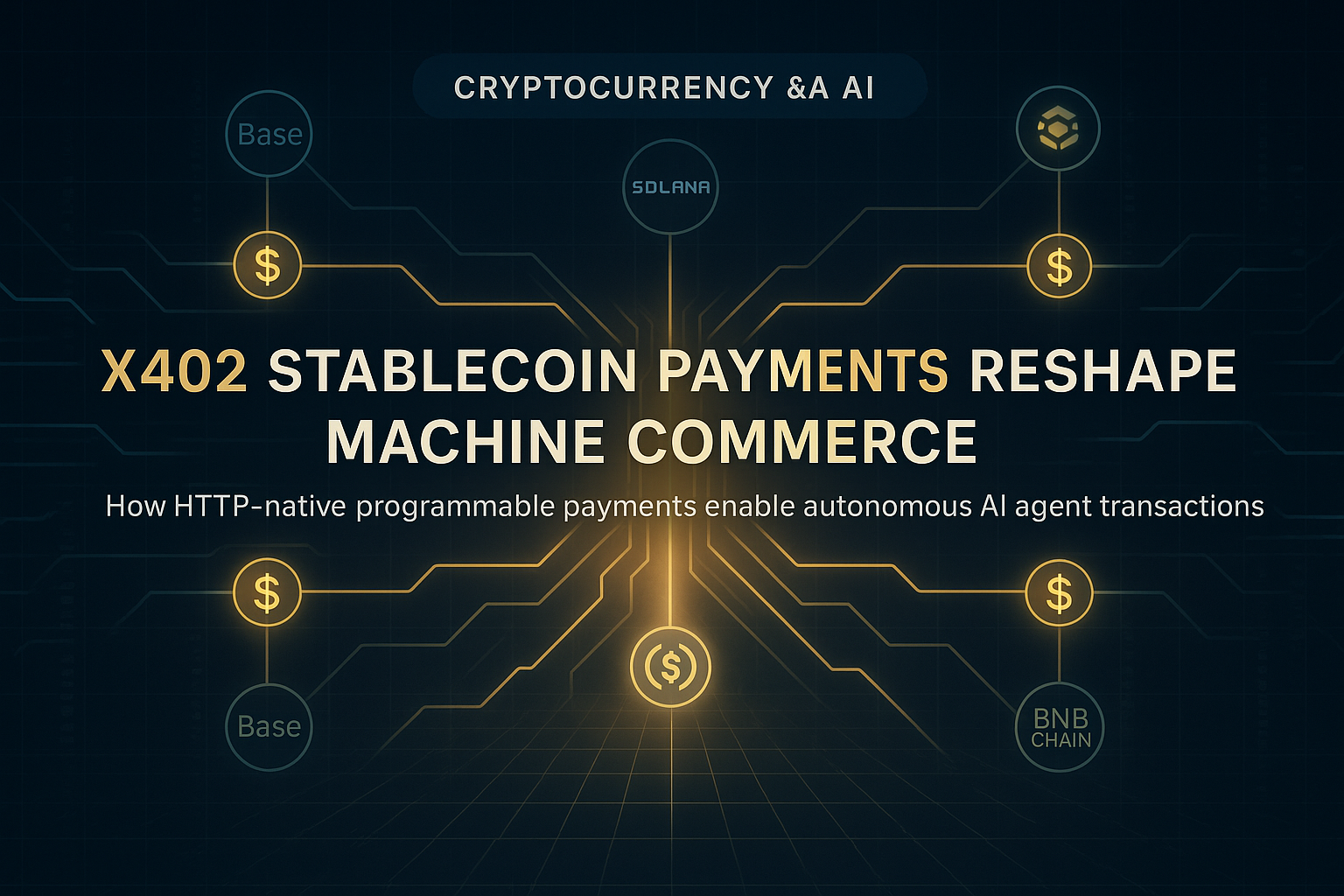
# X402 Stablecoin Programmable Payments: How AI Agents Are Revolutionizing Machine-to-Machine Commerce
The way software pays for services is undergoing a fundamental transformation. By September 2026, x402—an HTTP-native protocol for stablecoin payments—has emerged as the de facto standard enabling AI agents to autonomously pay for APIs, data, and digital resources using USDC and other stablecoins, without human intervention.
This isn’t just another blockchain protocol. It’s a bridge between the traditional web and Web3 that’s quietly reshaping how machines transact with each other at scale.
What Is X402? The HTTP Payment Protocol for the AI Age
X402 is a payment rail layered directly into HTTP, reviving the long-dormant HTTP 402 “Payment Required” status code and transforming it into a machine-readable payment instruction. According to research from the AI agent infrastructure ecosystem, x402 operates as a thin settlement layer that enables clients—typically AI agents or software—to pay for resources programmatically without human approval or traditional API keys.
Unlike traditional payment systems designed for humans, x402 is explicitly built for machines. When an AI agent requests an API call or protected resource, the server responds with HTTP 402 and includes machine-readable payment terms: the price, the blockchain network, the stablecoin asset (usually USDC), and the payment destination. The agent then constructs a cryptographic signature, transfers the stablecoin on-chain, and retries the request with proof of payment. The entire flow takes seconds and requires zero human oversight.
This is programmable payments in its purest form—agents can read payment instructions, decide whether to pay, execute the transfer, and conditionally retry the request, all in code.
The Core X402 Payment Flow: Five Steps to Autonomous Commerce
The x402 transaction cycle is elegantly simple:
1. Client requests a resource via standard HTTP (an API call, dataset, or model inference)
2. Server responds with HTTP 402 if payment is required, embedding price, chain, asset, and destination in response headers
3. Client constructs and signs a stablecoin transfer according to those exact terms
4. Client retries the HTTP request with a proof-of-payment (signed transaction hash) in the request headers
5. Server verifies settlement on-chain and delivers the requested resource
This flow makes x402 remarkably efficient for micropayments. Rather than opening a merchant account, managing subscriptions, or handling credit card processing, service providers can now accept per-request payments in USDC directly from agent wallets. According to 2026 ecosystem reports, x402 implementations achieve sub-two-second settlement, enabling high-frequency, granular monetization of API endpoints and digital services.
Why USDC Dominates Agent Payments in 2026
The choice of stablecoin matters. Research from the AI infrastructure space shows that USDC has become the default settlement asset for x402 transactions, accounting for over 99.99% of agentic transfer volume in recent 90-day periods. Circle, the USDC issuer, reported $77.0 billion in USDC circulation at the end of Q1 2026, with a significant portion flowing through agent-payment infrastructure.
This dominance isn’t accidental. USDC offers several advantages for machine-to-machine payments:
- Fiat-pegged stability eliminates price volatility in agent budgets
- Multi-chain deployment (Base, Solana, BNB Chain, Celo) gives agents flexibility in where they settle
- Institutional backing from Circle and partnerships with major payments companies (Mastercard, Visa, Stripe) provide regulatory clarity
- Native integration with agent wallets, facilitators, and orchestration platforms
According to reports on Circle’s September 2026 initiatives, the company is expanding USDC adoption through institutional payment infrastructure, including the acquisition of Tazapay, a cross-border payments platform. This move signals Circle’s strategic pivot from stablecoin issuer to digital dollar infrastructure provider, positioning USDC as the backbone of agent commerce.
Multi-Chain Deployment and Ecosystem Adoption
X402 isn’t confined to a single blockchain. By mid-2026, the protocol is live across multiple networks, each tailored to different agent use cases:
- Solana: Reports indicate Solana has overtaken Base in x402 transaction volume, driven by the network’s high throughput and low fees—ideal for high-frequency agent micropayments
- Base: Coinbase’s Layer 2 remains a major hub for x402 activity, supporting millions of agent transactions
- BNB Chain: Binance’s implementation, called B402, extends x402 semantics to its ecosystem, enabling agents to pay for services in USDC across BNB Chain
- Celo: Celo developers describe x402 as the HTTP payment protocol for agents, with settlement happening directly from buyer to merchant without requiring smart contracts or gas fees
This multi-chain approach reflects a broader shift: x402 is becoming network-agnostic infrastructure. Agents can choose which chain to settle on based on cost, speed, and liquidity, while service providers accept payments across all chains simultaneously.
Real-World Use Cases: From API Access to AI Model Inference
The early 2026 adoption wave reveals concrete use cases driving x402 growth:
API monetization: RPC providers and API services like AceDataCloud ship x402 clients, allowing agents to pay directly for API calls from their own wallets. This eliminates traditional API key management and enables true per-request billing.
AI model inference: Monad and other infrastructure providers are experimenting with x402-based pay-per-inference models, where agents pay USDC for each machine learning prediction or data processing task.
Paywalled content and data: Digital publishers and data providers are using x402 to gate premium content, allowing agents to autonomously purchase datasets, research, or real-time market feeds.
Agent commerce and services: The broader agent economy is emerging, with agents paying other agents for specialized services—from data analysis to market monitoring to autonomous trading. X402 provides the settlement layer for this machine-to-machine commerce.
According to on-chain analysis of x402 activity, agents are purchasing ordinary utility services rather than speculative crypto products, suggesting the protocol is solving real infrastructure problems, not creating artificial demand.
Authorization, Policy, and the Higher-Level Payment Stack
While x402 handles settlement, it deliberately avoids encoding authorization, spending limits, or policy logic. This separation of concerns is intentional. X402 operates purely at the settlement layer—it just moves money.
Higher-level controls are managed by agent wallets, orchestration platforms, and overlay protocols like:
- Stripe Machine Payments Protocol: Adds merchant risk management and fraud detection on top of stablecoin settlement
- Google AP2: Integrates programmable payments into Google’s agent infrastructure
- Visa Intelligent Commerce and Mastercard Agent Pay: Extend traditional payment network capabilities to agent transactions
- Agent authorization frameworks: Tools like Kite’s Agent Passport layer spending budgets, approval workflows, and session-based controls on top of bare x402 payments
This layered architecture means that x402 can remain simple and focused while more sophisticated payment governance happens above it. An agent might have a monthly budget of $1,000 USDC, approved spending categories, and rate limits—all enforced by the agent wallet. X402 simply executes the actual settlement when the agent decides to pay.
The Future: X402 as Web4 Infrastructure
Looking ahead, x402 represents a fundamental shift in how the internet handles commerce. Rather than requiring humans to sign up for accounts, manage subscriptions, and enter payment details, the web is becoming natively programmable for payments.
This has profound implications. Agents will be able to discover services through marketplaces, evaluate pricing, and autonomously negotiate rates—all without human intervention. Service providers will gain access to new revenue streams through granular, per-request monetization. And the friction between wanting a service and paying for it will collapse from minutes to milliseconds.
As Circle, Mastercard, Visa, and cloud providers like AWS and Coinbase invest in agent payment infrastructure, x402 is likely to become as foundational to Web4 as HTTP is to Web3. The protocol’s simplicity—using existing HTTP semantics rather than inventing new standards—means it can integrate into existing web infrastructure with minimal friction.
The Verdict: Programmable Payments Are Here
X402 stablecoin programmable payments represent more than a technical achievement. They’re evidence that the infrastructure for autonomous, machine-driven commerce is maturing. With USDC settlement, multi-chain deployment, and backing from major payments and technology companies, x402 is transitioning from an experimental protocol to production-grade infrastructure.
For developers, payment providers, and businesses building in the AI economy, the question is no longer whether programmable payments will exist—they’re already here. The question is how to integrate them into your services and business model.
Are you ready to accept payments from AI agents? What services would you monetize if your customers could pay autonomously, in seconds, without friction?
—
📖 **Recommended Sources:**
• **Perplexity AI Research** – Comprehensive overview of x402 standard, multi-chain deployment, and ecosystem adoption across Solana, Base, BNB Chain, and Celo (September 2026)
• **The Agent Times** – Reporting on AceDataCloud’s x402 client launch and Circle’s Agent Stack infrastructure expansion
• **CryptoBriefing** – Coverage of BNB Chain Agent Studio and x402 transaction volume trends across networks
• **Circle Official Communications** – Announcements on USDC circulation ($77.0B Q1 2026), Tazapay acquisition, and Agent Stack infrastructure
• **On-Chain Data Analysis** – Transaction volume and settlement data showing USDC dominance (99.99%+ of x402 transfers) and multi-chain usage patterns
ⓘ This content is AI-generated based on research through September 9, 2026. Please verify specific claims and current adoption metrics independently.