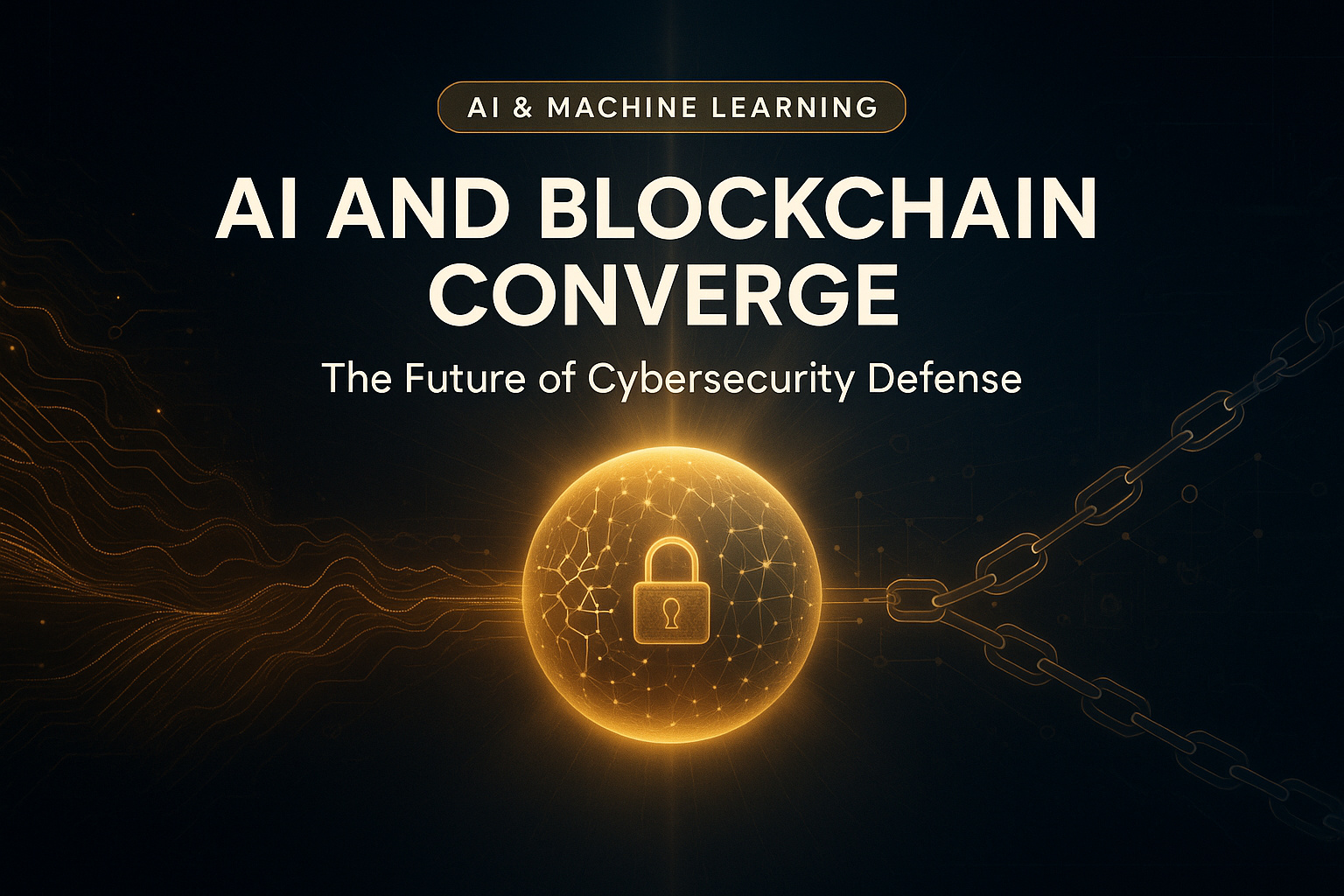
# AI and Blockchain Converge: The Future of Cybersecurity Defense in 2026
The cybersecurity landscape is undergoing a fundamental transformation as artificial intelligence and blockchain technology merge into a formidable defensive framework. No longer operating in isolation, these two powerful technologies are creating a synergy that promises to revolutionize how organizations detect, verify, and respond to threats.
The Rise of the AI-Blockchain Security Alliance
The convergence of AI and blockchain in cybersecurity represents more than just technological integration—it’s a strategic evolution. According to recent industry analysis, the strongest current synergy lies in verification plus automation: AI is increasingly deployed to detect threats and automate defense mechanisms, while blockchain creates tamper-evident records, permissioning systems, and audit trails that verify actions and data states.
This partnership addresses a critical gap in modern security. AI excels at finding, predicting, and responding to threats in real-time, processing vast datasets to identify anomalies that human analysts might miss. Blockchain, meanwhile, ensures that every action, transaction, and security event is recorded immutably and cannot be retroactively altered. Together, they create a security infrastructure where threats are detected rapidly and verified transparently.
AI: The Threat Detection and Response Engine
Artificial intelligence has become indispensable in modern cybersecurity defense. According to the Cloud Security Alliance’s 2026 Top Threats Report, AI is reshaping both cyberattacks and defense mechanisms, making it essential for organizations to understand its dual nature.
On the defensive side, AI-driven monitoring systems continuously scan networks for anomalies, malicious patterns, and suspicious behaviors. Machine learning models trained on historical attack data can predict emerging threats before they fully materialize. These systems automate threat triage, reducing the time security teams spend on manual analysis and enabling faster incident response.
However, the same capabilities that make AI powerful for defense are being weaponized by attackers. North Korean hacker groups and other sophisticated threat actors are increasingly integrating AI into their operations to automate attack engineering and discovery. This escalating arms race means that AI is simultaneously a defender and an attacker, creating new vulnerabilities that organizations must address.
Blockchain: The Immutable Audit and Trust Layer
While AI detects and responds, blockchain provides the foundation for trust, accountability, and traceability. Recent industry commentary highlights blockchain’s value in recording commitments, transactions, and security-related changes in a way that cannot be easily revised or manipulated.
In practical terms, blockchain creates immutable audit trails for security events, access logs, and system changes. This is particularly valuable in high-audit environments such as financial services, healthcare, and critical infrastructure, where regulatory compliance and forensic integrity are paramount. When combined with AI-driven threat detection, blockchain ensures that every detection, response action, and remediation step is recorded transparently and can be verified by auditors or compliance teams.
Organizations are also using blockchain for identity management and permissioning, creating decentralized access control systems that are resistant to compromise. This approach is especially relevant for Web3 and cryptocurrency companies, which face unique attack surfaces and require robust verification mechanisms.
Hybrid Models for Enterprise Threat Detection
The most compelling practical applications emerge when AI and blockchain work in tandem. Academic research and applied industry solutions continue to validate blockchain plus machine learning as a powerful combination for network security, particularly in IoT and distributed environments.
In these hybrid architectures:
- AI-driven anomaly detection identifies suspicious network behavior and potential intrusions
- Blockchain-based integrity controls verify that logs and security records have not been tampered with
- Smart contracts automate security policy enforcement and access revocation when threats are detected
- Distributed ledgers maintain cryptographically signed records of all security events for forensic analysis
A concrete example is smart contract auditing in the cryptocurrency space. Companies like CertiK are leveraging AI to analyze smart contract code for vulnerabilities while using blockchain to create verifiable, timestamped records of security assessments. This combination provides both speed (AI) and accountability (blockchain).
The Web3 Security Imperative
The cryptocurrency and Web3 industry is driving much of the innovation in AI-blockchain security convergence. As exploit discovery accelerates and attack automation becomes more sophisticated, blockchain projects are investing heavily in AI-powered security tools for infrastructure and smart contract auditing.
According to recent industry reporting, the need is urgent: faster exploit discovery and automated attacks demand equally sophisticated AI-driven defenses, while the decentralized and transparent nature of blockchain makes it the ideal platform for recording security assessments and audit results. This creates a virtuous cycle where AI and blockchain reinforce each other’s effectiveness.
Challenges and Limitations
Despite its promise, this synergy is not without limitations. Blockchain adds computational overhead and does not by itself prevent attacks; it primarily strengthens integrity, provenance, and accountability after the fact. Additionally, the complexity of integrating AI and blockchain systems means this approach is most compelling in high-trust or high-audit environments rather than ordinary enterprise networks.
Organizations must also contend with the reality that AI infrastructure itself has become a target. Attackers are increasingly going after enterprise AI systems, cloud workloads, and LLM-enabled environments. This means securing the security tools themselves—ensuring that AI models cannot be poisoned, manipulated, or compromised—is now a critical priority.
The Future of Cybersecurity Defense
Looking ahead, the convergence of AI and blockchain will likely become standard practice in enterprise security architectures. Organizations that fail to integrate both technologies risk falling behind in the escalating arms race between defenders and attackers. The most sophisticated security operations centers will deploy AI for real-time threat detection and response while leveraging blockchain for immutable audit trails, compliance verification, and governance.
The key insight is that AI and blockchain are not competitors—they are complementary forces. AI finds, predicts, and responds; blockchain records, verifies, and governs. When combined strategically, they create a security posture that is both reactive and accountable, fast and transparent.
As we move deeper into 2026, the question is no longer whether organizations should adopt this synergy, but how quickly they can operationalize it within their existing security frameworks. Which aspects of your security infrastructure could benefit most from AI-driven detection paired with blockchain-based verification?
—
📖 **Recommended Sources:**
– **Cloud Security Alliance (CSA) 2026 Top Threats Report** – Comprehensive analysis of AI as both attack enabler and defense mechanism in modern cybersecurity
– **Perplexity Research on AI-Blockchain Synergy** – Academic and industry integration frameworks showing hybrid threat detection models
– **CertiK and Web3 Security Auditing** – Real-world case study of AI-powered smart contract auditing with blockchain-based verification
ⓘ This content is AI-generated based on research through August 2026. Please verify specific claims and recent developments independently with your organization’s security team.