# Agentic AI in 2026: From Hype to Enterprise Production—The Autonomous Agent Revolution
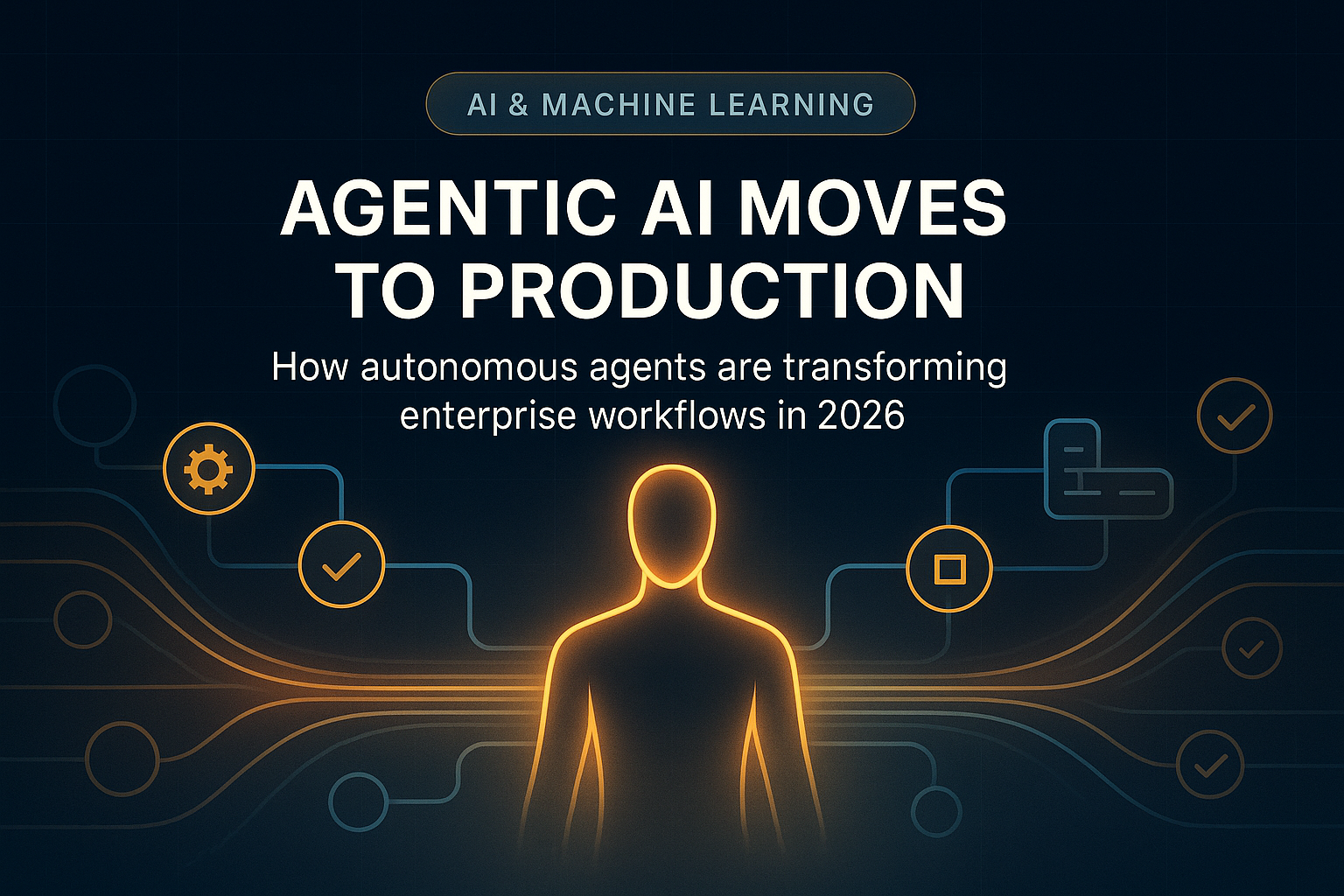
The age of agentic AI has arrived—not as science fiction, but as operational reality in enterprise workflows. What began as experimental prototypes just two years ago has evolved into production-grade autonomous agents handling critical business processes across finance, customer support, and back-office operations.
What Exactly Is Agentic AI?
Agentic AI refers to autonomous or semi-autonomous systems that pursue goal-oriented tasks with minimal human supervision. Unlike traditional chatbots that respond to single prompts, modern AI agents are long-lived processes that orchestrate tools, break down complex workflows into manageable steps, and adapt based on real-time feedback.
According to industry analysis, a true AI agent in 2026 combines several core capabilities:
- Multi-step planning and task decomposition – breaking high-level goals into executable subtasks
- Tool and API orchestration – seamlessly calling internal systems, databases, payment gateways, and external services
- Persistent state and memory – maintaining context across interactions and resuming workflows after interruptions
- Feedback loops and learning – adapting behavior based on outcomes and refining decision-making over time
This architecture fundamentally differs from single-prompt LLM interactions. An agent is a workflow engine wrapped around an LLM, not just a text generator.
The Inflection Point: 2026 as Enterprise Adoption Year
Industry observers describe 2026 as the critical inflection year where agentic AI transitions from “interesting technology” to “essential business infrastructure.” While agentic AI is labeled as “the most hyped enterprise technology of 2026,” the hype is now backed by real deployments.
According to industry trend analysis, approximately 40% of enterprise applications now include AI agents, compared to under 5% just a year prior. However, this growth comes with an important caveat: most organizations are deploying focused, single-agent systems embedded within existing applications rather than building fully autonomous “AI employees” across entire operations.
The practical approach reflects organizational maturity. Rather than pursuing ambitious multi-agent systems, enterprises are strategically placing agents in high-impact, well-defined domains where success is measurable and risk is manageable.
The Developer Ecosystem: Frameworks Driving Production
Behind every production agent sits a framework or SDK that handles the heavy lifting—state management, tool routing, memory persistence, and orchestration. The 2026 landscape has crystallized around several dominant players:
LangChain & LangGraph lead the open-source space, offering general-purpose agent infrastructure with graph-based workflow orchestration—critical for controlled, multi-step agents that enterprises demand.
OpenAI Agents SDK provides a compact, GPT-native approach with built-in tool handling and agent handoffs, appealing to organizations already invested in the OpenAI ecosystem.
CrewAI has gained traction for role-based multi-agent teams, where agents are defined by specific roles, goals, and backstories—a mental model that resonates with business stakeholders.
Microsoft’s Agent Framework and Semantic Kernel dominate enterprise deployments on Azure, offering deep integration with Microsoft 365, Copilot infrastructure, and enterprise RAG systems.
Beyond these, Google Agent Development Kit (ADK), Claude Agent SDK, LlamaIndex Workflows, and newer entrants like Mastra and PydanticAI are carving out specialized niches for cloud-native, typed, and provider-flexible agent development.
The fragmentation reflects a broader market reality: there is no single “best” agent platform—the choice depends heavily on existing infrastructure, preferred LLM provider, and specific use case requirements.
Where Agents Are Winning: Real-World Use Cases
The most successful 2026 agent deployments share common characteristics: high-volume, repetitive tasks with clear success criteria and manageable risk profiles.
Financial and operations automation has emerged as the flagship use case. Agents now handle reconciliation, pricing optimization, and risk monitoring in production environments—tasks that previously required dedicated teams.
Customer support and service desk automation represents another major win. Agents triage tickets, route to appropriate departments, resolve common issues, and orchestrate actions across CRM, knowledge bases, and RPA systems—all with human oversight for high-impact decisions.
Back-office workflow orchestration leverages agents for HR, procurement, and compliance processes. These agents consume documents via RAG pipelines, validate against policies, and coordinate approvals across systems.
Developer productivity and DevOps is an emerging frontier, with coding and computer-use agents performing code modifications, shell operations, log analysis, and CI/CD pipeline updates under human supervision.
The common thread: these are semi-autonomous systems, not fully independent actors. Human overseers approve high-impact actions, but agents handle planning, data gathering, and routine execution steps autonomously.
Technical Maturity: Graph-Based Workflows and Guardrails
As agentic AI matures, the architectural patterns have become more sophisticated. The industry has largely moved away from naive “loop until goal is done” approaches toward explicit, graph-based workflow definitions with clear nodes, edges, retry policies, and safety guards.
This shift reflects hard-won lessons from early deployments. Reliability and governance have become paramount concerns. Enterprises demand comprehensive tracing, logging, and control planes to answer critical questions: Who did what? When? With which tools? What were the outcomes?
Frameworks now emphasize typed and programmatic prompt engineering, treating LLM calls as optimizable programs with strict interfaces. Tools like DSPy and PydanticAI help make agents more predictable, debuggable, and suitable for regulated environments.
Safety mechanisms include strict tool schemas and permission boundaries, human-in-the-loop checkpoints for high-stakes actions, and guardrails that prevent agents from exceeding their intended scope.
The Broader Platform Shift
Beyond developer SDKs, major cloud and enterprise software vendors are shipping agent capabilities directly into their platforms:
- Google Vertex AI Agent Builder
- Amazon Bedrock Agents
- Microsoft Copilot Studio
- Salesforce Agentforce
- ServiceNow AI Agents
- UiPath Autopilot
These platforms democratize agent deployment, allowing enterprises to configure agents through visual interfaces rather than code. Simultaneously, no-code automation tools like n8n, Flowise, and Langflow enable non-technical users to assemble agent workflows visually.
This represents a dual trend: agent capabilities are moving both “down” into SDKs for developers and “up” into no-code platforms for business users.
Looking Ahead: The Agentic Internet
The vision emerging from industry leaders is an “agentic internet”—an ecosystem where AI agents seamlessly call services, coordinate workflows, and automate processes with minimal human intervention. This requires standardized APIs, secure tool integration frameworks, and clear identity and permission models for agents operating across organizational boundaries.
Current limitations—hallucination risks, cost and latency of multi-step workflows, and the lack of true standardization—remain active areas of development. But the trajectory is clear: agentic AI is no longer an experiment; it’s the infrastructure layer for enterprise automation in 2026 and beyond.
The Bottom Line
Agentic AI has crossed the chasm from research novelty to production necessity. Organizations that understand the capabilities, limitations, and architectural patterns of autonomous agents—and that deploy them thoughtfully in high-impact domains—are gaining measurable competitive advantages in operational efficiency, cost reduction, and employee productivity.
The question is no longer “Should we invest in agentic AI?” but rather “Where should we deploy autonomous agents first to maximize ROI while managing risk?”
What use case in your organization would benefit most from autonomous agent automation?
—
**📖 Recommended Sources:**
– **Daily.dev & StigStack** – Comprehensive 2026 agentic AI framework comparisons and developer guides
– **Industry Analysis Reports** – Enterprise adoption trends and production deployment statistics for autonomous agents in 2026
– **Framework Documentation** – LangChain, OpenAI Agents SDK, CrewAI, and Microsoft Agent Framework official resources on production patterns and best practices
ⓘ *This content is AI-generated based on research through August 2026. Specific statistics and platform capabilities reflect the state of agentic AI as of mid-2026. Please verify current information independently for the latest framework updates and enterprise adoption metrics.*